



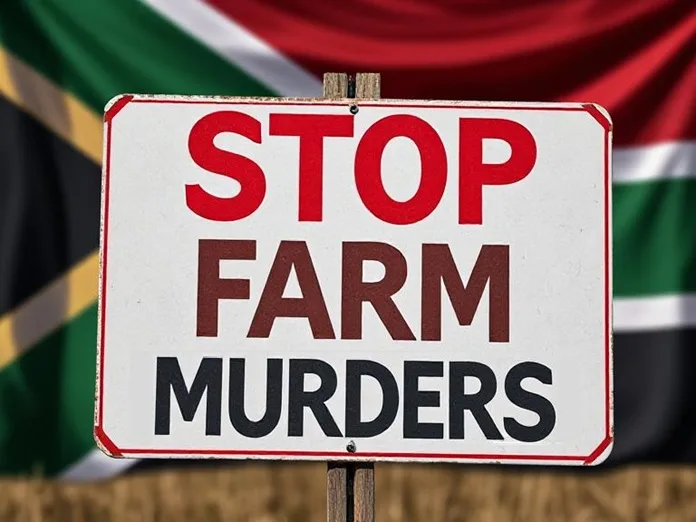
U.S. President Donald Trump met with South African President Cyril Ramaphosa today, where Trump presented a stack of documents detailing some of the murders of white South African farmers—a crisis critics say Ramaphosa’s government has failed to address.
Trump pressed Ramaphosa on the escalating violence in rural South Africa, where farm attacks—often brutal and racially charged—have claimed thousands of lives over the past decade. The U.S. president allegedly handed Ramaphosa a thick dossier containing graphic images and case files of slain farmers, demanding to know why his administration has not taken stronger action.
Ramaphosa Under Fire for Inaction
Ramaphosa, already facing intense scrutiny at home over corruption scandals and economic mismanagement, has long been accused of downplaying the farm murder crisis. His African National Congress (ANC) government has resisted calls to classify the attacks as hate crimes, despite evidence suggesting many are racially motivated.
Critics argue that Ramaphosa’s reluctance to confront the issue stems from political calculations, fearing backlash from radical factions within his party. His administration has instead focused on land expropriation policies, which some fear could further destabilize the agricultural sector and embolden violent elements.
Trump’s Blunt Approach
Trump, who has previously voiced concern over South Africa’s land reform policies and farm violence, took a characteristically direct approach in the meeting. He challenged Ramaphosa on whether his government was protecting all citizens equally or allowing ideological agendas to override justice.
International Reactions
Human rights groups have increasingly highlighted South Africa’s farm murders as a humanitarian crisis, with organizations like AfriForum lobbying for international intervention. Meanwhile, Ramaphosa’s supporters and main stream media dismiss such concerns as exaggerated or racially charged, framing them as attempts to undermine South Africa’s sovereignty.
The meeting has sparked fierce debate, with some praising Trump for pressuring Ramaphosa on an issue often ignored by global leaders, while others accuse him of exploiting the topic for political points.
Ramaphosa’s Weak Response?
This evasion has only fueled criticism that his administration lacks the political will to tackle the crisis head-on.
As pressure mounts, both domestically and abroad, the question remains: Will Ramaphosa finally take decisive action, or will his inaction further erode trust in his leadership?
For now, the stack of papers left on the table serves as a grim reminder of the lives lost—and the government’s failure to protect them.
We are South Africa Today, a voice in the dark. We have been covering farm murders and attacks for 11 years.
Read about more farm attacks here

