



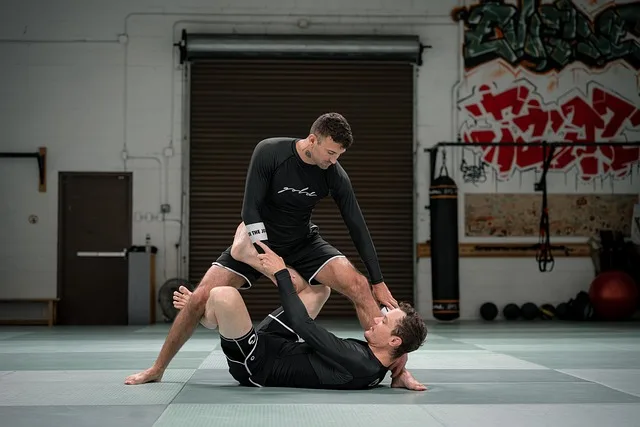
Physical fights are very likely to go to the ground; knowing how to escape from a “mount”, (a technique in which one fighter is lying on his back on the ground and the other “mounted” on him in a position of wide control) is a huge defensive advantage.
Likewise, getting rid of a choke, a “rear naked choke” or a “tie” can yield vital minutes until support arrives.
Punches, kicks and pushes are aggressions that – depending on the situation – also end in falling and serious injuries.
In the criminal environment, there is a tendency to assault the victims (without any technique) which, out of mere sadism, leads to a high psychological satisfaction and approval in the delinquent environment.
I cite some examples:
a) “to pass the squeegee”, “to give a band” (technical term for the fall of ashi barai);
b) “put your foot in your throat”;
c) “give a tie”;
d) “give a rear naked choke”;
e) “beat up”; and
f) the famous “flying.
Jiu Jitsu has an arsenal of techniques to prevent these offenses and provide effective counterstrikes based on the opponent’s own strength and lack of technique.
The retention and counter-retention of the firearm is also another skill that Jiu Jitsu makes possible, as there is no shortage of examples of situations in which the aggressor advances on the armed person to “take” the weapon.
Even though he is armed, an unarmed aggressor realizes whether the shooter will shoot and, not infrequently, intimidates him by challenging him to shoot.
As the martial art is practiced, the student becomes self-confident, attentive and fearless, behaviors that generate a clear change in body posture that will inhibit the approach of criminals and will convey an image of security and fearlessness, making would-be aggressors opt for an “easier target”.
The initiation of Jiu Jitsu takes place with the white belt and, after fulfilling the interstices established by the Brazilian Jiu Jitsu Confederation (CBJJ) plus the evaluation of the respective instructor, the student will evolve in the hierarchy of the martial art (white, blue, purple, brown and black belt).
An ideal training sequence is given at a rate of 03 times a week, with classes of approximately 1 hour (technique instruction and fight session).
Any martial art that does not have practical training, with real fights and with the supervision of the instructor, is deceptive and dangerous.
It is also foolhardy to establish that there is an exact formula for the exercise of self-defense, with the learning of just a few blows.
These two factors lead to complacency – believing that you are safe but actually not – which can have serious consequences for security.
In Jiu Jitsu, even black belt students, athletes and instructors, constantly train techniques and real combats because physical fighting is a skill that requires dedication and commitment.
Getting into the habit of fighting, training and, above all, staying alert, is a “homework” that needs to be done so that we can increasingly have the quality of life that only a safe environment provides.
Rafael Dilguerian de Oliveira Conceição
Brazil Police Lt Col (Ret)
BJJ Black Belt

