



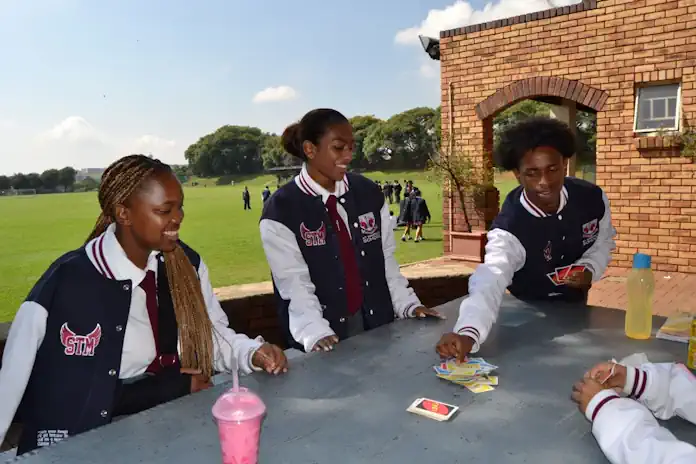
In September 2023 – before ‘phone-free schools’ became a widely debated topic in South Africa and beyond – St Martin’s School in Joburg South made a bold decision: to limit mobile phone use during the school day. Now over two years later, the results are not only visible, but deeply felt.
At a time when global concern around adolescent screen time, attention spans and mental health is intensifying, St Martin’s approach offers a considered, practical alternative to outright bans. Rather than removing phones entirely, the school introduced a ‘phone-free’ learning environment – one built on trust, responsibility and balance.
“We recognised early on that the conversation around phones in schools wasn’t going away,” says Headmaster Warren Venter. “Instead of waiting for a perfect solution, we chose to act… to put learning, wellbeing and human connection back at the centre of the school day.”
Globally, the move towards limiting phone use in schools is gaining momentum. According to UNESCO’s 2023 Global Education Monitoring Report, one in four countries has now introduced policies restricting mobile phones in schools, citing improved focus and reduced classroom disruption. Research from the London School of Economics has shown that banning phones in schools can improve academic performance by up to 6.4%, with the greatest gains seen among previously lower-performing students. At the same time, studies continue to link excessive screen time with increased anxiety, disrupted sleep and reduced social development in adolescents.
St Martin’s, however, has taken a more nuanced route. “A complete ban, in our context, simply isn’t practical,” Venter explains. “Many of our students rely on their phones for transport coordination, payments and communication with parents, particularly after sport. The aim was never prohibition, it was about preventing phones from interfering with learning and social interaction.”
Students are allowed to bring phones to school, but their use is restricted during lessons, break times, afternoon prep and co-curricular activities. Rather than centralised collection systems or locked pouches – which come with logistical and insurance challenges – students are encouraged to store devices securely in their lockers. The system is underpinned by mutual trust, consistent staff enforcement and clear boundaries.
What followed in those early weeks was both unexpected and telling. “There was a noticeable shift almost immediately,” says Venter. “We saw pupils reconnecting in very real ways: playing informal games like ‘open gates’, spending time in the coffee shop with board games, and simply being more present with one another. It reminded us how quickly behaviour can change when the environment supports it.”
While no system is without its challenges – the occasional discreet phone check between classes or a quick scroll during a bathroom break – the broader outcome has been overwhelmingly positive. More time on the sports fields, more conversation at break, and fewer digital distractions in the classroom.
Importantly, the school has not rejected technology altogether. Instead, it has redefined its role.
“We’re not anti-technology,” Venter adds. “We’re intentional about it. We use school-managed iPads for specific lessons, where the focus remains on learning rather than social media or personal apps. It’s about ensuring that technology serves education – not the other way around.”
The approach also speaks directly to a growing concern among educators and parents alike: the mental health of young people. With studies indicating rising levels of anxiety, depression and digital dependency among adolescents, creating structured “offline” time during the school day is increasingly seen as essential.
“School should be a space where pupils can think clearly, engage fully and build meaningful relationships,” says Venter. “If we can give them even a few hours a day without the constant pull of notifications, we’re equipping them with something incredibly valuable – the ability to focus, to connect and to simply be present.”
As more schools begin to explore similar policies, St Martin’s stands as an early adopter – not of restriction for its own sake, but of a more balanced, human-centred approach to modern education.
In a world that rarely switches off, the school’s decision is proving that sometimes, less screen time can mean far more connection.
