



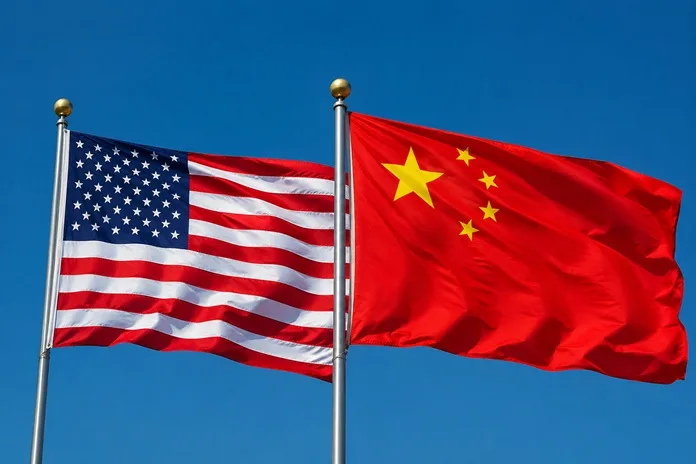
President Donald Trump and Chinese President Xi Jinping are set to meet in Beijing for a summit carrying major consequences for the future balance of global power, as rivalry between the United States and China deepens across trade, military influence and international diplomacy.
The talks come after years of growing tensions between the two nations, whose relationship increasingly shapes the global economy and geopolitical landscape. The summit is expected to focus on economic competition, strategic security concerns and the future direction of US-China relations.
Trade remains one of the most contentious issues between Washington and Beijing. During his first term, Trump launched a sweeping tariff campaign aimed at reducing America’s large trade deficit with China. The dispute escalated further during his second term, when the administration expanded tariffs under a policy branded “Liberation Day.”
China answered with retaliatory measures of its own, triggering a prolonged economic confrontation that at one point pushed tariffs above 125 percent on both sides. While some restrictions have since been reduced, the standoff exposed the dependence of both economies on one another.
The United States has struggled with rising consumer costs and pressure over inflation, while China has faced slowing growth, a weakened property sector, deflation concerns and high youth unemployment. Despite these challenges, Beijing has maintained a firm negotiating position and sought to demonstrate that its economy can absorb prolonged pressure.
China’s dominance in rare earth minerals has emerged as one of its strongest strategic advantages. The materials are essential for products including electric vehicles, smartphones, artificial intelligence systems and advanced military equipment. Beijing’s willingness to restrict supply during periods of tension underscored its leverage over critical global supply chains.
Chinese social media users have also mocked Trump with a phrase that roughly translates to “Trump the nation builder,” suggesting that his confrontational policies have unintentionally boosted China’s global standing and influence.
In Washington, however, some Americans interviewed appeared unfamiliar with Xi, highlighting differing levels of public awareness between the rival powers.
The summit also arrives during a period of shifting alliances and uncertainty surrounding US global leadership. Trump has repeatedly challenged traditional Western partnerships, criticized NATO and floated controversial positions involving Greenland, moves that critics say have unsettled long-standing allies.
At the same time, China has intensified efforts to position itself as a stable international partner. Beijing has expanded investment and diplomatic outreach across the Global South while presenting itself as an alternative to what it describes as Western unpredictability.
The symbolic setting of the summit is also significant. Beijing continues to reference the breakthrough achieved in 1972 when President Richard Nixon met Chinese Premier Zhou Enlai and signed the Shanghai Communiqué, a landmark step that transformed relations between the two countries after decades of isolation.
Military power and security concerns are expected to loom heavily over the meeting. The United States remains the world’s most battle-tested military force, though recent crises involving Iran and instability surrounding the Strait of Hormuz have fueled questions over Washington’s strategic effectiveness.
China, meanwhile, has rapidly expanded and modernized its armed forces over recent years. Although the People’s Liberation Army is now among the world’s largest militaries, analysts note it lacks modern combat experience compared with the United States.
Taiwan remains the most sensitive issue in the relationship. China has vowed to bring the self-governing island under its control, including through military force if necessary. Many analysts believe potential US involvement would determine the outcome of any future conflict over Taiwan.
Trump has maintained the longstanding US policy of “strategic ambiguity” on Taiwan, though some of his public remarks have created uncertainty over how far Washington would go militarily if China launched an attack.
The differences between the two political systems also continue to define the rivalry. Chinese leaders argue that Communist Party control has delivered national strength and stability, while Beijing portrays Western democratic systems as divided and unpredictable.
Xi, who faces no electoral cycle, is widely seen as operating with a long-term strategic outlook. Trump, meanwhile, approaches the relationship with a more confrontational and transactional style that has repeatedly disrupted diplomatic norms.
Even so, both governments have signaled that maintaining stability between the two powers remains a priority. Trump has frequently described his relationship with Xi in positive terms, while China has continued engaging with Washington despite mounting tensions.
The Beijing summit is now being viewed as more than a meeting between two presidents. It is seen as a pivotal moment in an increasingly intense contest over economic dominance, military influence and leadership of the international order.
