



U.S. President Donald Trump’s administration is continuing its campaign to end wind energy development through a series of executive orders, lawsuits, and lease buybacks. This is despite a recent court defeat and its own Department of Energy estimating the country could be powered by wind alone.
Trump has made no secret of his disdain for renewable energy. “We don’t want wind, and we don’t want solar because they’re a blight on our country,” he said in 2025.
On the first day of his second term, Jan. 20, 2025, Trump issued a presidential action to remove leasing opportunities for all new and renewed offshore wind projects. He also directed the government to “conduct a comprehensive review of the ecological, economic, and environmental necessity of terminating or amending any existing wind energy leases.”
In response, attorneys general from 17 states successfully sued the administration. A district court ruled the government’s action was “arbitrary and capricious and contrary to law.”
The administration appealed, but on June 10, the Department of Justice filed a motion to voluntarily dismiss the case. The U.S. Court of Appeals did so on June 15.
Andrea Campbell, the attorney general for the state of Massachusetts, one of the litigators behind the lawsuit, said in a statement: “Massachusetts has directed hundreds of millions of dollars into offshore wind development, and the court correctly protected those critical investments from the Trump Administration’s unlawful order.”
While the administration abandoned the appeal, it has been buying back leases for wind farms. On June 17, the administration announced plans to pay $765 million to Chicago-based Invenergy to halt four offshore wind energy projects off the coasts of California, New Jersey and Maine.
Invenergy will redirect the funds to the “development of natural gas-fired power plants in Indiana, Wisconsin, Iowa, Kansas, and Missouri and geothermal power generation projects in the Western U.S.,” the Department of the Interior said in a statement.
The wind projects were planned near densely populated coastal regions that need more affordable energy. Hillary Bright, executive director of Turn Forward, an offshore wind advocacy nonprofit, told Mongabay by email that simply replacing that energy production in another region doesn’t help coastal cities.
“These buyouts are not one-for-one ‘swaps’ for another kind of energy,” she said.
This is the third such buyback. Previously, the administration agreed to pay French oil and gas giant TotalEnergies $928 million to withdraw two of its offshore wind projects and invest in oil and gas projects. In all, the government has spent $2.6 billion to stop offshore wind development.
Wind provides roughly 10% of U.S. utility-scale electricity generation and has grown exponentially in the last two decades. In 2000, wind generated roughly 6 billion kilowatt-hours (kWh) of electricity; by 2022, it had grown by more than 7,100% to 434 billion kWh.
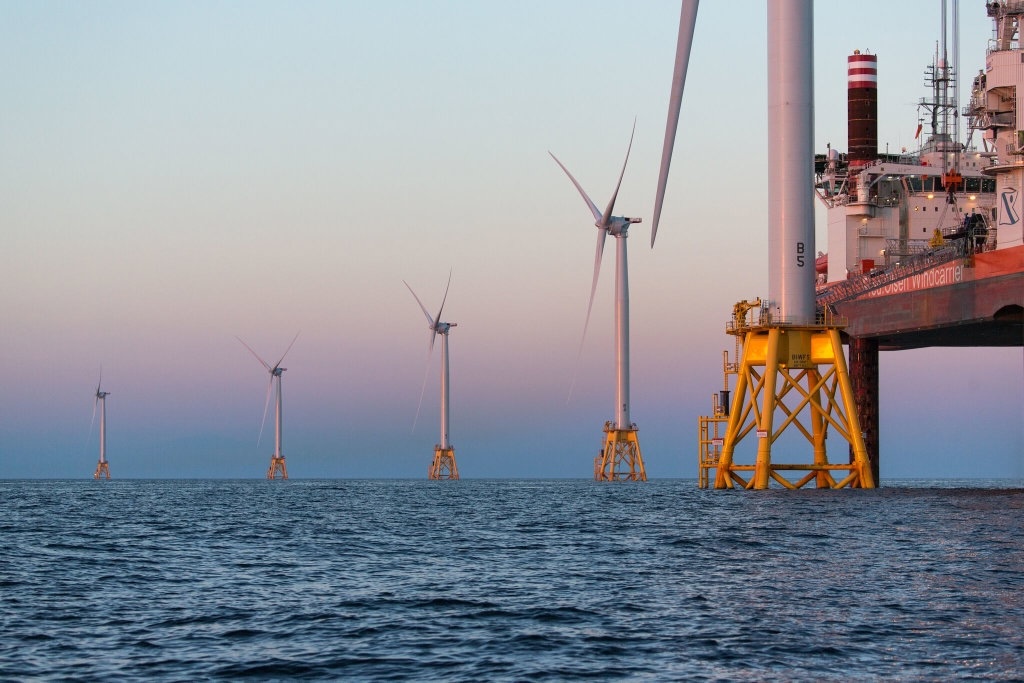
Banner image: A wind farm off the state of Rhode Island. Image by Joan Sullivan via Climate Visuals (CC BY-NC-ND 4.
This story first appeared on Mongabay
This article is licensed under a Creative Commons Attribution-NoDerivatives 4.0 International License.
You may republish this article, so long as you credit the authors and Mongabay, and do not change the text. Please include a link back to the original article.

