



- Wood from a Brazilian logging company banned several times for violating regulations may have ended up in the Netherlands, according to an investigation by campaign group Earthsight.
- The bans on logging company Samise stemmed from suspicions of, among other violations, illegal extraction, and resulted in fines and community service orders for the company.
- Yet Samise’s timber went on to be imported by Dutch companies GWW Houtimport, Van den Berg Hardhout, and Hoogendoorn Hout, via Brazilian exporter Greenex, according to the investigation.
- Earthsight called for rigorous implementation of the EU Deforestation Regulation (EUDR), which is scheduled to go into effect at the end of the year.
Two Dutch timber importers are at the center of a new investigation that shows they may have purchased suspect wood sourced to one of the largest logging companies in Brazil, which had temporarily lost its permits and been banned from clearing.
Brazilian logging company Samise Indústria Comércio e Exportação was clearing the forest to make roads and lumber yards months before receiving operating permits, according to an investigation by Earthsight, a U.K.-based nonprofit that exposes environmental and social crime. Employees also allegedly tampered with identification tags before inspections and transported illegally cleared lumber.
Some of the wood was eventually moved to sawmills owned by Brazilian company Greenex S/A Indústria Comércio e Exportação de Madeira, then exported to Dutch companies Hoogendoorn Hout and Van den Berg Houtgroep, the investigation found.
The transactions reveal weak points in international trade regulations and the certification process, intended to verify sustainably sourced wood, the report said.
“[Trade regulations] must go beyond surface-level checks on their supply chains,” Rafael Pieroni, Earthsight’s Latin America team lead, said in a statement. “European importers must refrain from treating certification as a substitute for rigorous due diligence.”
In the 2010s, Samise was one of three companies granted forestry concessions inside the 429,000-hectare (1.1-million-acre) Saracá-Taquera National Forest, which is covered almost entirely with primary forest and home to 29 mammal species found nowhere outside the Amazon.
In May 2023, Samise’s operations were banned due to evidence of fraud discovered by Brazil’s Chico Mendes Biodiversity Conservation Institute (ICMBio), the agency responsible for managing federal protected areas. The agency found that the company had moved logs to a neighboring farm without the proper transport permits, while also replacing identification tags before inspection.
Despite the ban, the company moved lumber from its station in the municipality of Terra Santa, in the state of Pará, to a sawmill owned by Greenex in the municipality of Santa Barbara do Pará. In total, it moved 3,800 cubic meters (134,200 cubic feet) of angelim vermelho (Dinizia excelsa), a dense, reddish-brown hardwood often used for building outdoor decks.
The ban on Samise’s operations was lifted in July 2023 following wood DNA tests that revealed the logs transported to the neighboring farm didn’t match the stumps on Samise’s property. The logs were from somewhere else, proving the company hadn’t illegally moved them.
The Earthsight report argued there was a conflict of interest in the results because Samise’s owner, Ricardo Batista Tamanho, also owns TMNH Participações, the parent of the company that conducted the DNA test, Genoma A.
Samise and Greenex didn’t reply to a request for comment for this story. But a spokesperson for Samise told Earthsight that it stood by the testing results, and that some of the alleged identification tag tampering could be explained by theft and vandalism.
The spokesperson also said there was no history of irregular deforestation in the company’s operations.
Following the ban reversal, officials uncovered other instances of wrongdoing: Samise employees had sanded off and replaced identification numbers on more than 600 logs, a common way of concealing illegal extraction, the Earthsight report said.
The logs were made up of 10 different species and valued at around $113,000.
Samise’s operations were suspended again on July 31, 2023, which led to two criminal cases filed by the Pará Federal Prosecutor’s Office. One of them resulted in a fine and community service in the form of funding environmental projects.
Later that year, the company was fined again for discrepancies in recorded log dimensions. It also built lumber yards and roads outside of an approved management plan, according to the Earthsight investigation.
On June 18, the Brazilian Forest Service permanently terminated Samise’s forest concession in the Saracá-Taquera National Forest.
“The issues identified in Samise’s concession in Saracá-Taquera underline wider concerns about how a program intended to preserve the Amazon could instead end up accelerating its destruction,” the Earthsight report said.
Dutch trade and oversight
The NGO’s investigation couldn’t definitively prove that the angelim vermelho logs moved in June 2023 during Samise’s operating ban were the same as what was exported by Greenex to the Dutch importers.
However, all angelim vermelho exported by Greenex to the Netherlands between July and October 2023 originated from Samise’s concessions, the investigation found, suggesting the Dutch companies likely did purchase the suspect wood.
Greenex was a leading Brazilian wood exporter to Europe, with the Netherlands making up around 30% of its international sales.
More than 90% of Greenex sales to the Netherlands were to Dutch importers GWW Houtimport, Van den Berg Hardhout, and Hoogendoorn Hout. In January 2026, Van den Berg Hardhout merged with GWW Houtimport to form Van den Berg Houtgroep, which supplies timber for boardwalks, terrace decking and other outdoor projects.
The companies didn’t respond to a request for comment for this story. But on their websites, they say they only purchase wood certified as sustainable by the Forest Stewardship Council (FSC).
Greenex has had FSC certification since 2016 but has also been fined 81 times since 2010 for exporting timber without environmental authorization, the Earthsight investigation found.
Certificate holders aren’t required to report sanctions or fines, an FSC spokesperson told Mongabay. But they should still inform the certification body of changes to their operations within 10 days.

“We recognize that our requirements do not specifically define those circumstances to include government sanctions or suspensions, and we are committed to further strengthening our systems,” the spokesperson said in an email.
The Earthsight report said the weak points in FSC regulations mean certification cannot be relied on as a legal guarantee. Instead, international trade regulations, such as the EU Timber Regulation (EUTR), must be robust and carried out consistently.
The EUTR requires companies to review timber shipments and reject anything posing a “non-negligible” risk of illegality. But a large percentage of noncompliant timber still makes it into European markets, the investigation found.
A different law, the EU Deforestation Regulation (EUDR), is set to go into force in December, with stricter policies than the EUTR. It requires producers to prove wood products, among several other commodities, weren’t sourced to land deforested after Dec. 31, 2020, in many cases with satellite mapping and GIS tools.
The Earthsight report stressed the importance of a rigorous implementation of the EUDR, carrying out its many policies as designed.
“For the EUDR to fulfill its potential in reducing deforestation and forest degradation, companies and enforcement authorities must heed the lessons learned from the EUTR’s poor enforcement, and ensure due diligence goes beyond surface-level checks,” the report said.
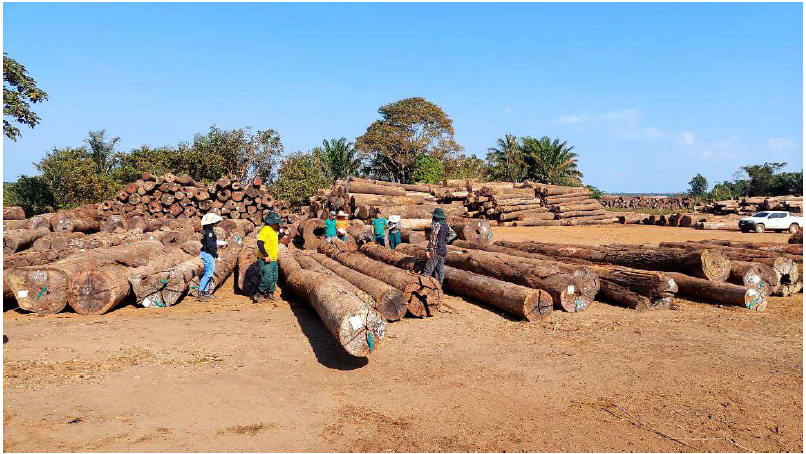
Banner image: Logging operation in the Amazon. Image by Fabio Nascimento. This photo was taken by a contributor so the rights for use cannot be granted beyond articles published for Mongabay.
See related from this reporter:
Paraguay expanded a reserve in the Gran Chaco. Why is deforestation still rising there?
FEEDBACK: Use this form to send a message to the author of this post. If you want to post a public comment, you can do that at the bottom of the page.
Credits

This story first appeared on Mongabay
This article is licensed under a Creative Commons Attribution-NoDerivatives 4.0 International License.
You may republish this article, so long as you credit the authors and Mongabay, and do not change the text. Please include a link back to the original article.

