



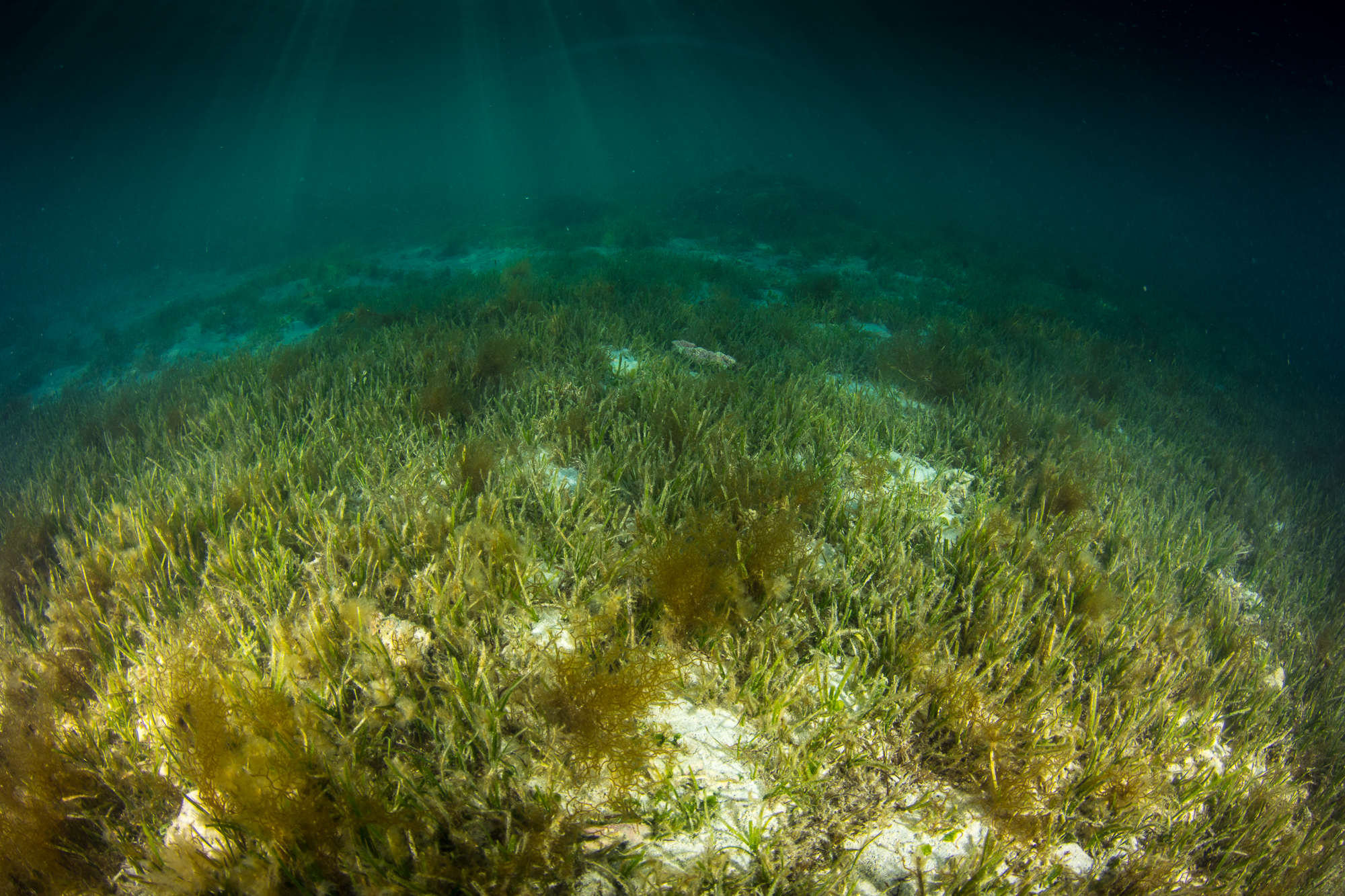
- Australia is a global stronghold for seagrasses, the flowering plants that grow in coastal waters and bays.
- Seagrasses are unsung but vital ecosystem engineers: They stabilize sediments, provide habitat and food for marine species, help cleanse the water column of pollutants and sequester vast amounts of carbon dioxide.
- Across Australia’s waters, these undersea meadows are suffering as coasts are developed, seas are polluted and climate change continues to raise water temperatures.
- Conservationists are working to restore seagrasses and build resilience to preserve these vital marine ecosystems.
Australia’s Great Barrier Reef is renowned for its coral, but far less so for its expansive seagrass meadows.
“People don’t dive on them, don’t snorkel on them, and don’t go rock pooling on them,” said Emma Jackson, director of the Coastal Marine Ecosystems Research Centre (CMERC) at Central Queensland University. She’s a self-confessed seagrass nerd. One reason, she said, is because “they have this wealth of different ecosystem services.”
Though they’re known as the “ugly cousins” of coral reefs, these flowering grass-like plants provide a home and foraging grounds for marine life, as well as habitat for commercial fish species. These meadows stabilize sediments, help cleanse the water column and sequester substantial amounts of carbon.
“I think when people understand that, then they can share my nerdiness and share that passion for seagrass,” Jackson said.
The Great Barrier Reef is home to around 3.5 million hectares (8.6 million acres) of seagrass, an area larger than Belgium, which accounts for about 11% of the world’s total. Australia is a global hotspot of seagrass biodiversity, hosting around half of the world’s 60 species of the plants.
But as climate change ratchets up temperatures and triggers more frequent extreme weather events, Australia’s marine meadows are increasingly battered by intense storms and cyclones, flooding, and devastating marine heat waves. Algal blooms are also impacting seagrasses by blocking out sunlight in some locations, such as off southern Australia.
To mitigate these increasing pressures, conservationists and communities are restoring damaged meadows and trying to build resilience against environmental change. Their work underlines the need to protect these vital ecosystems.
“I don’t think we should assume seagrass ecosystems are doomed, but I also think the era of relatively stable coastal conditions is behind us,” Peter Macreadie, director of the Royal Melbourne Institute of Technology’s (RMIT) Centre for Nature Positive Solutions, told Mongabay by email. “The systems that are healthiest and best protected today are likely to have the best chance of persisting under future climate change.”

A growing threat
Seagrass meadows have declined globally over the past decades. In Australia, some 1.6 million hectares (4 million acres) were lost since the 1950s, driven largely by coastal development, including wastewater– and agriculture-driven nutrient pollution and dredging.
Shark Bay, a UNESCO World Heritage Site in the state of Western Australia is known for its wide diversity of marine life, and it stands as testament to the growing impacts of climate change. A prolonged heat wave in the planet’s largest seagrass meadow during the 2010-2011 Southern Hemisphere summer, combined with runoff caused by flooding, decimated more than 100,000 hectares (250,000 acres) of seagrass there.
This massive seagrass die-off released up to 9 million metric tons of carbon dioxide into the atmosphere — a release dubbed a “carbon bomb,” equal to the yearly output from 800,000 homes, or 1.6 million cars driven over a two-month period. Twenty percent of the meadow was lost. It cost billions of dollars in damage and led to the closure of key fisheries for several years.
It also impacted many of the bay’s marine species. “The seagrass die-off directly affected our fish, squids, crabs, tiger prawns, dolphins, dugongs, the whole lot,” said Liam Ridgeley, who leads the Shark Bay Seagrass Restoration project.
He noted that, even a decade and a half later, the meadows are struggling to recover and remain highly fragmented and patchy. “We’re seeing continuation of the erosion of the seagrass meadows here.”
“That event was a real wake-up call because Shark Bay was one of the most intact seagrass systems on Earth,” Macreadie told Mongabay.
Others outline how in tropical areas, such as along the Great Barrier Reef, climate-fueled cyclones and storms are a growing concern: They can rip up entire meadows. Though seagrasses usually bounce back, increasing frequency damage means that some areas can’t. “They’re just not able to recover to what they were before they get hit again by another storm,” Jackson said.


Learning from heat
Another heat wave hit Western Australia in 2025, again killing off seagrasses. It gave researchers an opportunity to test how seagrasses respond and what the future might look like. Previous research found that thermal tolerance to heat waves varies starkly among both species and individual plants, with some tropical and subtropical species already coming up against their limits.
A study examining the impacts of the 2025 heat wave in Exmouth Gulf, Western Australia, confirmed earlier findings by Kathryn McMahon, professor of marine science at Edith Cowan University, and her colleagues. Two species that are at risk based on heat tolerance, Halophila and Halodule, suffered large losses in the gulf, while Cymodocea — which had greater resilience — didn’t. Their paper is currently under review.
“We had this extreme natural event that we didn’t really want to see, but [it] supported our [prior] research,” McMahon said.
That heat wave also prompted McMahon and other seagrass experts to establish the Seagrass Heatwave Collective. One goal is to develop an effective early-warning system based on seagrass’s thermal tolerance and work these findings into active restoration efforts.
“We could harness that [thermal tolerance] for restoration activities to ‘future-proof’ seagrass meadows to the marine heat waves that we are currently experiencing,” McMahon said. The plan would be to restore meadows with plants or species that can better tolerate projected temperature increases.

Disrupted sediment
Marine heat waves can directly harm seagrass. But recent research from Australia also shows that higher temperatures can also disrupt microbes in the marine sediment.
For decades, the Eraring power station in New South Wales state has drawn water from a saltwater lake for cooling, and releases warm water into Myuna Bay. As a result, the water in the bay has consistently been 1°-3° Celsius (1.8°-5.4° Fahrenheit) warmer than nearby sites. This effectively mimics the warming caused by a heat wave, altering microbial communities, according to a study published in Aquatic Microbiology.
“Communities in the bacteria in those sediments, they shift in such a way that they have a negative impact on [seagrass]. So the plant gets kind of attacked from both sides,” said Renske Jongen, a researcher at the University of Sydney.
She compared it to the symbiotic relationship between coral and the algae that live within them. In the case of seagrass, these microbes are essential to root health. It’s thought that heat waves stimulate sulfide-producing microbes, which can enter the roots and intoxicate and eventually kill the plant.
Jongen said this could have implications for restoration. “It might be important [to know that] if you want to restore somewhere that even though the water looks fine, the microbes in the sediment might not be,” she said.

Giving seagrass a fighting chance
Ongoing research aims to benefit Australia’s numerous seagrass restoration projects currently underway. Scientists, citizen scientists, community volunteers, and Traditional Owners — Indigenous peoples with ancestral custodianship of the area — are working to restore meadows nationwide.
Cockburn Sound, in Western Australia, is one area that’s seen extensive restoration efforts, but some have been more successful than others. The sound suffered huge seagrass losses from the 1960s to the 1990s, largely driven by poor water quality caused by industrialization. Up to 80% of the area’s seagrass was lost by the 1980s.
Since then, there’s been some successful restoration using various techniques. An analysis found that almost three-quarters of 66 restoration sites show “demonstrable success in restoring seagrass.”
Those projects included a 3-hectare (7.4 acre) plot planted with a type of seagrass called ribbon weed (Posidonia australis). Though it took several years, ecosystem function returned, said Jennifer Verduin, a professor and oceanographer at Murdoch University. She and her team are also planning to launch a 100-hectare (247-acre) seagrass restoration project in Shark Bay in collaboration with Traditional Owners that will also use Posidonia sprigs.
Ridgely’s volunteer-led initiative is placing sandbags stuffed with seeds to restore seagrasses in Shark Bay and stabilize sediment.


Another large-scale tropical seagrass restoration project is underway in Cairns, in the state of Queensland, and the Seed for Snappers program run by OzFish has deployed more than 60,000 seeds near Adelaide, in South Australia state.
Recently, Jackson’s team opened one of the world’s largest seagrass nurseries to aid restoration on the Great Barrier Reef. “The largest sort of restoration plot that we’ve done to date with the seeds that we’ve been able to produce, is about a hectare,” she said, or about 2.5 acres. “The only bottlenecks to actually scaling up are the storage costs and the seed collection costs.”
Other innovations, such as using underwater drones and robots to plant seeds, are undergoing trials on the Great Barrier Reef and elsewhere. It could, in time, be a game changer. “That could actually put seeds in precisely where you want them, at the depth that you want them, in the place that you want them, and cover 5-10 hectares [12-25 acres] in a day,” she said.
For now, much more work is needed to understand and refine restoration techniques, experts say, while projects still rely on the dedication of volunteers.
Ramping up efforts to protect seagrass by removing threats and restoring meadows is important, Macreadie said, but so is a mindset shift at the national level.
“Australia has some encouraging seagrass recovery stories, but unfortunately they are still the exception rather than the rule,” he said. “The next step is probably better integration: treating seagrass not just as habitat, but as part of how we think about coastal resilience, fisheries, climate and long-term economic risk.”

Banner image: A leafy sea dragon among seagrass in South Australia. Image by Jayne Jenkins / Ocean Image Bank.
Thai island community rallies to protect beloved dugongs, revive declining seagrass
Why saving seagrass meadows could help save the world’s coastlines
Citations:
Salinas, C., Duarte, C. M., Lavery, P. S., Masque, P., Arias‐Ortiz, A., Leon, J. X., … Serrano, O. (2020). Seagrass losses since mid‐20th century fueled CO2 emissions from soil carbon stocks. Global Change Biology, 26(9), 4772-4784. doi:10.1111/gcb.15204
Arias-Ortiz, A., Serrano, O., Masqué, P., Lavery, P. S., Mueller, U., Kendrick, G. A., … Duarte, C. M. (2018). A marine heatwave drives massive losses from the world’s largest seagrass carbon stocks. Nature Climate Change, 8(4), 338-344. doi:10.1038/s41558-018-0096-y
Caputi, N., Kangas, M., Chandrapavan, A., Hart, A., Feng, M., Marin, M., & Lestang, S. D. (2019). Factors affecting the recovery of invertebrate stocks from the 2011 Western Australian extreme marine heatwave. Frontiers in Marine Science, 6. doi:10.3389/fmars.2019.00484
Said, N., Webster, C., Strydom, S., Dunham, N., Adams, M. P., & McMahon, K. (2025). Seagrasses are most vulnerable to marine heatwaves in tropical zones: Local‐scale and broad climatic zone variation in thermal tolerances. New Phytologist, 249(6), 2835-2851. doi:10.1111/nph.70742
Hensel, E., Patrick, C. J., Wilson, S. J., Song, B., Reay, W. G., & Orth, R. J. (2024). Incorporating generalist seagrasses enhances habitat restoration in a changing environment. Journal of Applied Ecology, 61(6), 1469-1480. doi:10.1111/1365-2664.14643
Jongen, R., Gribben, P. E., Erickson, K. R., & Marzinelli, E. M. (2026). Ocean warming indirectly affects seagrass performance through effects on sediment microbial communities. New Phytologist, 251(1), 191-206. doi:10.1111/nph.71195
Walker, L. D., Gribben, P. E., Glasby, T. M., Marzinelli, E. M., Varkey, D. R., & Dafforn, K. A. (2024). Above and below-ground bacterial communities shift in seagrass beds with warmer temperatures. Frontiers in Marine Science, 11. doi:10.3389/fmars.2024.1374946
Kendrick, G. A., Austin, R., Ferretto, G., Van Keulen, M., & Verduin, J. J. (2025). Lessons learnt from revisiting decades of seagrass restoration projects in Cockburn Sound, southwestern Australia. Restoration Ecology, 33(4). doi:10.1111/rec.70040
Verduin, J. J., Paling, E. I., Pedretti, Y., Rivers, L. E., & van Keulen, M. (2026). Adaptive management and long-term monitoring approaches achieve first functional seagrass meadow restoration in Cockburn Sound, Western Australia. Estuarine, Coastal and Shelf Science, 333, 109738. doi:10.1016/j.ecss.2026.109738
FEEDBACK: Use this form to send a message to the author or editor of this post. If you’d like to post a public comment, you can do so at the bottom of the page.
Cite this article
Sean Mowbray (2026). Australia’s seagrass meadows under pressure as climate change turns up the heat. Mongabay Conservation news. DOI: https://doi.org/10.66709/news-322342
Credits

This story first appeared on Mongabay
This article is licensed under a Creative Commons Attribution-NoDerivatives 4.0 International License.
You may republish this article, so long as you credit the authors and Mongabay, and do not change the text. Please include a link back to the original article.

