



- Fires in Indonesia’s West Kalimantan province have sent haze across the border into Malaysia, where worsening air pollution has forced six schools in Sarawak state to switch to online classes.
- Indonesia is entering the peak of its fire season, with West Kalimantan accounting for more than half of the nearly 49,000 hectares (121,000 acres) burned across six priority provinces as of Aug. 9.
- The fires are also threatening biodiversity, including orangutan habitat and rehabilitation efforts in West Kalimantan, while a separate blaze has forced the closure of Bromo Tengger Semeru National Park on the island of Java.
- Authorities have deployed tens of thousands of personnel and dozens of aircraft to fight the fires, but environmental groups say funding cuts and the intensifying El Niño are raising concerns about Indonesia’s preparedness.
JAKARTA — Haze from fires in Indonesian Borneo has drifted across the border into the Malaysian portion of the island, pushing air pollution there to “very unhealthy levels” and causing school closures.
On Aug. 12, Sarawak’s Tebedu district, near the Indonesia-Malaysia border, recorded an air pollution index (API) exceeding 200, considered “very unhealthy,” prompting the government to close six schools and shift classes online.
IQAir, a Swiss-based air quality technology company, ranked Kuching, the capital of Malaysia’s Sarawak state, as the most polluted major city in the world on Aug. 11.
According to Malaysia’s Air Pollutant Index Management System (APIMS), 11 areas in Sarawak recorded unhealthy API readings on Aug. 11, up from eight on Aug. 9.
The worsening air quality in Sarawak comes as fires intensify in Indonesia’s West Kalimantan province, which neighbors the Malaysian state.
The ASEAN Specialised Meteorological Centre (ASMC), which monitors and assesses wildfires and transboundary haze in the Southeast Asia region, observed smoke drifting from West Kalimantan into western Sarawak across several days in July.

As haze blanketed parts of West Kalimantan, authorities in the provincial capital, Pontianak, have suspended schools indefinitely and shifted classes online.
Fires also affected parts of Sumatra. Haze from the western Indonesian island has historically drifted north to Singapore and Peninsular Malaysia during severe fire seasons. The Singaporean government has said its haze task force is ready to roll out action plans if air quality in the city-state deteriorates.
Indonesia’s disaster management agency, the BNPB, has warned the country is entering the peak of the fire season, with August and September expected to carry the highest risk.
For weeks, Indonesia has been battling land and forest fires that have broken out across the country, from Sumatra in the west to Papua in the east.
Authorities are prioritizing firefighting efforts in six provinces — Riau, Jambi and South Sumatra in Sumatra, as well as West Kalimantan, Central Kalimantan and South Kalimantan in Borneo — which have vast areas of peatland that are prone to catching fire during the dry season.
Of the six, West Kalimantan is the worst-affected province. According to the BNPB, as of Aug. 9, 28,680 hectares (70,870 acres) of land had been burned in West Kalimantan, accounting for more than half of the 48,889 hectares (120,807 acres) of burned land across the six provinces.
Madani Berkelanjutan, an Indonesian NGO focusing on the climate crisis, put an even higher number. It identified 50,558 hectares (124,932 acres) of area “indicated as burned” in West Kalimantan alone.

Haze and hotspots
The haze and wildfires have returned this year as Indonesia faces increasingly dry conditions amid a “super” El Niño that officially arrived in June.
The U.S.-based Climate Prediction Center gives an 81% chance that this year’s El Niño will reach “very strong” intensity between October and December, potentially ranking among the most severe in the historical record since 1950.
Indonesia already saw an increase in fire activity last month, before the peak wildfire season.
A spatial analysis by Madani Berkelanjutan found that the area indicated as burned increased eightfold from 15,474 hectares (38,237 acres) in June to 124,040 hectares (306,510 acres) in July.
FireWatch, a new satellite monitoring platform developed by the forest monitoring platform Nusantara Atlas, detected more than 96,000 fire hotspots across Indonesia as of July 27.
That was already higher than the number recorded at the same point in the previous devastating fire seasons: about 88,000 hotspots were detected by late July 2019, and roughly 58,000 during the same period in 2023.
As of Aug. 11 this year, FireWatch had recorded more than 154,000 hotspots across Indonesia — a 60% increase from the July figure.

Wildfires threaten biodiversity
The fires in West Kalimantan have also threatened wildlife habitats and rehabilitation efforts.
On July 22, a fire broke out about 1 kilometer (0.6 miles) from an orangutan rehabilitation center run by the nonprofit organization YIARI in Ketapang district, where more than 60 critically endangered Bornean orangutans (Pongo pygmaeus) are undergoing rehabilitation after being rescued from the illegal wildlife trade and habitat loss.
On Aug. 11, fire flared up again near the orangutan center.
“The fire is now really close to the orangutan rehabilitation center, and we are worried that wind will spread the fire even more,” YIARI said in an Instagram post.
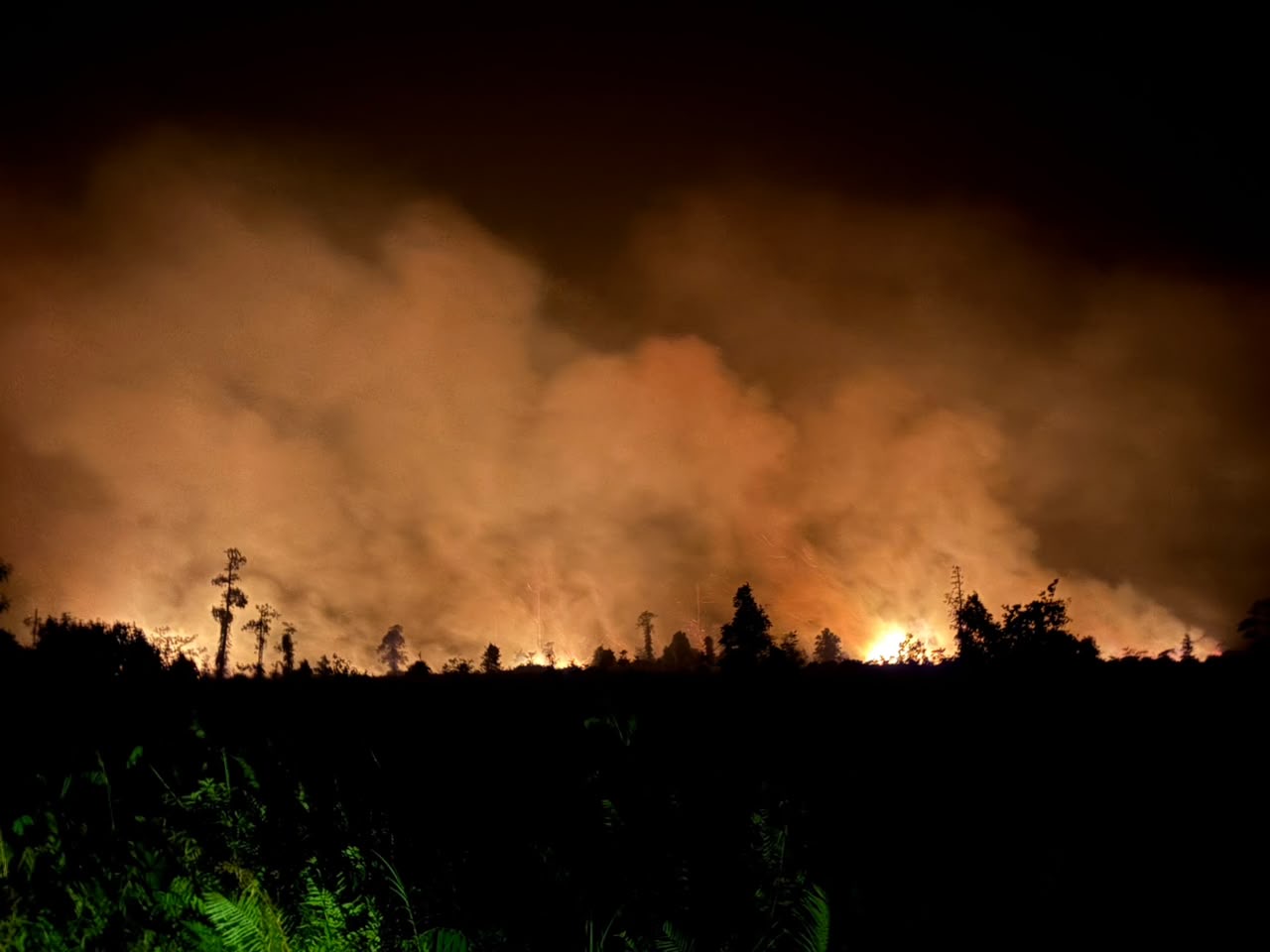
YIARI told Mongabay that firefighters were finally able to extinguish the fires in the early hours of Aug. 12, but smoke still lingered in the area.
The fires have also begun affecting wild orangutans. Earlier in July, authorities and conservationists rescued a male orangutan from farmland near an expanding blaze in Ketapang.
On Aug. 7, FireWatch detected fires at the edge of the Sungai Putri forest, a critical peatland that’s home to between 750 and 1,750 Bornean orangutans, making it the third-largest population of the apes in West Kalimantan.

Research has shown that prolonged fires can severely reduce food availability for orangutans, forcing the apes into starvation conditions, while smoke exposure can weaken their immune systems and damage their health.
Madani Berkelanjutan estimates that about 22,200 hectares (54,900 acres) of Indonesia’s indicated burned territory this year were within key biodiversity areas.
One example of a biodiversity-rich area affected by fires is Bromo Tengger Semeru National Park on the island of Java. The park is home to globally threatened species, including the critically endangered Sunda pangolin (Manis javanica) and the endangered Javan leopard (Panthera pardus melas).
The blaze broke out on Aug. 3, and as of Aug. 11, had engulfed some 899 hectares (2,221 acres) of savanna and forest within the national park. The disaster forced the total closure of the protected area, which is one of the country’s best-known tourist destinations.
Local media reported that the destruction of natural vegetation had reduced food sources for wild animals, with groups of long-tailed macaques (Macaca fascicularis) increasingly appearing by the roadsides to seek food from residents and tourists.
However, Rudijanta Tjahja Nugraha, the Bromo national park authority’s chief, said the fire had not directly affected wildlife because most of the burning occurred in the park’s savanna landscape.

‘El Niño is right in front of us’
The BNPB says it has deployed large numbers of personnel and aircraft to deal with the fires. Around 48,000 personnel have been deployed across the six priority provinces, while 35 aircraft are available for monitoring, water bombing, and cloud-seeding operations to induce rainfall.
However, environmental groups have questioned the government’s preparedness to tackle the problem. The scale and the surge of the wildfires show that Indonesia can’t afford to wait for fires to become large before responding, said Madani Berkelanjutan deputy director Giorgio Budi Indrarto.
“El Niño is right in front of us,” he said at a recent event in Jakarta. “So if the government is still busy with other things, it will fall behind, and it will certainly be overwhelmed.”
Yosi Amelia, Madani Berkelanjutan’s climate and ecosystem program lead, also questioned the government’s preparedness to tackle this year’s fire season, pointing to funding cuts for disaster management.
The current budget for the BNPB is the lowest it’s been in 15 years, at 491 billion rupiah ($27.5 million) this year — down from 2.01 trillion rupiah ($113 million) in 2025.
The cut came as the government reallocated vast sums to President Prabowo Subianto’s flagship programs, including 335 trillion rupiah ($19.9 billion) for a universal school meals program in 2026. However, the government dismissed concerns that the BNPB budget cut had affected its readiness to respond to fires.
Forestry Minister Raja Juli Antoni said on Aug. 6 that the president had approved additional funding if needed.
“President Prabowo Subianto’s order is clear: the government is ready to protect our citizens from the threat of forest and land fires,” he said. “The president also said that if the budget is insufficient, it should be increased so that the state is present in preventing forest fires.”
Still, there are concerns that fiscal constraints are leaving some provinces with inadequate funding for fire prevention.
In Sumatra’s Riau province, the 2026 budget for fire management is only 3.67 billion rupiah ($205,500), according to FITRA Riau, an NGO that campaigns for government funding accountability. Gusmansyah, the NGO’s deputy coordinator, described the allocation as small for a province that has historically been one of Indonesia’s worst fire and haze hotspots.
Banner image: Fire near YIARI’s orangutan rehabilitation center in Ketapang district, West Kalimantan province, on Aug. 11, 2026. Image courtesy of YIARI.
FEEDBACK: Use this form to send a message to the author of this post. If you want to post a public comment, you can do that at the bottom of the page.
Cite this article
Hans Nicholas Jong (2026). Indonesia’s wildfire season surges as haze spreads into Malaysia. Mongabay Conservation news. DOI: https://doi.org/10.66709/news-326174
Credits

This story first appeared on Mongabay
This article is licensed under a Creative Commons Attribution-NoDerivatives 4.0 International License.
You may republish this article, so long as you credit the authors and Mongabay, and do not change the text. Please include a link back to the original article.

