



Until fairly recently, the conversation around electric cars in South Africa focused largely on whether they were a realistic option locally. Price, access to charging, long-distance travel and the stability of the electricity supply were all cited as obstacles. These remain valid considerations, although growing sales across several forms of electrification show that they are not preventing the market from developing.
Figures from naamsa show that 4,585 new-energy vehicles were sold during the first quarter of 2026, up 31.5% from 3,487 over the same period last year. Conventional hybrids still accounted for most of the total, with 2,764 units sold, while battery-electric vehicle sales increased from 276 to 544 units.
The more noticeable change came from plug-in hybrids. Sales rose from 241 units in the first quarter of 2025 to 1,277 during the same three months this year. The volumes remain small in relation to the wider new-car market. Still, the increase suggests that buyers are becoming more comfortable with electrification when it does not require them to give up petrol entirely.
OMODA & JAECOO’s South African strategy is not based on replacing petrol-powered vehicles, but on giving buyers a wider choice of powertrains. ICE models remain an important part of its local range, while conventional hybrids, plug-in hybrids and fully electric vehicles provide additional options as demand for new-energy vehicles grows.
“Our view is that there isn’t a single point at which the whole country suddenly becomes ready for electric cars,” says Shannon Gahagan, National Brand and Marketing Manager for OMODA & JAECOO South Africa.
“A customer who drives 40 km a day and can charge at home is in a very different position from someone who regularly travels between provinces or lives somewhere they cannot install a charger. Both may want to use less fuel, but that does not mean the same vehicle will work for both of them.”
The recent interest in plug-in hybrids is not difficult to understand. For shorter journeys, a sufficiently charged PHEV can operate on electric power. The petrol engine remains available when the battery is depleted, or the journey extends beyond its electric range.
In theory, this allows an owner to do much of the weekly commute electrically and still drive from Johannesburg to Durban without having to arrange the trip around charging stops. It is an attractive proposition in a country where public charging is becoming more widely available but remains concentrated around cities and major routes.
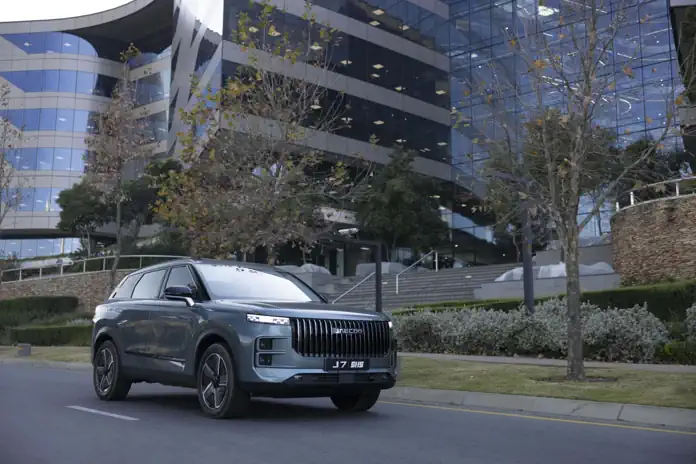
The brand’s plug-in hybrid offering includes the OMODA C9 SHS and C7 SHS, as well as the JAECOO J7 SHS. The C7 and J7 are priced identically and use the same powertrain, leaving the choice largely to their different designs and characters, while the larger and more powerful C9 sits above them as the flagship offering. All three combine useful electric driving capability with the flexibility of a petrol engine for longer journeys.
“We are meeting customers who like the idea of doing their ordinary daily driving on electric power, but still want the freedom to undertake longer journeys without having to plan every stop around charging,” says Gahagan.
“That is where a plug-in hybrid works particularly well. Regular charging allows the owner to make the most of its electric capability, but if charging is not available, the vehicle can continue the journey using its petrol engine. It offers the benefits of electric driving without the same dependence on charging infrastructure.”
The benefits of a PHEV still depend heavily on how it is used. An owner who can charge at home each night may complete much of the working week without using much petrol. If the battery is seldom charged, however, the petrol engine has to do more of the work while carrying the extra weight of the hybrid system, reducing the efficiency the technology is intended to provide.
A conventional hybrid asks less of the driver. It does not offer the same electric-only driving ability, but neither does it require an external charger. The battery is replenished while the car is being driven, and the electric motor assists the petrol engine when it can do so most effectively.
That helps explain why hybrids continue to dominate South Africa’s new-energy vehicle sales. They allow buyers to reduce fuel consumption without giving much thought to charging, route planning or where the car is parked overnight.
Models such as the C5 SHS and J5 SHS provide a less disruptive introduction to electrification. They are aimed at motorists interested in better fuel consumption but not necessarily ready, or able, to plug in a car.
At the other end of the range is the JAECOO J5 BEV, the company’s new fully electric model. Its 58.9 kWh battery provides a claimed range of 402 km on the WLTP cycle, with DC charging supported at up to 130 kW.
For many drivers, more than 400 km of range will be enough for commuting and everyday use, particularly if they can charge at home. It may be less practical for someone who regularly travels long distances or drives through areas where charging stations are harder to find.
It is therefore difficult to say whether South Africa as a whole is ready for electric cars. Some motorists already have the charging access and driving habits to make a BEV practical, while others will find a plug-in or conventional hybrid better suited to their needs.
The J5 range offers a fairly direct illustration of that strategy. Buyers can choose between petrol, hybrid and fully electric versions of the same broad type of compact crossover, depending on their budget, driving habits and access to charging. The emphasis is not on positioning electrification as a replacement for ICE, but on ensuring that customers can select the powertrain best suited to their individual needs.
“We don’t expect one powertrain to replace all the others overnight,” says Gahagan. “At the moment, there are customers for each of them. Our approach is to give people more than one way into electrified motoring and then allow the market to show us how quickly that balance changes.”
How quickly that balance shifts will depend on more than buyer interest. Price and finance will remain important, along with how easily owners can install a charger at home, the availability of public charging and what electrified cars are worth when the time comes to sell. A wider choice of more affordable models should also make the technology accessible to buyers who have so far been priced out.
It remains too early to tell how the mix will settle. Plug-in hybrids are growing quickly, conventional hybrids still account for most sales, and BEVs are finding a larger, if still limited, audience. That is likely to remain the shape of the market for some time, as buyers weigh price and convenience against how far they are ready to move away from petrol.

