



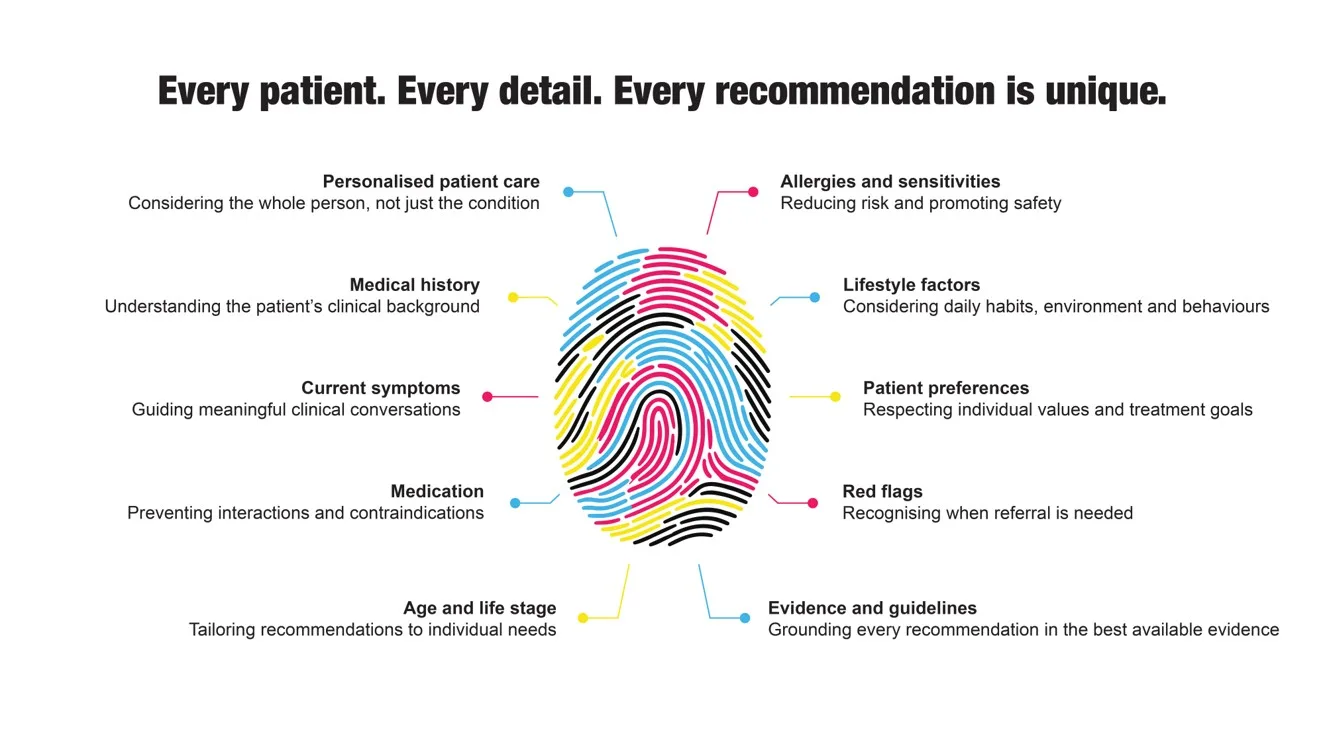
With one doctor for every 3,198 South Africans, and a healthcare system in which most people rely on the public sector while private care remains concentrated among a minority, the pharmacy has become the frontline of healthcare for millions of South Africans. Not by design, but by necessity.1,2
Every day, pharmacy professionals assess symptoms, identify red flags, dispense prescription medication and, importantly, recommend over-the-counter treatment to patients. For many South Africans, the pharmacist is the first, and sometimes the only, healthcare professional they can easily access. This makes the recommendation moment at the dispensary counter far more than a retail interaction. It is often a crucial healthcare decision that can influence symptom relief, treatment success, patient safety, recovery and overall wellbeing. Six forces are redefining how recommendations are made at the pharmacy counter, with consequences for patients, pharmaceutical brands and the future of community healthcare in South Africa.
- Some patients are dependent on the pharmacist’s recommendation
For many patients, the pharmacy professional may be the only healthcare professional they speak to about a symptom, concern or treatment choice. Community pharmacies are accessible, local and often easier to reach than a doctor’s consulting room, especially when patients are managing cost, transport, time away from work, or long queues in the public system. In this context, a recommendation is not simply a product suggestion. It may be the patient’s first clinical conversation, their first safety check and, when needed, the point at which they are referred for more urgent care. South African research has already highlighted the community pharmacy sector as an underused access point for health services, particularly where healthcare systems are stretched.3
- Some patients are informed, but not always accurately
Many patients arrive at the pharmacy counter with a treatment idea shaped by Google searches, social media, health forums, influencers or AI tools. This is not necessarily a problem. Informed patients can ask better questions and participate more actively in their care. The challenge is that online health information varies widely in quality, and misinformation can make patients more confident about the wrong treatment. Recent research in JMIR highlights the ongoing challenge of health misinformation on social media, while pharmacy literature reinforces the role pharmacists can play in correcting misinformation and guiding evidence-based decisions.4,5 In practice, this means a patient may leave with a different product from the one they intended to buy — not because their preference was ignored, but because a pharmacy professional assessed the symptoms, risks and evidence and made a safer recommendation.
- Recommendation confidence is the real driver of product selection
With hundreds of treatment options across almost every therapeutic category, pharmacy professionals recommend what they clearly understand and clinically trust. Research into pharmacists’ OTC recommendations shows that pharmacists consider clinical evidence, product suitability and professional judgement when making recommendations.6 Confidence does not come from memorising product claims. It comes from understanding the patient, understanding the evidence and knowing when a treatment is appropriate. For pharmaceutical brands, this has important implications. A product that is recognised but not understood clinically will not be recommended consistently, regardless of how much is spent on awareness. Brand recognition may get a product onto the shelf. Clinical confidence is recommended.
- The pharmacy consultation has become a clinical event
A request for a cough remedy may involve a patient already taking codeine. A query about weight-loss supplements may reveal symptoms that require medical assessment. A parent asking about fever management may have a child whose symptoms warrant an urgent referral. Today’s pharmacy professional navigates chronic disease, polypharmacy, pregnancy, peadiatric dosing, age-related contraindications and the appropriate boundaries of self-care. These decisions are often made within minutes, with little access to the patient’s medical history beyond what the patient reveals at the counter. That makes the quality of the conversation and the pharmacist’s ability to ask the right questions central to safe care.
- Patients are more complex than ever
South Africa carries a high and overlapping burden of disease. HIV, tuberculosis, hypertension, diabetes, arthritis and other chronic conditions increasingly intersect in patients who are managing more than one health need at the same time. A 2024 BMJ Global Health study notes that, by international standards, South Africa has very high levels of HIV, hypertension, diabetes and arthritis, with common disease combinations including hypertension and diabetes, and hypertension and HIV.7 This is not a patient population requesting simple remedies in isolation. It is a population that requires counselling, safety checks, monitoring, judgement on referrals, and trust that their overall well-being is being taken seriously. The pharmacy professional who fields these interactions is not simply a retail function. They are a frontline healthcare provider, and the quality of that care depends directly on the currentness and depth of their clinical education.
- Ongoing education is not a benefit. It is a requirement
South Africa’s community pharmacies now shoulder a share of primary healthcare that, in a better-resourced system, would often be handled by a doctor. Globally, the Global Self-Care Federation estimates that current self-care practices save 10.9 billion individual hours and 1.8 billion physician hours each year.8 In South Africa, where access to healthcare professionals is uneven and health needs are complex, the pharmacy’s role as first-line care is not a trend. It is structural. Treatment guidelines change. New evidence emerges. Patients arrive with more complicated histories and varying-quality information. A pharmacist who qualified a decade ago needs to continually update their clinical knowledge in meaningful ways, including through ongoing clinical education offered by Pharmacy Institute and used by more than 13,200 members. Every recommendation is ultimately a reflection of what a healthcare professional knows at that moment. For this reason, pharmaceutical manufacturers should invest in ongoing clinical education not only to support stronger recommendation behaviour, but as a responsible way to improve patient care. Continuing professional development is also recognised in pharmacy education literature as central to maintaining competence and improving practice.9 For pharmaceutical brands, ongoing clinical education is among the highest-return investments available. Not in awareness, but in advocacy. The difference between a brand a pharmacist has heard of, and a brand a pharmacist trusts enough to recommend by name, is clinical confidence.
Clinical education is an crucial healthcare investment
More than 13,000 pharmacy professionals across South Africa interact with patients every day. Their recommendations collectively shape millions of treatment decisions each year. Those decisions are increasingly clinical, increasingly evidence-based and increasingly influenced by the depth of education behind them, not the volume of advertising in front of them. Supporting the clinical education of pharmacy professionals is not simply a marketing initiative. It is a healthcare investment. For patients, it means safer, more personalised recommendations. For pharmacy professionals, it means greater confidence in complex decision-making. For pharmaceutical brands, it means moving from awareness to genuine advocacy. And in a country where the pharmacy counter is, for millions of people, the most accessible point of clinical care they will encounter, it may be one of the most important healthcare investments available.
By Michael Gullan, CEO, Pharmacy Institute

