



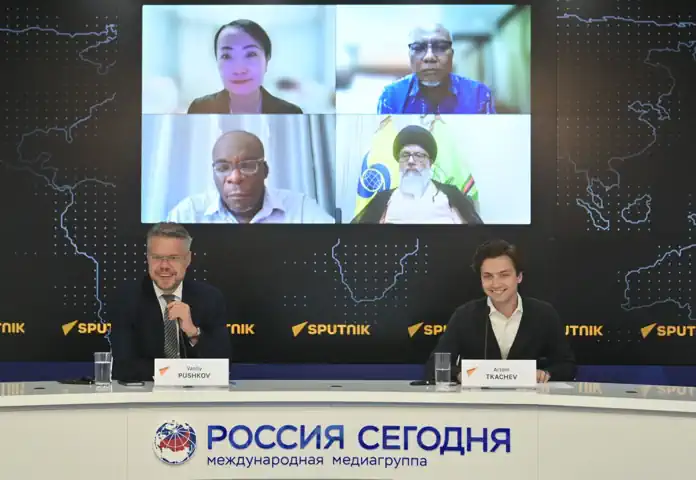
An international video conference bringing together representatives of the media community and academia from Russia, China, Indonesia, Afghanistan, Nigeria and Tanzania was held in Moscow. Participants discussed the role of SputnikPro in promoting international humanitarian and educational cooperation, as well as prospects for further interaction between countries amid the changing media landscape.
Opening the discussion, Vasily Pushkov, Director of International Cooperation at the Rossiya Segodnya Media Group, noted that one of SputnikPro’s key objectives is to break down barriers between media professionals:
“I believe that journalists, by the very nature of their profession, have a responsibility to rise above geographical and political boundaries, because the issues we deal with transcend both place and time.”
Zhong Dandan, Party Secretary of the Communication University of China, emphasized that cooperation with SputnikPro provides the university’s students with invaluable international experience:
“Today, as we find ourselves on the verge of a certain crisis in international communication, this experience is particularly valuable. China is always ready to learn from and draw on the experience accumulated by other countries — this is an essential prerequisite for successful communication.”
According to her, building strong ties between media organizations and universities is an integral part of students’ professional development.
Continuing the discussion, Choirul Anwar, Director of International Cooperation at Persada Indonesia University, said that global challenges, conflicts and climate change require a joint approach:
“International cooperation becomes more important than ever in times of crisis — we need to act together in order to successfully address most of these challenges.”
The speaker added that, given the diversity of the modern world, Indonesia has always sought to maintain dialogue.
Sayed Isa Mazari, Editor-in-Chief of the Afghan Voice Agency (AVA), noted that the ties established between the agency and the international SputnikPro project should be viewed as something greater than cooperation between media organizations alone:
“The better the people of our two countries understand one another, the more favorable the conditions will be for developing cooperation in such areas as trade, education, culture, science and technology, tourism and investment.”
Ayodele Joseph, Dean of the Faculty of Communication and Media Studies at Kaduna State University, stressed the importance of cooperation with Russia for Nigeria:
“Our relations have great potential, and Nigeria — particularly our university — has much to offer within the framework of SputnikPro.”
In his view, the project could become an important educational bridge connecting the countries and providing a platform for the exchange of knowledge, views and expertise.
Darius Mukiza, media consultant and lecturer at the University of Dar es Salaam School of Journalism and Mass Communication, said that this year the university had been given the opportunity to host a seminar under the SputnikPro program:
“More than 150 students received training, which provided a major incentive for us to continue our cooperation and begin exploring the possible integration of the project into our educational system.”
The speaker added that he highly values cooperation between the two countries and sees SputnikPro as a foundation for the further development of Russian-Tanzanian relations in the field of education.
Since 2018, SputnikPro’s in-person events have been held in dozens of countries, while its online sessions have reached a broad international audience. The total number of SputnikPro participants has exceeded 15,000.

