



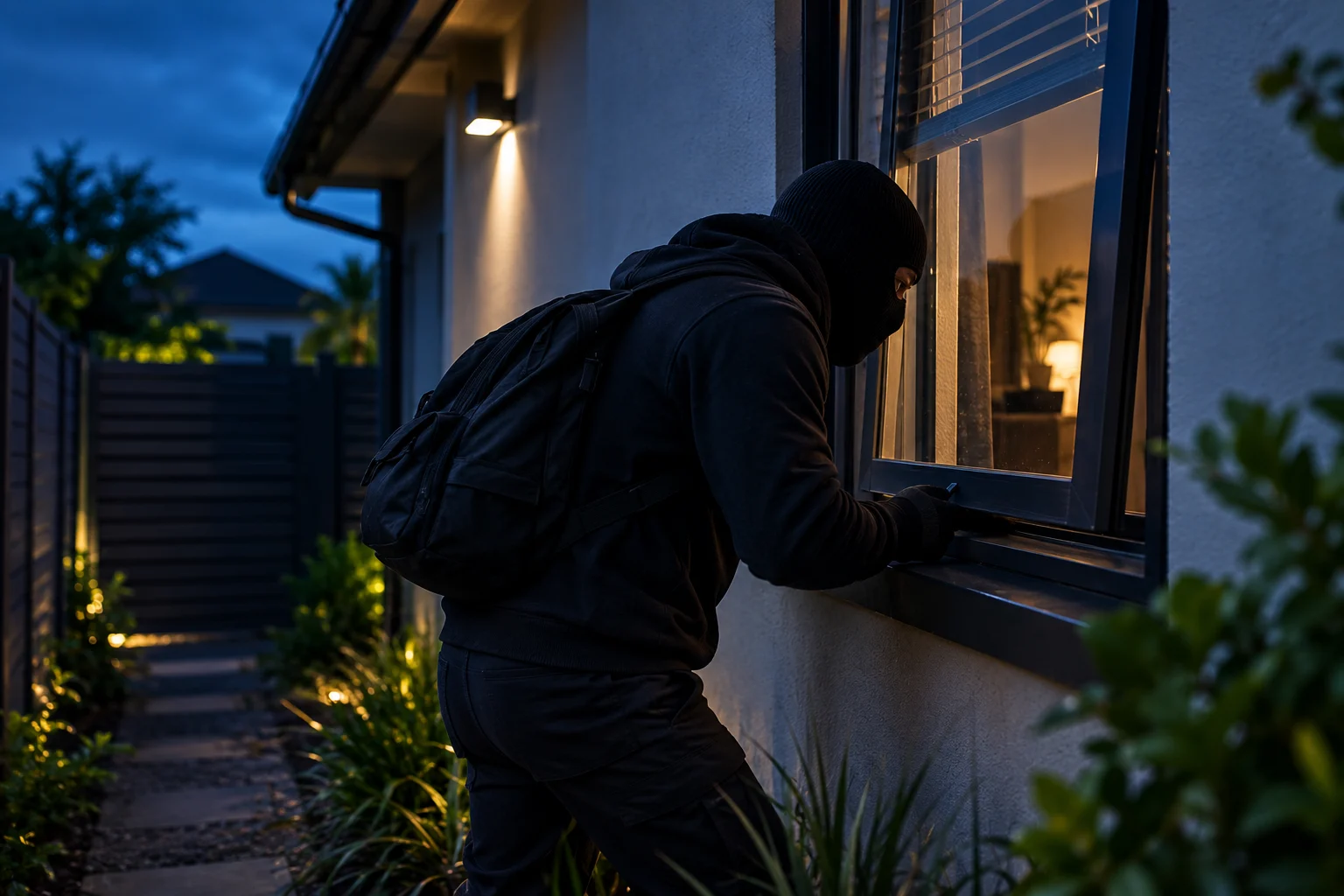
Ten minutes may not sound like long, but it can be more than enough time for a burglar to identify a vulnerable entry point, force their way into a property, locate valuables, and even interfere with the home’s security equipment. That’s why homeowners should be aware that, for burglars, the first few minutes are often all about speed, warns a leading security expert.
A Level 5 Investigator tracker report by Blue Security analysing trends in residential break-ins has found that offenders often prioritise speed and ease of access rather than trying to defeat or overcome the strongest part of a property.
Blue Security CEO Henk van Bemmelen notes that this provides a valuable insight for homeowners, as understanding how break-ins typically unfold can help identify vulnerabilities that are otherwise easy to overlook.
“People naturally think about securing the obvious points such as the front door and driveway gate, but that is not necessarily where an offender will try to enter. Instead, the report confirms that burglars will usually search for the quickest and least exposed route into the property. A rear window or back door that offers some concealment can be far more attractive than a heavily secured entrance at the front of the home,” he says.
Homeowners should therefore look at their property from the perspective of someone trying to get in quickly and leave undetected. Drawing on the investigation’s findings, van Bemmelen offers some security tips for homeowners to address weaknesses that could be exploited by criminals:
- Find the easiest way in
It is tempting to focus security attention on the front of a property, but criminals may deliberately look elsewhere. Poorly protected rear areas, concealed side routes, easily accessible windows, and entry or exit paths that allow offenders to avoid observation can all increase a property’s vulnerability. Blue Security’s investigations have repeatedly identified rear and side windows, rear doors, roller doors, front gates, and perimeter or palisade fencing as entry points.
The lesson is to assess a home from all sides and reduce the opportunities for someone to approach unseen. This may mean improving lighting in side passages and rear gardens, cutting back dense hedges or overgrown trees, strengthening gates and fences, and checking that cameras, beams or other detection measures cover areas that are hidden from the street or neighbouring properties.
“Walk around the outside of your home and look for places that could offer an intruder cover while they gain access. The harder you make it to enter unnoticed, the less tempting your home will be as a target for break-ins.”
- Test whether your physical barriers are still doing their job
Break-ins are often carried out using simple force rather than more sophisticated methods. Doors and windows may be forced, glass broken, burglar gates damaged, perimeter fences climbed, and alarm wiring cut. This makes regular checks just as important as having security measures in place in the first place.
“Locks, gates, burglar bars, and fencing can all deteriorate or become damaged over time. Homeowners should perform routine maintenance to check that these barriers are still secure, and repair or reinforce any weak points before they create an opportunity.”
- Keep portable valuables out of sight
Once inside, offenders often quickly target valuables that are easily found and easy to carry. Blue Security’s report lists laptops, cellphones, cash, radios, tools, and copper pipes among the most commonly stolen items.
To limit temptation and minimise potential losses, avoid leaving valuables in places that are clearly visible through windows or close to entry points, particularly in rooms that can be accessed quickly from outside. Where practical, store valuable electronics, keys, and other important belongings out of immediate sight.
- Protect the equipment protecting you
Another key finding by the Level 5 Investigator tracker is that offenders may deliberately target security equipment once they are inside. Digital video recorders (DVRs), alarm radios, cameras, and wiring may be removed or disabled as criminals attempt to interfere with detection or evidence.
Van Bemmelen adds that this is why the placement and protection of critical security equipment should form part of a professional installation or property security assessment, rather than being treated as an afterthought.
“Security equipment should be installed with the possibility of tampering in mind. A good assessment looks not only at whether a property has cameras, alarms, and other security measures, but also at how easily those systems could be reached during a break-in.”
Ultimately, the key takeaway is that homeowners should not think only about whether a burglar can get into a property, but how quickly they could do so.
“Those first few minutes are absolutely critical. Every obstacle that slows an offender down acts as a deterrent and gives your security measures and response network more opportunity to work” he concluded.

