
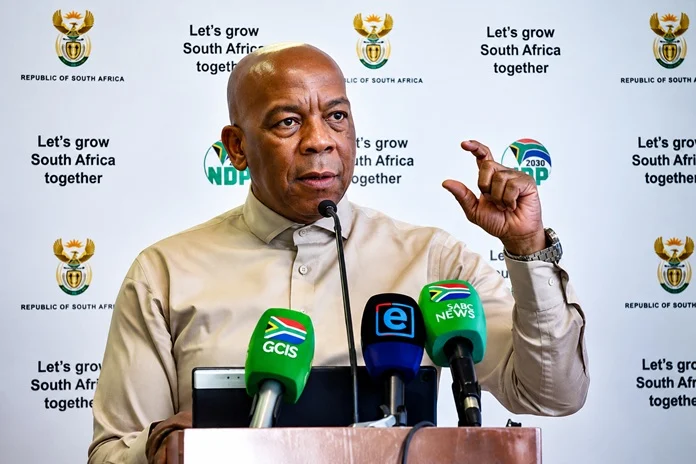
PRETORIA, Gauteng — Electricity and Energy Minister Kgosientsho Ramokgopa has officially outlined the blueprint for Eskom 2.0, confirming the end of double-digit tariff increases and a three-year contract extension for Eskom board chairperson Mteto Nyati. Speaking at a media briefing in Pretoria, Ramokgopa detailed the power utility’s transition from operational recovery to long-term financial and energy sustainability in a newly liberalized market.
The Dawn of Eskom 2.0 and the End of Bailouts
According to Ramokgopa, the era of severe load shedding is officially behind South Africa, thanks to improved generation performance and a surplus of electricity. However, the focus must now shift from simply keeping the lights on to building a commercially viable utility.
Ramokgopa defined “Eskom 2.0” as an entity operating in a liberalized environment where it is no longer a generation monopoly. With new private players entering the market, Eskom’s share of domestic demand is shrinking. Consequently, the utility must look beyond its borders and seek new energy opportunities across the African continent to support regional industrialization.
Crucially, the Minister assured consumers that the era of aggressive, double-digit tariff hikes—previously sitting at 10% to 11%—is over. While slight adjustments to electricity prices will occur, they will be significantly lower and designed to benefit South Africans.
Furthermore, Ramokgopa made it clear that there will be no more government bailouts for the power utility. He noted that the R292 billion previously deployed to support an ailing Eskom carried a massive opportunity cost, diverting funds away from refurbishing, maintaining, and building new national infrastructure.
Leadership Continuity and Strategic Priorities
To steer this new chapter, the Cabinet has extended the contract of Eskom Board Chairperson Mteto Nyati for another three years. Appointed in 2023, Nyati’s initial term was set to expire at the end of October.
Ramokgopa praised Nyati for accepting the “poison challenge” of leading Eskom during its darkest hours and successfully working with the executive team, including Group CEO Mr. Dan Marokane, to resolve the load-shedding crisis.
Nyati has committed to three core priorities for his extended tenure:
1. Driving down costs to address the affordability of electricity.
2. Positioning Eskom to benefit fairly from the new renewable energy market.
3. Providing reliable, affordable energy to help reindustrialize South Africa and the broader SADC region.
Expert Analysis: The Risks of the Transition
While the government celebrates the operational turnaround—dubbed “Eskom 1.0″—industry experts warn that the road to “Eskom 2.0” is fraught with structural and financial challenges.
Former Eskom Executive Manager and power energy expert, Prof. Vally Padayachee, praised Nyati’s reappointment for ensuring vital leadership continuity but cautioned that moving from operational recovery to long-term sustainability is not a straightforward passage. Padayachee highlighted a recent R30 billion profit reported by the utility but identified several critical risks that could derail permanent recovery.
The Achilles Heel: Municipal Debt
Padayachee identified the municipal debt crisis as Eskom’s primary financial vulnerability. Municipalities currently owe Eskom over R111 billion, a figure that represents almost 50% of the utility’s bottom line.
Padayachee explained that this debt is an “Achilles heel” impacting both Eskom and the national fiscus. He noted that municipalities are not merely delinquent; they are facing severe socio-economic challenges, including significant job losses and economic downturns. Furthermore, many municipalities act as virtual resellers, with 60% to 90% of their operating budgets consumed by the cost of purchasing electricity from Eskom, a burden exacerbated by Eskom’s historically skyrocketing prices.
Technological Leaps and Execution Fatigue
Beyond the balance sheet, Padayachee outlined critical operational and strategic risks. Technologically, Eskom must successfully integrate Artificial Intelligence (AI) for grid management and technical loss reduction. This must be done while simultaneously managing the complex transition of its coal fleet, balancing strict emissions targets with the need for reliable baseload power.
Strategically, Padayachee warned of “execution fatigue.” The board is tasked with a massive, multi-year roadmap that includes building a credible renewable energy pipeline, expanding cross-border trade, and fixing procurement inefficiencies.
“You have to be careful that execution fatigue, stress, unreasonable stress, depression, and burnout don’t prevail among the top leadership and the foot soldiers,” Padayachee advised, noting the intense pressure required to maintain a high-performance culture in such a complex business environment.
Navigating the Just Energy Transition
Addressing the tension between energy security and the shift to cleaner power, Padayachee established a clear hierarchy for South Africa’s energy future: energy security is the first priority, financial affordability is second, and the “just transition” is third.
He noted that Eskom has strategically decoupled its energy transition from the immediate decommissioning of its coal fleet. By keeping the coal fleet operational while carefully managing emission levels to comply with net-zero targets, Eskom aims to ensure a balanced just energy transition that protects jobs and communities while moving toward a low-carbon economy.
Ultimately, while the absence of load shedding marks a monumental victory, the true test of Eskom 2.0 will be its ability to transform into a modern, disciplined, and commercially viable utility that no longer relies on the taxpayer as a crutch.