



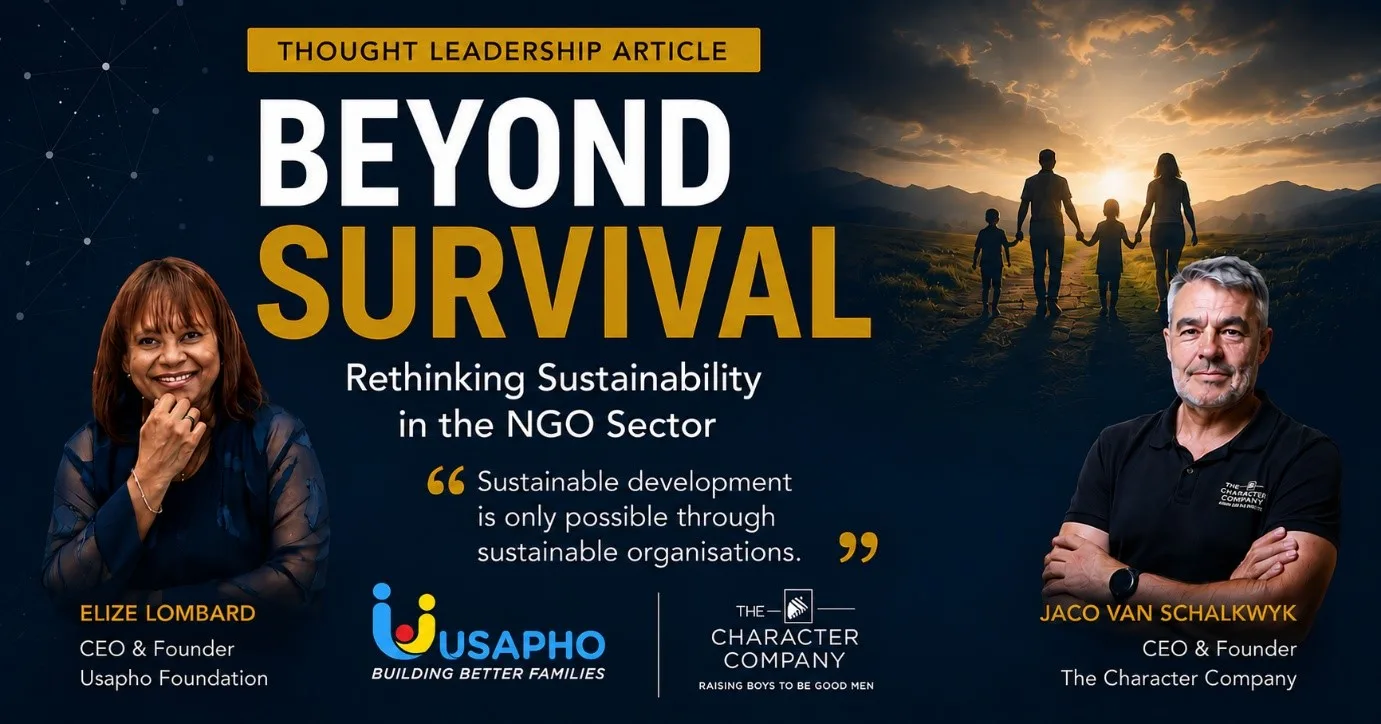
A thought leadership article by Elize Lombard (CEO & Founder| USAPHO Foundation) and
Jaco van Schalkwyk (CEO & Founder | The Character Company)
Sustainable development is only possible through sustainable organisations.
Beyond the Next Funding Cycle
A few years ago, we found ourselves standing at a crossroads that many nonprofit leaders will recognise.
A significant funding partner wanted to continue investing in a programme that was changing lives. On paper, everything looked promising. The relationship had been established, the funding was substantial, and the programme had gained momentum.
Then came the condition.
The programme had to be delivered according to a model that we believed would ultimately create dependency rather than long-term sustainability. We presented alternatives. We shared evidence. We proposed approaches that would strengthen communities instead of deepening their reliance on external support.
The response was simple.
Accept the model, or lose the funding.
It was one of the most difficult decisions we have faced.
Like many NGOs, we had already invested months building the relationship. Walking away meant losing significant funding, ending a promising initiative, and returning to the drawing board to find ways of serving our beneficiaries with resources we simply did not have.
Yet we walked away.
Not because we did not need the funding.
But because we believed that compromising our mission would ultimately cost our communities far more than losing a grant.
Looking back, that decision shaped our understanding of sustainability more than any conference, strategy session or research paper ever could.
It taught us that sustainability is not measured by how much funding flows through an organisation.
It is measured by whether the people and communities we serve become stronger, healthier and more resilient because of our work.
That experience also exposed a difficult truth.
Sometimes the greatest threat to sustainability is not a lack of funding. It is accepting funding that pulls us away from the very purpose we exist to fulfil.
That lesson continues to shape how we think about leadership, partnerships and the future of the NGO sector.
We Have a Sustainability Problem…
But Not the One Most People Think
Mention sustainability in almost any NGO boardroom and the conversation quickly turns to funding.
Where will the next grant come from?
How do we diversify our income?
How do we keep the doors open?
These are valid questions.
Without resources, no organisation can fulfil its mission.
Yet after decades of combined experience working alongside families, communities, NGOs, funders and government partners, we have become convinced that the sector is asking the wrong first question.
Funding is important but it has never been the foundation of sustainability.
Leadership is.
Strategy is.
Healthy governance is.
Accountability is.
Trust is.
Relationships are.
Funding supports sustainability, but it does not create it.
When organisations place funding at the centre of every conversation, they unintentionally reduce sustainability to a financial exercise. In reality sustainability is far broader. It is the ability of an organisation to remain healthy, relevant and effective regardless of changes in leadership, funding environments or external circumstances.
Some of the best-funded organisations struggle to create lasting impact.
Some of the smallest organisations quietly transform communities for decades.
The difference is rarely found in their bank accounts.
More often, it is found in the strength of their leadership, the clarity of their strategy, the health of their organisational culture and the quality of their relationships.
Sustainability, before anything else, is a leadership discipline.
Beyond Funding
One of the greatest misconceptions in the nonprofit sector is that sustainability belongs to the CEO.
It doesn’t.
Sustainability belongs to everyone.
It belongs to boards that govern wisely.
It belongs to leaders who make courageous decisions.
It belongs to staff who embrace continuous learning.
It belongs to volunteers who strengthen community ownership.
It belongs to funders who invest beyond projects.
It belongs to communities who become active partners rather than passive recipients.
When sustainability becomes everyone’s responsibility, organisations become stronger.
When it rests on one person’s shoulders, organisations become vulnerable.
This is particularly important in family-strengthening work.
Strong families are not built through one intervention.
Healthy communities are not transformed through one funding cycle.
Changing lives is rarely linear.
It is relational.
It is developmental.
It takes patience.
It requires leaders who are prepared to think beyond quarterly reports and annual funding cycles.
A New World Requires New Thinking
Over the past few years, many leadership thinkers have begun describing our world using a new framework: BANI.
Unlike the older VUCA model, which described a world that was volatile, uncertain, complex and ambiguous, BANI describes a reality that is increasingly:
Brittle
Anxious
Non-linear
Incomprehensible
For those working in the NGO sector, this language feels uncomfortably familiar.
Many organisations appear stable until one major donor withdraws.
One key leader resigns.
One crisis exposes weaknesses that had quietly accumulated over time.
That is brittleness.
Leaders, staff, caregivers, volunteers, communities and funders are carrying unprecedented levels of emotional pressure.
Burnout has become normal.
Uncertainty has become constant.
That is anxiety.
Small events increasingly create enormous consequences.
A delayed payment affects salaries.
A staffing change disrupts programmes.
A policy shift reshapes entire funding landscapes.
That is non-linearity.
At the same time, the challenges facing our communities continue to grow more interconnected.
Poverty influences education.
Education influences employment.
Employment influences family wellbeing.
Family wellbeing influences mental health.
Mental health influences community safety.
No single organisation can solve these challenges alone.
No single intervention explains them fully.
That is incomprehensibility.
The conclusion is unavoidable.
If the world has changed…
Our understanding of sustainability must change with it.
Funding alone cannot build organisations capable of navigating a BANI world.
Resilient leadership can.
Healthy governance can.
Strong partnerships can.
Adaptive strategy can.
Communities that are empowered rather than dependent can.
The organisations that will thrive in the coming decade will not necessarily be those with the largest budgets.
They will be those that are most willing to learn, adapt, collaborate and lead with courage.
Accountability: The Missing Ingredient
If there is one conversation the NGO sector has avoided for too long, it is accountability.
Not accountability to donors.
Not accountability to compliance.
Accountability to one another.
Across the world, it has become relatively easy to establish an NGO. That is something to celebrate. Communities need people willing to respond to local challenges with courage and compassion.
But starting an organisation and sustaining an organisation are two very different things.
Too often, we confuse activity with impact.
We celebrate the number of workshops delivered, meals distributed, beneficiaries reached or reports submitted, while giving far less attention to a more important question:
Are we building organisations that will still be creating meaningful impact ten or twenty years from now?
Sustainability demands a level of humility that can be uncomfortable.
It requires leaders to ask difficult questions.
Where are our blind spots?
What risks are we ignoring?
Who has permission to challenge our thinking?
When was the last time someone outside our organisation questioned our assumptions?
These are not signs of weak leadership.
They are signs of mature leadership.
The healthiest organisations we have encountered are not those that have all the answers.
They are the ones willing to keep asking better questions.
Mentorship, peer learning and honest accountability should not be viewed as signs that something is wrong.
They are essential ingredients of organisations committed to continuous growth.
Perhaps the future of sustainability depends less on protecting our reputations and more on creating environments where leaders can learn from one another without fear.
Collaboration Is No Longer Optional
One of the greatest paradoxes in the nonprofit sector is this:
We all speak about collaboration.
Yet many organisations continue to operate in isolation.
We compete for funding.
We protect relationships.
We guard information.
We duplicate programmes.
We solve the same problems independently.
Meanwhile, the communities we serve continue to face increasingly complex challenges.
No single organisation can address poverty on its own.
No organisation can strengthen families in isolation.
No NGO can improve education, mental health, employment, gender equality or community wellbeing without partnerships.
The Sustainable Development Goals themselves recognise this reality.
The final goal, Partnerships for the Goals (SDG 17), reminds us that lasting change depends on collaboration across sectors, organisations and communities.
Perhaps collaboration should no longer be viewed as an optional strategy.
Perhaps it is the strategy.
When organisations move from competition to collaboration, something remarkable happens.
Resources are multiplied.
Knowledge is shared.
Innovation accelerates.
Communities receive more integrated support.
And organisations become stronger together than they could ever become alone.
The question is no longer whether we can afford to collaborate.
The question is whether we can afford not to.
Are We Building Independence… or Dependency?
This is perhaps the most uncomfortable question we have had to ask ourselves throughout our own leadership journeys.
Are we helping people…
Or are we unintentionally creating dependence?
Every organisation begins with a desire to help.
To feed.
To teach.
To mentor.
To protect.
To restore.
These are worthy goals.
But if our work leaves individuals, families or communities more dependent on our organisation than they were before, then we have to pause and ask whether we are creating the future we hoped for.
Sustainable impact is not measured by how many people need us.
It is measured by how many people no longer need us in the same way because they have developed the confidence, capacity and resilience to move forward.
The same principle applies to organisations.
An NGO that depends entirely on a single donor is vulnerable.
A community that depends entirely on a single NGO is vulnerable.
A sector that depends on short-term thinking is vulnerable.
Sustainability is about building resilience at every level.
It is about creating pathways towards ownership rather than dependence.
That journey is rarely easy.
But it is always worthwhile.
Family Transformation Cannot Be Measured in Twelve Months
Much of our combined work has centred on strengthening families, developing young people and building healthier communities.
If there is one lesson these experiences have taught us, it is this:
Transformation does not follow funding cycles.
Healing trauma takes time.
Restoring trust takes time.
Developing healthy parenting practices takes time.
Breaking cycles of absent fatherhood takes time.
Changing generational patterns takes time.
Some of the most significant outcomes cannot be fully measured within a twelve-month reporting period.
They unfold over years.
Sometimes over decades.
Yet funding structures often reward what is easiest to count rather than what matters most.
Outputs are important.
They provide evidence of activity.
But outputs alone do not tell us whether lives are changing.
They do not tell us whether children are growing into resilient adults.
They do not tell us whether families are becoming stronger.
They do not tell us whether communities are becoming healthier.
As organisations, we have a responsibility to measure what matters.
As funders, there is an opportunity to recognise that meaningful human development often requires longer horizons, greater trust and deeper partnerships.
The greatest returns on investment are not always the quickest to appear.
A Challenge to Funders
This article is not a criticism of funders.
On the contrary.
Without committed funding partners, countless organisations would never have the opportunity to serve their communities.
Many funders are already asking difficult questions about how they can create deeper, more sustainable impact.
We applaud that.
At the same time, we believe the conversation needs to evolve.
If sustainable development is the goal, then sustainable organisations must become part of the investment strategy.
Projects matter.
But organisations deliver projects.
Healthy organisations sustain them.
That means investing not only in programme delivery, but also in leadership development, governance, organisational culture, staff wellbeing, monitoring and evaluation, succession planning and strategic capacity.
These are often described as “overheads.”
We believe they are better understood as investments in impact.
Because without healthy organisations, even the most generously funded projects will eventually reach their limits.
The strongest funding relationships we have experienced have never been purely transactional.
They have been partnerships built on trust.
Relationships where difficult conversations were welcomed.
Where learning mattered as much as reporting.
Where organisations were encouraged to innovate rather than simply comply.
Where long-term outcomes carried as much weight as short-term outputs.
That kind of partnership changes organisations.
More importantly, it changes communities.
Beyond the Organisation
Ultimately, the sustainability conversation is not really about NGOs.
It is about people.
It is about children growing up in safe and nurturing families.
It is about parents who have the confidence and support to raise resilient young people.
It is about communities that are healthier, stronger and more connected than they were before.
Around the world, NGOs play a critical role in advancing many of the United Nations Sustainable Development Goals (SDGs). Whether supporting healthier families (SDG 3: Good Health and Well-being), promoting gender equality (SDG 5), reducing inequalities (SDG 10), strengthening sustainable communities (SDG 11), contributing to peaceful and inclusive societies (SDG 16), or building partnerships for the goals (SDG 17), NGOs often work closest to the realities these global goals seek to address.
Yet there is a truth that deserves greater attention.
Sustainable Development Goals require sustainable organisations.
If organisations disappear because leadership burns out, governance is weak, partnerships fail, or funding models prove unsustainable, communities lose far more than programmes.
They lose trusted relationships.
They lose accumulated wisdom.
They lose years of credibility.
Most importantly, they lose momentum.
For many communities, NGOs are not simply service providers.
They are trusted companions on a journey of transformation.
That is why sustainability matters.
Not because organisations need to survive for their own sake.
But because communities deserve organisations capable of walking alongside them for as long as meaningful change requires.
Beyond Survival
Despite the challenges facing our sector, we remain deeply hopeful.
We see organisations becoming increasingly willing to collaborate rather than compete.
We see funders beginning to recognise the importance of investing in organisational health alongside programme delivery.
We see boards asking better questions.
We see leaders becoming more intentional about succession planning, governance, staff wellbeing and strategic thinking.
Most encouraging of all, we see communities stepping into greater ownership of their own development.
These are not isolated successes.
They are signs that the sustainability conversation is evolving.
Perhaps the future of the NGO sector will not be defined by those organisations with the largest budgets.
Perhaps it will be defined by those with the healthiest leadership, the clearest purpose, the strongest partnerships and the courage to keep learning.
Perhaps sustainability has never really been about funding.
Perhaps it has always been about stewardship.
Stewardship of people.
Stewardship of relationships.
Stewardship of resources.
Stewardship of trust.
Stewardship of the opportunity we have been given to create lasting impact.
Instead of asking,
“How do we sustain our organisation?”
Perhaps the better question is,
“How do we build organisations capable of sustaining transformation?”
Because when we answer that question well, funding becomes an enabler rather than the destination.
Leadership becomes a responsibility rather than a position.
Communities become partners rather than beneficiaries.
And sustainability becomes more than a strategy.
It becomes a legacy.
An Invitation
We have not written this article as observers of the NGO sector.
We have written it as practitioners.
Between us, we have spent decades walking alongside families, communities, NGO leaders, boards, volunteers, funders and government partners. We have celebrated moments of remarkable transformation and experienced seasons of deep uncertainty. We have navigated funding challenges, difficult leadership decisions, governance complexities and the constant tension between immediate needs and long-term impact.
Some of our greatest lessons came through success.
Others came at a much greater cost.
We have experienced what it feels like to invest months, even years, into partnerships that ultimately proved unsustainable. We have wrestled with decisions that meant choosing long-term impact over short-term security. We have discovered that building sustainable organisations is rarely about finding easy answers. It is about asking better questions, making courageous decisions and remaining faithful to the mission, even when the path is difficult.
Those experiences have shaped us.
Today, we are passionate about helping other impact organisations and funding partners navigate that journey with greater confidence.
Not because we have all the answers.
But because we have travelled this uneven road ourselves.
If our experience can help strengthen your leadership, sharpen your strategy, build healthier organisations, improve partnerships or shorten your learning curve, we would be honoured to walk alongside you.
Through our Sustainable Impact strategic advisory practice, we partner with NGO leaders, boards and funders to strengthen organisational health, build sustainable strategies and create the conditions for lasting impact.
Whether you are leading an established organisation, building a new initiative, serving on a governing board, or investing in social impact as a funding partner, we invite you to begin the conversation with us.
Because sustainable communities can only be built through sustainable organisations.
And sustainable organisations are built by courageous leaders who are willing to think beyond survival.
We would love to walk that journey with you.
Author’s Note
This article reflects our combined experience, research and perspectives developed over many years of working alongside NGOs, families, communities, boards and funding partners.
To support the drafting, structuring and editorial refinement of this manuscript, we used generative artificial intelligence as a writing partner. Every idea, opinion, conclusion and final editorial decision remains our own.
Connect With Us
Elize Lombard
CEO & Founder USAPHO Foundation
Cell +27 83 601 1159
E-mail – [email protected]
Jaco van Schalkwyk
CEO & Founder | The Character Company
Cell +27 63 624 6108
E-mail – [email protected]

