



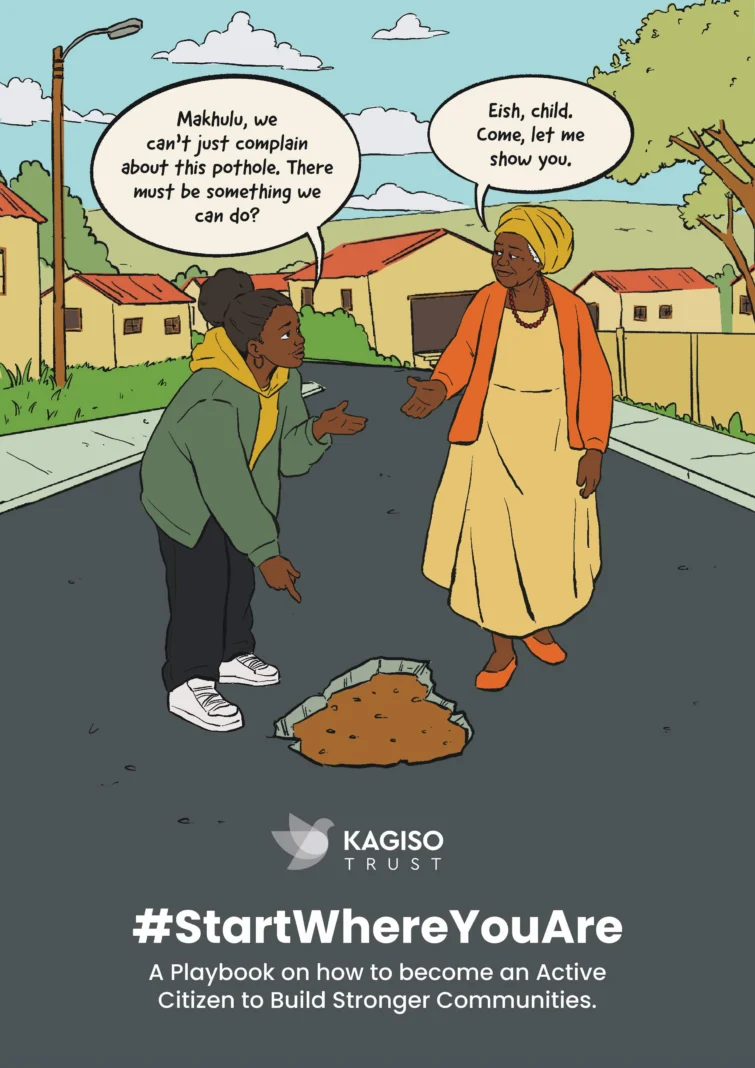
New comic-format playbook shows ordinary South Africans exactly how to engage with local government on issues that matter
Key points
- Kagiso Trust launches the #StartWhereYouAre Playbook today, 30 September 2026, as the anchor tool of its nationwide #StartWhereYouAre active citizenship and voter education campaign leading up to the 2026 local government elections.
- Active citizenship is everyday work, before, during and after elections. The practical guide shows South Africans how to move from wanting to participate to knowing exactly what they can do.
- The playbook uses a comic-strip format with relatable characters and everyday scenarios to demonstrate the citizen action cycle: Notice → Understand → Report → Organise → Follow up.
- The playbook release is part of a multi-channel #StartWhereYouAre rollout featuring a national radio campaign and community voter education.
- Distribution of printed copies of the playbook will be led by Kagiso Trust’s Civil Society Support Programme teams across the country.
Civic organisations continually tell South Africans that participation matters. Voting is important. Communities should be engaged. Local government works better when citizens are organised.
But there has been a missing piece: a practical answer to the question that arises. “I want to get involved. But where do I start?”
Kagiso Trust is answering that question with the launch today of the #StartWhereYouAre Playbook, a practical, accessible guide that transforms active citizenship into everyday actions.
The release forms part of Kagiso Trust’s wider #StartWhereYouAre campaign, an extensive civic and voter education drive designed to energise and mobilise communities ahead of the 4 November local government elections.
“We have put a lot of effort into telling people that they should participate in democracy,” says Dean Zwoitwaho Nevhutalu, Chairperson of the Kagiso Trust Board of Trustees. “The playbook answers the next question, and the answer is simple: Start where you are.”
Making active citizenship visible and accessible
The playbook is presented in comic-strip format, using relatable characters and real community scenarios to show how active citizenship works in practice. It demonstrates the citizen action cycle that applies to everyday issues like a pothole that needs fixing, water supply problems, waste management, electricity failures, housing concerns and road safety.
Readers are guided through five practical steps:
- Notice: Identify an issue in your community that needs to change.
- Understand: Research what’s happening and who is responsible for fixing it.
- Report: Document the problem and report it to the right people.
- Organise: Work with neighbours to amplify the message and create collective pressure.
- Follow up: Keep monitoring until the issue is resolved and hold officials accountable.
“The playbook is not about voting logistics or electoral procedures,” says Nevhutalu. “It is about showing citizens how to engage with local government on practical issues that affect their daily lives, and how to do that whether it is before, during or after an election.”
Multi-platform campaign activation
To ensure the guide reaches communities across all nine provinces, the playbook is backed by a dynamic multi-channel rollout under the broader #StartWhereYouAre campaign banner.
This includes a planned national radio programme encouraging South Africans to vote and showing them how to take practical action where they live, alongside face-to-face community mobilisation. As part of the voter education drive, Kagiso Trust’s Civil Society Support Programme (CSSP) team will engage communities across the country and distribute printed copies of the #StartWhereYouAre Playbook.
“The team will hold interactive workshops with residents, youth formations, faith-based groups and local civic forums,” says Nevhutalu. “We want to ensure that citizens who lack regular digital access are equipped with tangible, reusable tools to organise and hold local government to account.”
A guide for every stage of the election cycle
The playbook structures active citizenship around the election cycle, recognising that citizen engagement looks different at different moments:
- Before election day: Check your voter registration is current. Understand how local government works and what it is responsible for. Research candidates and their track records. Identify a local issue that matters to you.
- Around election day: Ask candidates tough questions about their plans. Understand what they are promising. Make an informed choice based on evidence, not emotion or party loyalty.
- On election day: Vote with information and purpose, knowing exactly why you are making the choice you are making.
- After election day: This is where real active citizenship happens. Attend council meetings. Monitor whether elected representatives are keeping their promises. Document progress. Follow up on issues you reported. Hold leaders accountable.
“Voting is important, but it’s just one moment. Active citizenship is everyday work,” says Nevhutalu. “The playbook shows that the real power lies in what happens before and after election day. That’s when communities need to be organised, engaged, and holding their representatives accountable.”
No permission required
A central principle running through the playbook is that you do not need permission to participate in democracy. You do not need to be an expert or wait for an invitation. Ordinary people can act on issues affecting their communities.
“One person noticing a problem and talking to their neighbour is how change starts,” says Nevhutalu. “The playbook shows that you do not need to be a politician or an activist to make a difference. You just need to start where you are.”
The #StartWhereYouAre playbook is available here on the Kagiso Trust website, and printed copies will be distributed nationwide through CSSP community voter education activations and regional civil society networks.

