



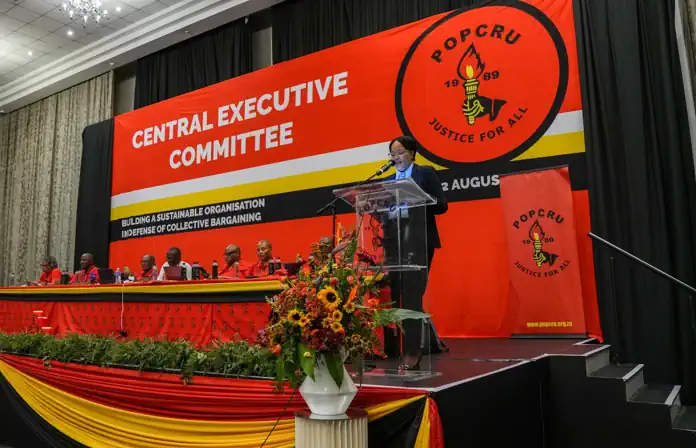
The Police and Prisons Civil Rights Union (POPCRU) has called for the immediate implementation of the agreed two-stream promotion system within the South African Police Service (SAPS), after Acting National Commissioner Lieutenant General Puleng Dimpane provided an update on the process at the union’s Central Executive Committee (CEC).
Dimpane told delegates last week that SAPS is reviewing its promotion policy in consultation with organised labour, with POPCRU playing a central role. The agreed two-stream approach is intended to allow support and administrative employees to progress within their professional fields, rather than having to move into the operational SAPS Act structure simply to advance their careers.
Dimpane noted that SAPS expects to conclude the consultation process by the end of the 2026/2027 financial year. POPCRU, however, says implementation of the two-stream system must begin before the end of the financial year as a starting point, rather than members being required to wait any longer for meaningful career progression.
POPCRU President Thulani Ngwenya says members now need firm answers on the remaining steps towards implementation, the timelines involved, and how the eventual structure will operate. He demands direct engagement with POPCRU on the decisions that will shape its members’ career progression.
“Our members cannot keep being told that their careers are still ‘under consideration’ while years pass and promotion opportunities remain blocked. SAPS must implement the two-stream system as agreed and begin doing so before the end of this financial year, finally giving experienced non-operational staff a real route to move forward in their careers.”
Dimpane also confirmed during the meeting that approximately 9,076 of the most senior qualifying Police Act members with 10 or more years in rank are being prioritised for progression during the 2026/27 financial year, subject to available funding. Those members are expected to progress from constable to sergeant, from sergeant to warrant officer, and from Warrant Officer Band B1 to B2 effective 1 October 2026.
POPCRU welcomes movement for these long-serving members but says the scale of the intervention also exposes how deeply career stagnation has taken root inside SAPS. The union has repeatedly raised cases of members who have given decades of service and are approaching retirement while still holding the rank of warrant officer.
“The planned progression of these members must form part of a much bigger correction to the promotion system, rather than becoming another once-off intervention that leaves the same structural blockages in place,” notes Ngwenya.
POPCRU’s long fight for meaningful promotion reform continues
Promotion reform remains an important issue for POPCRU, with the union repeatedly raising career stagnation and unequal access to advancement within SAPS. One of POPCRU’s biggest concerns has been the artificial ceiling placed on support and administrative employees appointed under the Public Service Act. These members are effectively capped at salary level 7, while operational SAPS members can progress much higher.
For support employees to move beyond that ceiling, they have historically had to leave their professional stream and enter the SAPS Act structure simply to advance. Ngwenya says this has left qualified accountants, human resources professionals, forensic analysts, administrators, and other specialists trapped below senior management positions in the very fields where they have built their qualifications, skills, and experience.
Ngwenya says the timeframe mentioned by Dimpane must now translate into implementation, with the first steps taken before the end of the current financial year rather than the process being allowed to drag on further.
“We must break the promotion deadlock in SAPS stunting our members’ careers, so the agreed two-stream system must now be implemented, with clear opportunities and firm timelines. Our members have waited long enough for this process to begin moving their careers forward,” he concludes.

