



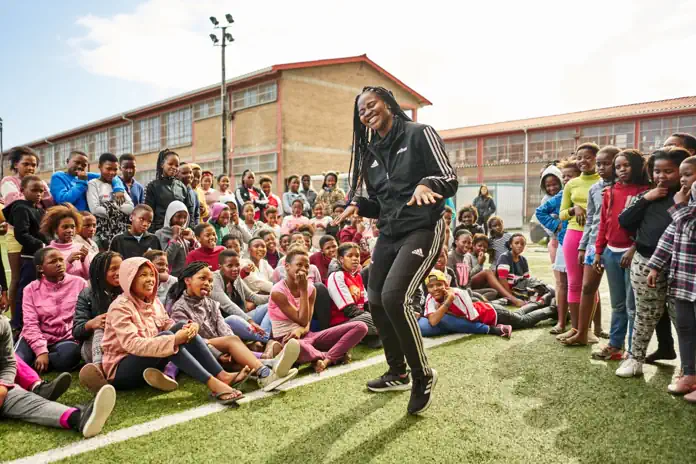
Girls and young women in South Africa continue to face barriers that can limit their access to sport, education and economic opportunities. Safe-Hub is working within communities to close the gender gap – creating safe, inclusive spaces where girls can participate, develop and lead.
Johannesburg, 19 August 2026: According to Stats SA, young women and girls consistently face a higher risk of disengagement, compared to their male counterparts. In the first quarter of 2026, 39,2% were not in employment, education or training (NEET), a 1.7% increase year on year. During the same period, the NEET rate for young men dropped by 0.7% to 36.0%.
There was a time when Siphokazi looked on track to becoming one of those young women. She had failed Matric, fallen pregnant and didn’t have employment. But the young woman who grew up in Khayelitsha in Cape Town was determined to break the cycle. She went on to complete an NQF Level 4 Sports Administration qualification, as well as a South African Football Association (SAFA) Level 4 refereeing qualification and now refs for SAFA nationwide. “I did not want my children to grow up like I did,” she says. “I wanted them to have dreams and opportunities.”
Taking charge of her destiny
It was that determination that led Siphokazi to Safe-Hub, a holistic model that aims to transform underserved neighbourhoods by giving young people safe access to personal development within their communities.
It was through Safe-Hub that Siphokazi joined a football team and became a coach. “They strengthened and inspired me to teach other kids in the community not to make the same mistakes I did,” she says. “It encouraged me to be a good role model.” Subsequently, Siphokazi has been with Safe-Hub for 14 years and has worked her way from a coach on the pitch to working for the support office in a national role as National Product Coordinator for after-school programmes across 16 Safe-Hubs. Through her work, she has enabled thousands of young people to take control of their futures like she did and contributed to AMANDLA Social Enterprises, parent organisation of Safe-Hub, being awarded Recreation Body of the Year’ at the 2024 South African Sport Awards.
Beyond recreation, sport allows Safe-Hub participants to learn discipline, commitment, leadership, and the ability to work in a team. Boys and girls enjoy these opportunities equally, as well as life-skills, academic and health support, and psychosocial support services.
“Sport is not always experienced as an equally accessible space. Boys may receive greater access to playing facilities, equipment, coaching attention and competitive opportunities. Girls may also encounter stereotypes suggesting that certain sports are not appropriate for them,” says Florian Zech, Founder of Safe-Hub.
“As girls enter adolescence, participation may be affected by concerns about body image, menstruation, clothing, privacy, safety and the availability of suitable facilities,” says Zech. “Intentional facilitation is important to ensure that girls are not marginalised, intimidated or given fewer opportunities to participate and lead.”
Gendered challenges
The communities in which Safe-Hub operates (there are now 16 sites across South Africa, in addition to four internationally), face numerous challenges that impact young women and girls.
Gender-based violence is a national disaster in South Africa, limiting access to public spaces, transport and movement, especially after dark. “Safety is therefore not only a protection issue; it can determine access to sport, education, social networks and development and career opportunities,” says Zech.
Girls are often disproportionately expected to help around the home, leaving them with less time for studies, sport and personal development. “This may include caring for younger siblings, preparing meals, cleaning and assisting elderly or unwell family members,” says Zech. “When a young woman must choose between school, informal work, household responsibilities and programme participation, development activities may become difficult to sustain.”
With limited access to quality care, girls may experience both physical and mental health challenges, particularly in adolescence. Furthermore, entrenched gender stereotypes often shape what girls believe they are allowed or expected to do. “A lack of visible women coaches, facilitators and leaders can reinforce these messages,” says Zech.
Space for girls to thrive
By working with members of the community and forming long-term partnerships with like-minded businesses and organisations (including adidas Foundation, Bundesliga and Discovery Pink Drive), Safe-Hub has developed a model that addresses these challenges.
“Through its after-school programme, Safe-Hub provides structured community spaces where girls participate in sport, learning and personal-development activities,” says Zech. “These activities give girls opportunities to be physically active, build friendships, practise teamwork, develop confidence and experience a sense of belonging.”
However, Zech notes that access to an activity does not automatically make it inclusive. With this in mind, Safe-Hub intentionally prioritises inclusivity. Meanwhile, women leaders become role models, showing girls what’s possible; 61% of Safe-Hub staff working directly with children and young people are women.
Safe-Hub’s solution is constantly evolving. “One emerging area is helping to create safer and more inclusive environments through curriculum activities that encourage participants to examine identity, discrimination, harmful stereotypes, social expectations and how people present themselves,” says Zech.
Rewriting the statistics
As South Africa grapples with gender disparity in the workplace, stats out of Safe-Hub look remarkably different, indicating that change is possible with the right model.
Sixty-one percent of Safe-Hub employees are women, including 55% of its management and 47% of its senior leadership. Fifty-four percent of Safe-Hub sites and 52% of its programmes are led by women. Inclusive workplace policy includes paid menstrual leave days or the flexibility to work from home.
In 2025, 48% of registered Safe-Hub participants were women and girls. In 2026, women make up 64% of the young people registered for Safe-Hub’s Youth Café programme and 60% of the young entrepreneurs registered in its ILED programme.
Painting an encouraging picture for the next generation, girls make up 51% of Safe-Hub’s early childhood development programme.
Safe-Hub alumnae like Siphokazi are proof that when young women and girls succeed, they share their success with others around them. That’s how you uplift a community. “I’m where I am today because they saw potential in me,” says Siphokazi. “I also know the story doesn’t end with me. We are working together to change the future.”
About Safe-Hub:
Safe-Hub is an established, international social enterprise that works with local partners to create safe, inclusive spaces where young people from under-resourced communities can access the care, resources and opportunities they need to thrive. Through holistic, multi-purpose hubs, Safe-Hub supports young people across their full development journey – from early childhood through to economic participation. Its award-winning sustainability model, developed by AMANDLA Social Enterprises, is rooted in catalysing communities to support themselves by building local leadership, skills and systems that enable long-term impact and local economic development. Safe-Hub is committed to taking collective action to overcome global inequality.
Safe-Hub is currently active in South Africa, Germany, the United States, India and Côte d’Ivoire.
Visit: https://safe-hub.org/
Facebook: Safe-Hub Global
Instagram: safe_hub_global
Press Contact:
Mantis Communications
Kerry Simpson
Tel: 079 438 3252
Email: [email protected]

