



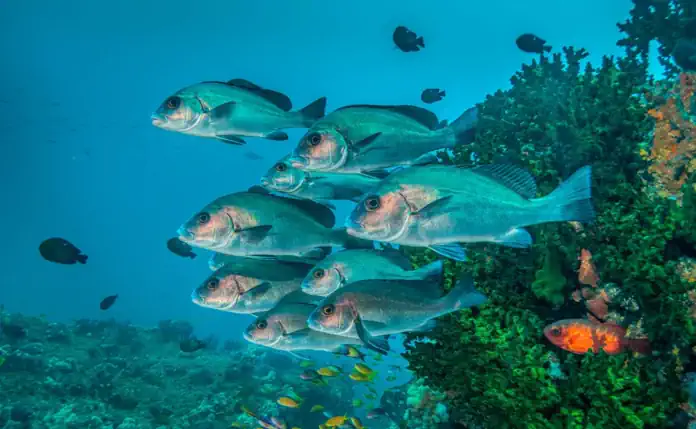
As the world prepares to celebrate MPA (Marine Protected Areas) Day on 1 August, attention is once again turning to one of the most ambitious conservation commitments ever made: the Global Goal to protect 30% of the world’s land, freshwater, and ocean by 2030.
“MPA Day has always been about helping people understand why Marine Protected Areas matter,” said Dr Judy Mann-Lang, from the Two Oceans Aquarium and Founder of MPA Day. “With only four years remaining to achieve the 30×30 target, it’s encouraging to see the growing momentum around ocean conservation. At the recent Our Ocean Conference hosted in Kenya, we saw stakeholders from governments, communities, conservation organisations and others coming together in unprecedented ways to support ocean protection.”
Dr Mann-Lang says that while the countdown to 30×30 is important, what is more important is that these protected areas become more than lines on a map. They need active protection. And this can only be achieved with the involvement of local communities.
“The good news is that we know what works. MPAs have repeatedly demonstrated their value for biodiversity, fisheries, tourism, climate resilience, and coastal livelihoods. Now we need to accelerate action and continue building support for these important ocean spaces at all levels,” she said.
What Is the 30×30 Goal?
The United Nations General Assembly proclaimed 2021-2030 to be the UN Ocean Decade of Ocean Science for Sustainable Development (‘Ocean Decade’). Adding strength to this, the 30×30 Global Goal, also known as Target 3 of the Kunming-Montreal Global Biodiversity Framework, was adopted by nearly 200 countries with the aim of safeguarding biodiversity and building resilience to climate change to secure a healthier future for every living being.
It calls for the effective conservation and management of 30% of the world’s land, 30% of inland waters, and 30% of marine and coastal areas by the year 2030.
Research indicates that almost 10% of the global ocean is currently designated as protected; however, only around 3.3% of the ocean is considered effectively protected through strong implementation and management measures. More than 26% of the ocean still needs meaningful protection to reach the global target.
Notable Achievements
Despite the scale of the challenge, the last few years have seen remarkable progress in ocean conservation. These include:
- High Seas Treaty Established
In January 2026, the High Seas Treaty officially entered into force, creating the first legal mechanism to establish MPAs in international waters beyond national jurisdiction. For the first time, countries now have a framework to create protected areas across these vast ocean spaces. This is particularly significant because:
- The High Seas cover nearly 50% of the planet.
- More than two-thirds of the world’s ocean lies beyond national borders.
- These waters contain critical habitats, migratory routes and deep-sea ecosystems.
As Rebecca Hubbard, Director of the High Seas Alliance, is quoted as saying: “The High Seas are full of life – from tiny plankton all the way up to the great whales that rely on them. We’re only just beginning to understand how important this vast, interconnected world is for the health of our entire planet…With the High Seas Treaty now coming into force, we finally have the tools to safeguard this extraordinary part of our planet. Protecting it really does mean protecting our future.”
- Expanding MPAs Globally
At the recent Our Ocean Conference in Kenya, a total of USD 355 million was committed to Marine Protected Areas, and nine African governments announced new marine protections.
At the UN Ocean Conference (UNOC3) in France, several countries made bold commitments to create, expand, and strengthen MPAs. Recent conservation commitments include:
- Chile is implementing management plans across three major MPAs, increasing its highly or fully protected marine area to more than 12%.
- South Georgia and the South Sandwich Islands are expanding protection to more than 1.2 million km², with over 40% of their waters now highly or fully protected.
- American Samoa is increasing its fully protected waters to more than 25% of its Exclusive Economic Zone.
- French Polynesia is announcing plans to protect more than 900,000 km² of ocean.
- The proposed Melanesian Ocean Reserve, led by Indigenous communities, could become the world’s largest Indigenous-led multinational ocean reserve at almost 6 million km².
How You Can Help
“One of the greatest achievements of the ocean conservation movement has been helping people recognise that ocean protection is not only the responsibility of governments and scientists,” said Mann-Lang. “Whether you’re participating in an MPA Day event, reducing pollution, supporting conservation organisations, sharing knowledge, or simply learning more about your local MPA, every action contributes to a larger movement.”
While the 30×30 goal is ambitious, Dr Mann-Lang says it is achievable through ongoing collaboration: “Ocean protection starts with human connection, and every person can be part of the solution.”
MPAs remain one of the most effective tools available for achieving the 30×30 goal. Often described as ‘nature reserves of the sea’, MPAs help to:
- Protect breeding and nursery grounds for fish species.
- Restore marine biodiversity.
- Safeguard threatened species.
- Build resilience to climate change.
- Support tourism and coastal economies.
- Improve long-term fisheries sustainability.
- Create opportunities for education and scientific research.
Join The Movement!
Join in on all the MPA Day 2026 action:
www.MPADay.org for updated events and activities
Marine Protected Areas Day on Instagram
@MPASouthAfrica on Facebook
MPA Day on LinkedIn
Check out the MPA Day videos on YouTube
MPA Day 2026 FAQs
What is MPA Day?
MPA Day is an annual global celebration held on 1 August to raise awareness about Marine Protected Areas and their importance for people, marine life and healthy oceans.
What is the 30×30 Global Goal?
The 30×30 Global Goal is an international commitment adopted by nearly 200 countries through the Kunming-Montreal Global Biodiversity Framework to effectively conserve and manage at least 30% of the world’s land, inland waters, and marine areas by 2030.
Why are Marine Protected Areas (MPAs) important for achieving 30×30?
Marine Protected Areas are one of the most effective tools available for ocean conservation. By safeguarding critical habitats, breeding grounds, and migration routes, MPAs help restore biodiversity, support sustainable fisheries, strengthen resilience to climate change, and protect ocean ecosystems that millions of people rely on for food, jobs, and recreation.
Sources: Marine Conservation Institute (Halfway to 30×30, 2025; 10% Protected. 3% Effective. The Widening Gap We Can’t Ignore, 2026); High Seas Alliance (Historic High Seas Treaty Enters into Force, 2026); United Nations University (What is the High Seas Treaty and Why is it Important?, 2026).

