



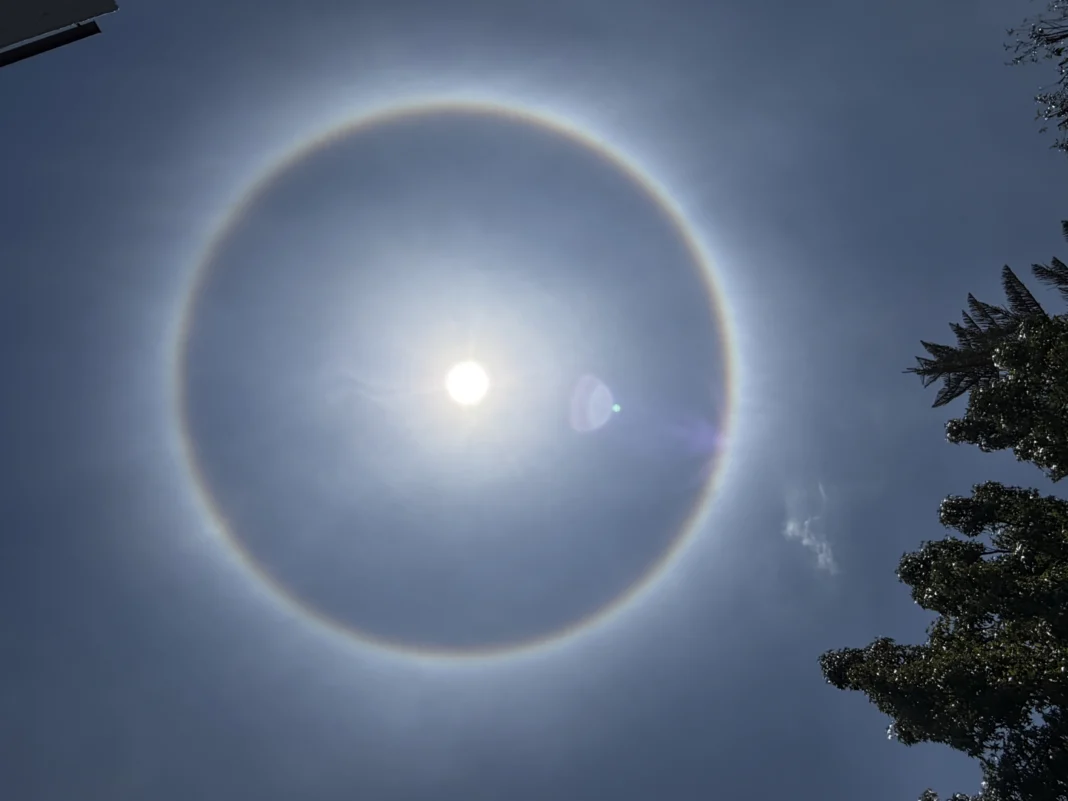
Residents across parts of South Africa—including Johannesburg, Pretoria, Midvaal, and areas of Limpopo—looked up on Monday, November 16, 2026, to see a striking, rainbow-tinted ring encircling the midday sun.
Photos and videos of the glowing circle quickly flooded local social media feeds. While the display looked otherworldly, meteorologists and atmospheric scientists confirmed it was a classic 22-degree solar halo.
What Causes a 22-Degree Solar Halo?
Unlike a standard rainbow, which forms when sunlight bounces through falling raindrops behind you, a solar halo is created high up in the freezing upper atmosphere.
- High-Altitude Ice Crystals. Thin, wispy clouds known as cirrus or cirrostratus clouds float roughly eight to ten kilometers above the ground. At that altitude, temperatures drop to around minus 30 degrees Celsius, turning water vapor into millions of microscopic, six-sided (hexagonal) ice crystals.
- Bending the Light. As direct sunlight passes through these tiny hexagonal prisms, the light bends—or refracts—at a precise angle of approximately 22 degrees. Because the crystals are randomly oriented in the sky, they bend light in every direction around the sun, creating a complete luminous circle.
- Faint Rainbow Colors. Just like a glass prism, the ice crystals split white sunlight into its color spectrum. Observers can often spot a soft reddish-orange tint along the inner edge of the ring and a pale bluish glow on the outside.
Does a Sun Halo Predict Rain?
In traditional weather folklore across Southern Africa and around the world, a ring around the sun or moon has long been treated as a sign of approaching rain.
Modern meteorology backs up the core of that old saying. According to experts from the South African Weather Service (SAWS) and physical geographers at Wits University, high-altitude cirrus clouds often drift into an area ahead of an advancing weather front or low-pressure system. While a halo does not guarantee a storm, it frequently signals that moisture is building in the upper atmosphere and a shift in the weather may follow within a day or two.
Sky-Watching Lore and Symbolic Meaning
Long before atmospheric physics explained ice refraction, ancient sky-watchers and early astrologers paid close attention to solar halos. Because the sun represents vitality, clarity, and leadership in traditional sky lore, seeing it crowned by a perfect geometric ring was often recorded as a moment of heightened awareness or a turning point in the seasons.
Even today, from a purely grounded perspective, a solar halo serves as a natural reminder to pause and look up. Interestingly, because light refracts at a specific angle relative to your exact position, no two people see the exact same halo. The ring you see is created by the specific ice crystals aligned directly between your eyes and the sun.
How to View a Solar Halo Safely
Solar halos can appear anywhere in the world whenever high ice clouds drift across a bright sky. If you spot one, protect your eyesight with two simple habits:
- Block the Sun. Hold your thumb, a building edge, or a tree branch directly over the bright center of the sun so you can comfortably view the outer ring without glare.
- Use Your Phone Camera. Point your phone toward the sky in selfie mode or behind a dark filter and view the ring on your screen rather than staring straight into direct sunlight.

