



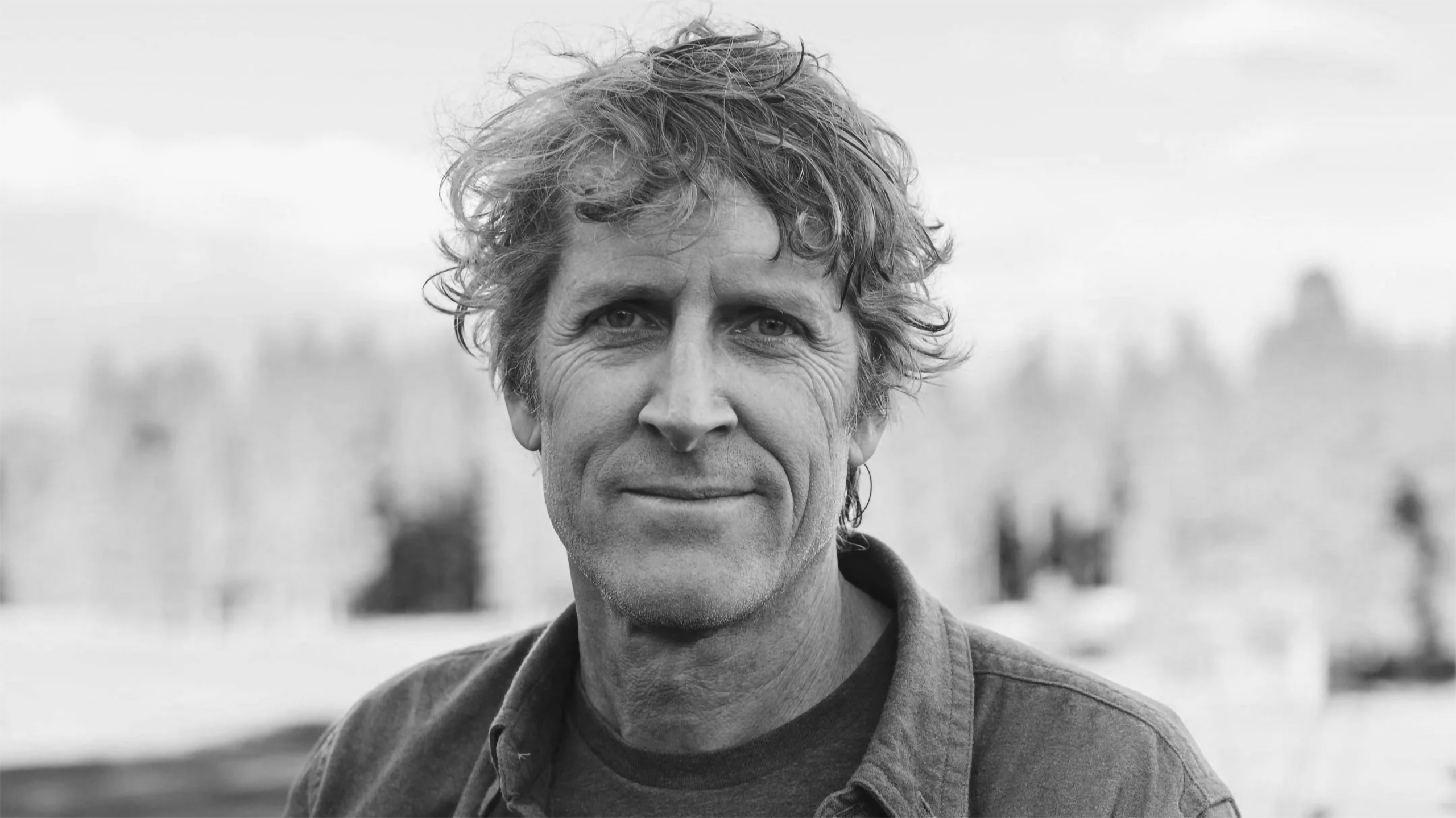
- David Page, executive director of Winter Wildlands Alliance, died at 57 when a dump truck whose brakes had failed struck his car on Teton Pass; his dog, Rio, also died in the crash.
- An award-winning writer and longtime POWDER contributor, Page wrote closely reported stories about avalanche risk, immigrant workers in ski towns, mountain communities, and the landscapes of the American West.
- He joined Winter Wildlands Alliance in 2016 and became executive director in 2022, working on national forest planning, winter travel rules, conservation funding, and public participation in land-management decisions.
- Page lived in Mammoth Lakes with his wife, Allison, and built his life around family, skiing, music, dogs, and the Sierra Nevada; fuller accounts of his life appear in “Remembering David Page” and “Remembering David Page: A Writer Who Helped Define POWDER.”
A backcountry ski run can depend on decisions made years before the snow falls. Forest plans determine where motorized vehicles may travel. Congressional appropriations affect whether trails are maintained and land-management agencies can enforce their rules. Public meetings give skiers, snowmobilers, conservationists, and local residents a chance to argue over how mountains should be used.
David Page knew this work in detail. He also knew how to describe what it felt like to move through those mountains. Page, the executive director of Winter Wildlands Alliance, died on July 7th in a multi-vehicle crash on Teton Pass in Wyoming. He was 57. Rio, the family dog who often accompanied him outdoors, died in the accident as well.
He had come to conservation advocacy through writing. Raised in Denver, he studied history and Spanish literature at Dartmouth, comparative literature at Berkeley, and creative writing at the University of California, Irvine. He wrote for the New York Times, Men’s Journal, Skiing, and other publications, and became a senior correspondent for POWDER. His guide to Yosemite and the southern Sierra Nevada went through three editions.
His articles were closely reported and attentive to the people in them. “The Human Factor,” an examination of the decisions that lead experienced skiers into avalanche danger, was a finalist for a National Magazine Award in 2015. It was later used in avalanche courses. Another article described the immigrant workers whose labor sustains many ski towns. He also wrote about major descents, disappearing whitebark pines, solitary skiers, remote slopes, and the beer at the end of a long tour.
Page joined Winter Wildlands Alliance in 2016 and became its executive director in 2022, a position he called his dream job. He worked on national-forest planning, winter travel rules, conservation funding, and public participation in decisions about federal land. His colleagues relied on his command of policy and his willingness to question weak assumptions. He could work with government officials, athletes, scientists, local advocates, and people who disagreed with him. Fluent in Spanish and French, and conversational in Arabic, he was accustomed to listening carefully before making his case.
He could also be irreverent. At POWDER’s annual ski test he arrived in costumes and wigs. Excursions described as two-hour trips sometimes lasted eight. In Mammoth Lakes, he and his wife, Allison, built their family life around skiing, camping, music, dogs, and the Sierra Nevada. During the pandemic he coined “Ski Kind,” a campaign asking skiers to treat newcomers considerately and to take greater care around wildlife and winter landscapes.
Several longer tributes describe him with the space that his life warrants. “Remembering David Page,” published by Winter Wildlands Alliance and its partners, records the effect he had on colleagues and the public-lands movement. Matt Hansen’s “Remembering David Page: A Writer Who Helped Define POWDER” recalls the reporter, skier, editor’s companion, and friend who raised the standard of the magazine around him.
On his final day, Page had been working on the problems that occupied much of his last decade: how people with different claims on the mountains might find terms they could accept.
Banner image: David T. Page. Photo courtesy of the Winter Wildlands Alliance
This story first appeared on Mongabay
This article is licensed under a Creative Commons Attribution-NoDerivatives 4.0 International License.
You may republish this article, so long as you credit the authors and Mongabay, and do not change the text. Please include a link back to the original article.

