



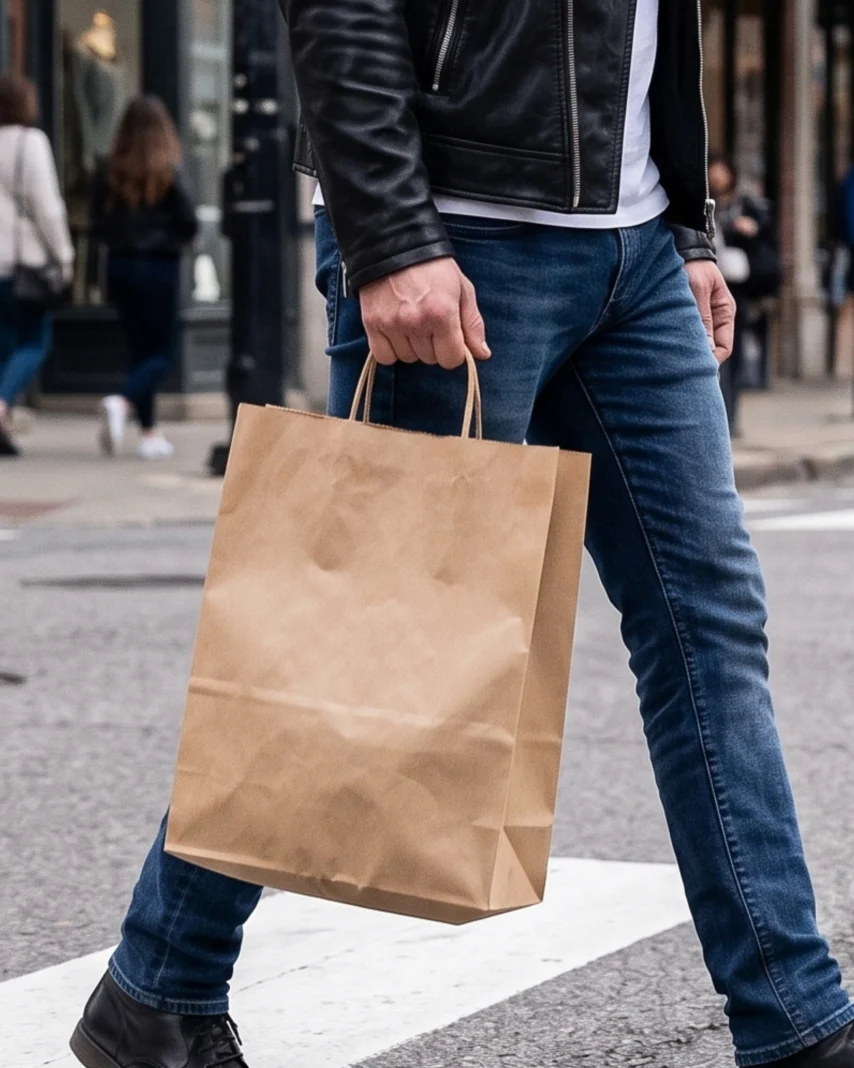
Each day, millions of paper shopping bags zip through South African streets via motorcycle to online grocery shoppers. However, while paper is clearly the king of delivery, there is still some way to go to replace the large numbers of plastic shopping bags at supermarket tills – an exciting opportunity for Traderbag as a leading supplier of customisable retail paper bags.
Directors Daniel and Declan Cherry explain that although there are no formal statistics, some numbers indicate the size of the potential market.
Leading grocery chain, Shoprite, reported selling 753.3 million recyclable plastic shopping bags in 2025. The South African Revenue Service collected approximately R699 million from the plastic bag levy during the 2024/25 financial year. With a 32c per bag levy, this equates to approximately 2.18 billion levy-equivalent plastic bags!
Going for grocery
Up until now, Traderbag has successfully focused on fashion and general retail, but supplies Still Good, a local business connecting consumers with surplus food from 170 Pick n Pay, SPAR and Food Lover’s Market retail outlets.
Paper grocery bags are also not new to many older South Africans. For Traderbag, they are simply an older solution that is being reconsidered in a market where priorities have changed.
“Plastic bags became popular because they were cheaper to manufacture at scale, very light to transport and store, resistant to moisture and extremely strong relative to the small amount of material used. For supermarkets, that made commercial sense,” explains Declan Cherry.
At the time, sustainability was not a priority, he continues: “The environmental impact of single-use plastic wasn’t part of decision-making. What has changed is consumer awareness. People are now far more conscious of sustainability, waste and microplastics. Younger generations are questioning materials and products that previous generations accepted as normal,” adds Daniel Cherry.
Bagging the benefits
One of the biggest practical advantages is that paper grocery bags stand up. Because they have flat bases and retain their shape, products can be organised and bags remain upright, making both packing and unpacking easier.
Complaints about breaking handles come down to design. The handle itself can be made from stronger paper, the attachment area can be increased, and a reinforcing paper patch can be placed behind the handle to spread the load over a larger area.
Although some still believe that paper grocery bags cannot handle wet goods or condensate from cold or frozen goods, there is real-world evidence showing that paper can deal with moisture with the right specifications.
Standard paper will lose strength if it becomes completely saturated, but stronger kraft papers, wet-strength and semi-wet-strength papers, together with improved bag construction, allow packaging companies to design around those challenges.
“Checkers Sixty60 uses paper delivery bags made from 100% recycled FSC-certified paper, while Pick n Pay asap! has used recyclable brown paper delivery bags, and Woolies Dash uses fully recyclable FSC-certified paper bags made from recycled content. Groceries that include refrigerated products, frozen foods, milk, meat that create condensation are delivered daily. Woolies Dash is particularly interesting because Woolworths guarantees an unbroken cold chain for its on-demand grocery deliveries while still using paper delivery bags,” says Declan Cherry.
Shopping conveniences aside, for Traderbag, the most important difference is what happens to the bag at the end of its life.
Paper is made from renewable fibre, it is widely recyclable, and the fibre itself is naturally biodegradable. FSC certified paper used by Traderbag is responsibly sourced, renewable and biodegradable. ¹
“If a conventional plastic bag escapes the waste system, it can persist in the environment for decades or even hundreds of years. Paper fibre breaks down naturally. That doesn’t mean producing a paper bag has zero environmental impact, but when the paper is responsibly sourced, recyclable and biodegradable, you have a fundamentally different end-of-life story,” adds Daniel Cherry.
First impressions count
The question remains why the popularity of paper bags for delivery has not filtered back to supermarkets.
“I think the role of the bag is slightly different. When you order groceries online, the bag makes that first impression. The customer has not been in the store or interacted with the brand physically, so the way that order arrives becomes part of the overall experience. A well-presented paper bag has much more value in that setting.
“At a till, the customer has already experienced the store, the branding and the environment. Historically, the checkout bag has been treated as a functional item where cost, strength, compact storage and moisture resistance are priorities,” Daniel Cherry replies.
However, this is changing. As retailers focus on sustainability and the complete customer journey, Traderbag intends moving with the times.
As a relatively young company, it will continue to focus on fashion and broader retail and growing its share of that market. However, the sheer scale of the grocery market is difficult to ignore.
“Even a small shift from plastic to paper in the grocery sector represents a very significant opportunity, both commercially and environmentally. We don’t need to move away from fashion to pursue that. We have already built the manufacturing, warehousing and distribution infrastructure, so grocery is a market we can start exploring alongside the industries we already serve,” Declan Cherry concludes.
- Paper made from wood or fibre certified by the Forest Stewardship Council (FSC)
About Traderbag:
Traderbag produces custom branded paper bags for South African retailers, with a direct-to-store delivery model and a process designed to take the complexity out of ordering and reordering.
The company’s value proposition is straightforward: great packaging done properly at a scale that works for South African retail. From the initial brief through to design, print, and delivery, Traderbag handles the end-to-end process so that retailers can focus on sales while their packaging supports their branding.
Every bag is printed with water-based inks. Retail clients have a choice of custom sizing, handle options and high-quality print finishes.
The company is based in Durban but supplies customers throughout South Africa. The entire supply chain is South African. The bags are made locally in Johannesburg and Durban. All paper is FSC approved. Get in touch with the Traderbag team: www.traderbag.co.za

