



Beauty is a curse — at least for the turquoise dwarf gecko of central Tanzania. Between December 2004 and July 2009, demand for this gecko from collectors in Europe boomed, leading to the capture and export of an estimated 40,000 of these striking reptiles from Tanzania.
“I remember when I saw them for the first time [at] a fair, it was about 600 euros per specimen,” or about $700, Dennis Rödder, a herpetologist at the Leibniz Institute for the Analysis of Biodiversity Change in Germany, told Mongabay in a video call. “I think within three or four years, the species appeared everywhere across Europe. You could buy them in every pet shop.”
Turquoise dwarf geckos (Lygodactylus williamsi) grow to a length of 6-9 centimeters (about 2.5-3.5 inches) and are known from only two small patches of forest in Tanzania: The Kimboza and Ruvu forest reserves. These protected areas cover a combined 34 square kilometers (13 square miles). Adult females have a green-brownish color that mimics the leaves of the trees they live in, but the males’ skins are a vivid contrasting blue, one of the rarest colors in nature, meant to stand out and attract females.
Active during the day, and so fiercely territorial they evict their young hatchlings from their home trees soon after birth, this species lives exclusively on screwpines (Pandanus rabaiensis), a tree found in Kenya and Tanzania. Standing anywhere from 3-20 meters tall (up to 66 feet), these trees feature long, spiked leaves and a fountain-shaped architecture that provide the ideal habitat for the reptiles, giving them shelter to hide and reproduce, a platform to bask, and a feeding place where water for cooling and insects accumulate.
“It’s the perfect environment for them,” Charles Kilawe, a forest ecologist at Tanzania’s Sokoine University of Agriculture, told Mongabay in a video call. “The leaves of the Pandanus have spines, and it protects [the lizards] against predators like snakes or … eagles.”
But the gecko’s reliance on the screwpine as protection against natural predators has left it vulnerable to another predator: using machetes, poachers cut down large screwpines to grab their helpless resident geckos. The logging to capture these animals was so intense that by 2009, screwpines had gone from covering more than half of Kimboza to only 17.6% of the forest reserve’s area.
That year, researchers estimated that only around 150,000 of these beautiful geckos remained in the wild.
“When I started to work there in 2016, it was difficult to spot them,” Kilawe said.

In 2009, herpetologist Morris Flecks and colleagues from the Leibniz Institute interviewed one group of gecko collectors from the communities around Kimboza and estimated that they had captured between 32,000 and 42,000 turquoise dwarf geckos from the forest reserve over the previous five years. The researchers noted that this total — which they believed represented at least 15% of the wild population at the time — could be even higher as it didn’t account for many more geckos collected by other groups known to be operating in the forest.
Collection or export of the geckos — or any other wildlife species from a protected forest reserve — required a license, but officials from the Tanzania Wildlife Research Institute told the researchers no such permits were ever issued.
This frenzied collection for the pet trade and the rapid destruction of their already limited habitat led to a steep decline in the geckos’ population size; Rödder, Flecks and other herpetologists recommended that the species should be listed as critically endangered by the IUCN. This was done in 2012. It took another five years before international trade in turquoise dwarf geckos was banned when the species was added to Appendix I of CITES, the global treaty on the wildlife trade.
By this time, the wholesale capture of the geckos in the shadow of Tanzania’s Uluguru Mountains had tapered off; overseas markets were saturated, and while the reptiles remained popular, captive-bred geckos were widely available across Europe, pushing the price of a turquoise dwarf gecko from a peak of $1,500 per specimen to just $40 each.
“Population sizes are back to pre-collecting events. So that’s the good part,” Rödder told Mongabay.
“The not-so-good part is that after a couple of years after our study, there was a wildfire in one of these reserves.”

Habitat loss due to illegal logging, collection of firewood, conversion of forest to agricultural land, mining, and the growing presence of the invasive Spanish cedar (Cedrela odorata) inside and outside the two forest reserves where L. williamsi is found continue to put pressure on the geckos.
Spanish cedar was introduced to Kimboza in 1960, ironically as a means to relieve logging pressure on native tree species. The idea was that this fast-growing tree, native to the Americas, could provide a reliable source of quality timber and firewood.
The idea was too successful. The exotic cedar, which can grow to a towering 40 m (130 ft), turned out to be very invasive: because it produces seeds twice a year that are dispersed by wind and germinate easily in open areas, the species has taken advantage of gaps and changes to forest structure caused by illegal logging and fires to replace screwpine in many areas.
“By 2016, Cedrela was the most dominant tree in the forest, covering nearly 32% of the big trees area,” Kilawe told Mongabay.
In 2022, Kilawe published a study of Kimboza aimed at determining if turquoise dwarf geckos were directly affected by the presence of Spanish cedars. He found screwpines still thriving in swampy areas and on limestone outcrops, but where a similar survey 40 years earlier found P. rabaiensis in more than half of plots it surveyed, screwpines occurred in barely half the plots Kilawe examined — a severe reduction in habitat for geckos. The presence of cedars, meanwhile, had moved in the opposite direction, found in 16% of plots in 1982, but 52% in Kilawe’s study.
While he found turquoise dwarf geckos just as frequently in screwpines growing under the taller cedars, results from the surveyed plots showed that the number of lizards in screwpines shadowed by dense exotic canopy was considerably lower than in areas where there were fewer cedars or none at all.
Further research is needed to understand what the direct effect of the cedars’ presence on geckos is, but the invasives’ steady expansion into forest areas opened up by fire or tree falls raises fears that cedars will continue to displace gecko habitat. Similar impacts on native biodiversity have been reported from other places where the tree has been introduced, such as Ghana and the Galápagos Islands.
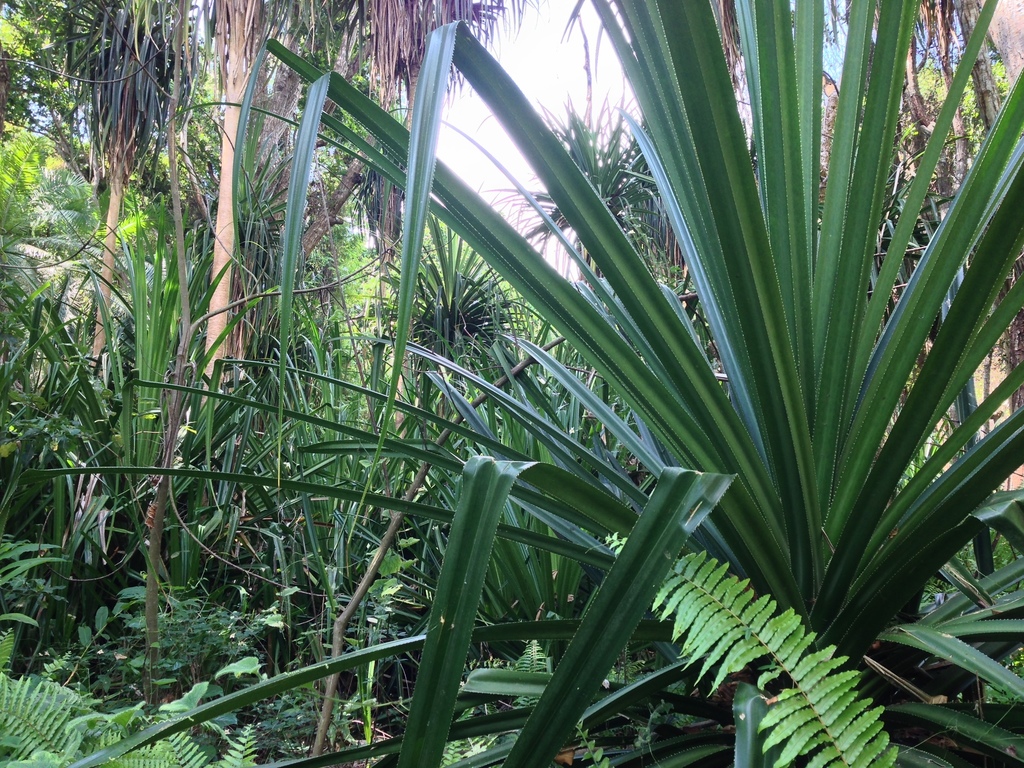
Today, people from the villages surrounding Kimboza Forest Reserve assist rangers in managing the forest, Kilawe said. Led by Kilawe, they have cut down nearly 100,000 Spanish cedar trees since 2016, and reduced forest fires by around 80%.
They have also planted about 5,000 native trees per year since 2018, working step by step to rebuild the original structure of Kimboza’s forest. Kilawe told Mongabay 10 “ambassadors” drawn from the different villages are paid for their efforts; guiding tourists is another source of occasional income linked to protecting this ecosystem.
“We are hoping that if the removal process continues, in about five years, maybe the forest might be Cedrela-free,” Kilawe said. “It is very important and effective to work with the community in conservation.”
Once caught between the devil and the blue sea, the turquoise dwarf gecko is recovering thanks to these reforestation efforts and the prohibition on trade worldwide. Kilawe said the restoration of Kimboza’s forests has also allowed other animals, such as blue monkeys (Cercopithecus mitis) and birds like the white-chested alethe (Chamaetylas fuelleborni) and the trumpeter hornbill (Bycanistes bucinator) to return to the forest, showing that collaborative hard work can save species and places from the fragile edge of extinction.
Banner image: Turquoise dwarf gecko. Image © Ardgard Essau via iNaturalist (CC BY-NC 4.0).
Citations:
Flecks, M., Weinsheimer, F., Böhme, W., Chenga, J., Lötters, S., & Rödder, D. (2012). Watching extinction happen: The dramatic population decline of the critically endangered Tanzanian Turquoise Dwarf Gecko, Lygodactylus williamsi. Salamandra, 48(1), 12-20. Retrieved from https://www.salamandra-journal.com/index.php/contents/2012-vol-48/270-flecks-m-f-weinsheimer-w-boehme-j-chenga-s-loetters-d-roedder
Kilawe, C. J., Mchelu, H. A., & Emily, C. J. (2022). The impact of the invasive tree Cedrela odorota on the Electric Blue Gecko (Lygodactylus williamsi) and its habitat (Pandanus rabaiensis) in Kimboza Forest Reserve, Tanzania. Global Ecology and Conservation, 38, e02225. doi:10.1016/j.gecco.2022.e02225
Slash-and-burn farming eats away at a Madagascar haven for endangered lemurs, frogs
New gecko species findings highlight threats to Cambodia’s limestone hills
Feedback: Use this form to send a message to the author of this post. If you want to post a public comment, you can do that at the bottom of the page.
Credits

This story first appeared on Mongabay
This article is licensed under a Creative Commons Attribution-NoDerivatives 4.0 International License.
You may republish this article, so long as you credit the authors and Mongabay, and do not change the text. Please include a link back to the original article.

