



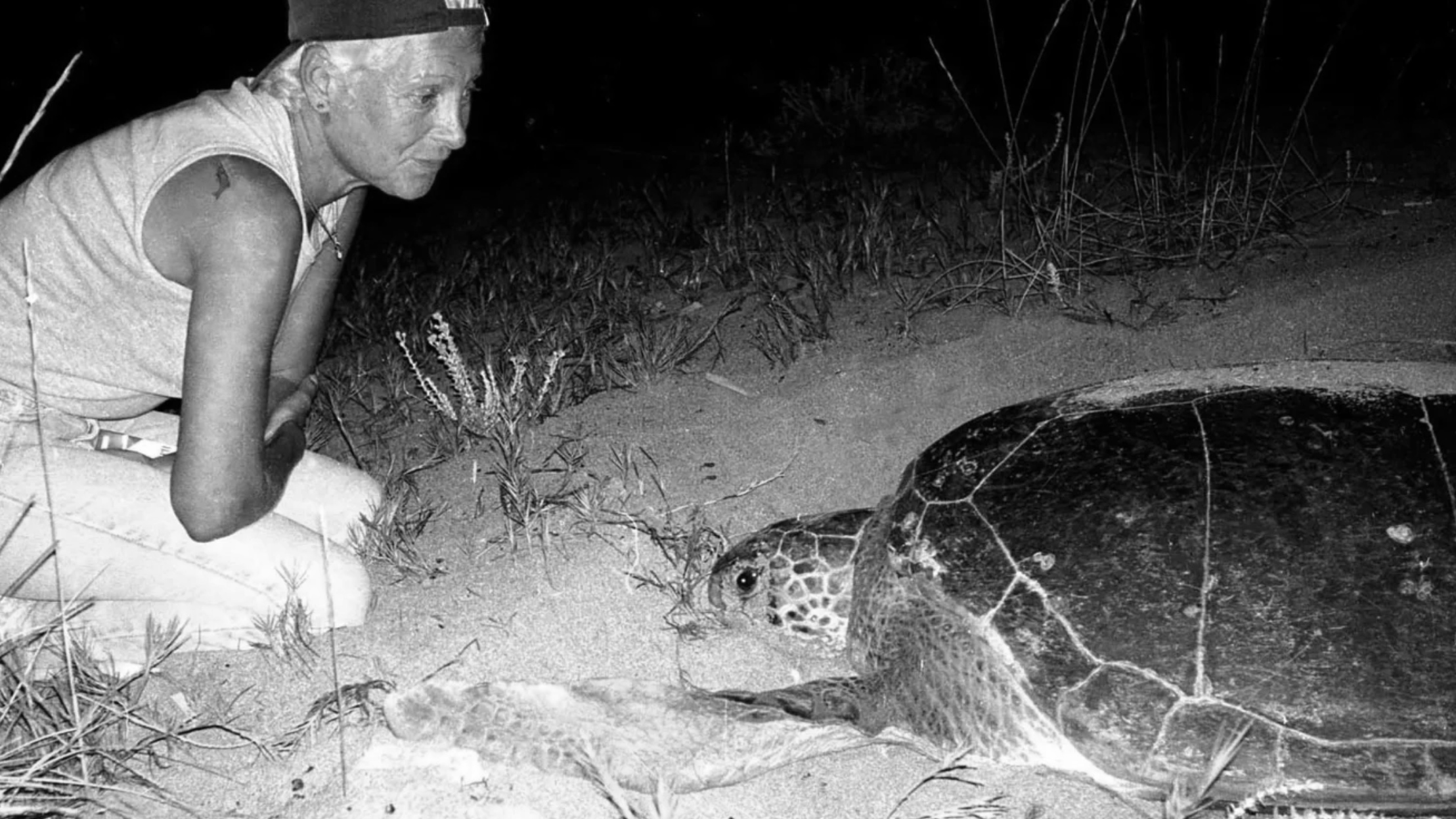
- Mona Khalil died on June 19 after being wounded when an Israeli strike hit her home at Mansouri beach in southern Lebanon.
- For more than 25 years, she protected endangered loggerhead and green sea turtles that nested on a narrow stretch of coast near Tyre.
- She left a settled life in the Netherlands to return to Lebanon, where she turned her family home into the Orange House, a conservation project and guesthouse.
- Her work combined daily field labor, public education, local advocacy, and resistance to pollution, dynamite fishing, coastal development, and war.
At night on Mansouri beach, the first evidence was often a track in the sand. The beach lies south of Tyre, near the border with Israel, where checkpoints, shelling, and evacuation orders have long shaped daily life. It is also one of Lebanon’s important nesting grounds for loggerhead and green sea turtles. The turtles come ashore after dark. They dig, lay, cover, and return to the water.
For the hatchlings, the distance from nest to sea is only a few yards. It is still dangerous. Dogs and foxes dig up eggs. Crabs and birds take the young. Lights from roads and resorts pull them away from the water. Plastic drifts offshore. Fishing nets catch adults that have survived for decades. Even a footprint can trap a turtle no bigger than a child’s palm.
Mona Khalil gave much of her life to that narrow strip of beach. She was 76 when she died on June 19 from wounds sustained after an Israeli airstrike struck her home at Mansouri beach earlier that month. Her assistant was also injured, suffering severe burns. The house, known to visitors and volunteers as the Orange House, had been the base of her conservation work for more than 25 years.
She had not set out to become a conservationist. Born in Lagos to Lebanese parents, she later left Lebanon during the civil war. In the Netherlands she worked as a porcelain restorer, a trade that required patience, precision, and care for damaged things. She could have remained there. Instead she kept returning to the family land on Lebanon’s southern coast.
One night in 1999, while walking near the shore, she heard a sound in the sand and saw a turtle coming up to lay her eggs. She learned that the beach was one of the last important nesting places in southern Lebanon. In 2000, after Israel withdrew from the area, she returned more permanently. With Habiba Fayed, she restored the family farmhouse and began protecting the nests.
The Orange House was named for the country that had sheltered her. It also helped pay for the work. Guests came for a bed near the sea and often found themselves drawn into the project. They picked up rubbish at dawn, watched for turtle tracks, helped monitor nests, and learned why a light left on at night could send hatchlings away from the sea, or why a plastic bag offshore could kill a turtle that mistook it for food. Some visitors complained about power cuts and the lack of air-conditioning. Others came away remembering hatchlings pressing toward the Mediterranean under the eyes of children, volunteers, and a woman who expected people to take the beach seriously.

Her work was direct and exacting. She placed metal grids over nests to keep out predators while leaving space for hatchlings to escape. She moved eggs higher up the beach when flooding threatened them. She measured nests, counted eggs, recorded distances from the sea and vegetation, and shared data with conservation groups. She learned from scientists and then taught others. Much of the job came down to being there at the right hour, before a nest was lost.
This put her in conflict with people who treated the shore as disposable. She challenged dynamite fishing, pollution, and construction that crowded the beach. She said she had been shot at and that people had tried to burn her house. She kept rescued animals in the courtyard and defended turtles with the same force she brought to arguments with officials and developers.
War kept returning to Mansouri. During the 2006 conflict between Israel and Hezbollah, her house was hit and she lost some of her hearing. The beach, emptied by fighting, produced an unusually high number of nests that year. In 2020, when resorts closed and lights went off during the pandemic, turtles again returned in higher numbers. Human absence, even under grim circumstances, gave the turtles a little room.
In recent years she had stepped back from public work, and younger volunteers took on more of the daily protection. They spoke of themselves as her children, trained by her example and by her insistence that the beach belonged to creatures with an older claim than any developer or army. She helped make Mansouri part of a community-protected zone and turned a family house into a place where people learned the habits of a threatened species by serving it.

She refused to leave during the latest war. Friends said she believed her civilian status would protect her. The strike hit the side of the house where her bedroom was. She was taken first to a hospital in the south and then to Beirut, where doctors tried to save her. Her friends were left with the damaged house, the wounded assistant, and the beach she had stayed to guard.
The turtles will come back without knowing any of this. A female that hatched there decades ago may still rise from the sea on a dark night, find the same strip of sand, and begin to dig. The eggs will need shade, distance, luck, and protection from teeth, lights, waves, and carelessness. Somewhere above them, if the work holds, there may be a square of metal grid set in the sand by one of the people Khalil taught.
Header image: Mona Khalil in 2004 at Mansouri Beach in Lebanon. Photo by Joseph Barrak/AFP/Getty Images
Credits

This story first appeared on Mongabay
This article is licensed under a Creative Commons Attribution-NoDerivatives 4.0 International License.
You may republish this article, so long as you credit the authors and Mongabay, and do not change the text. Please include a link back to the original article.

