



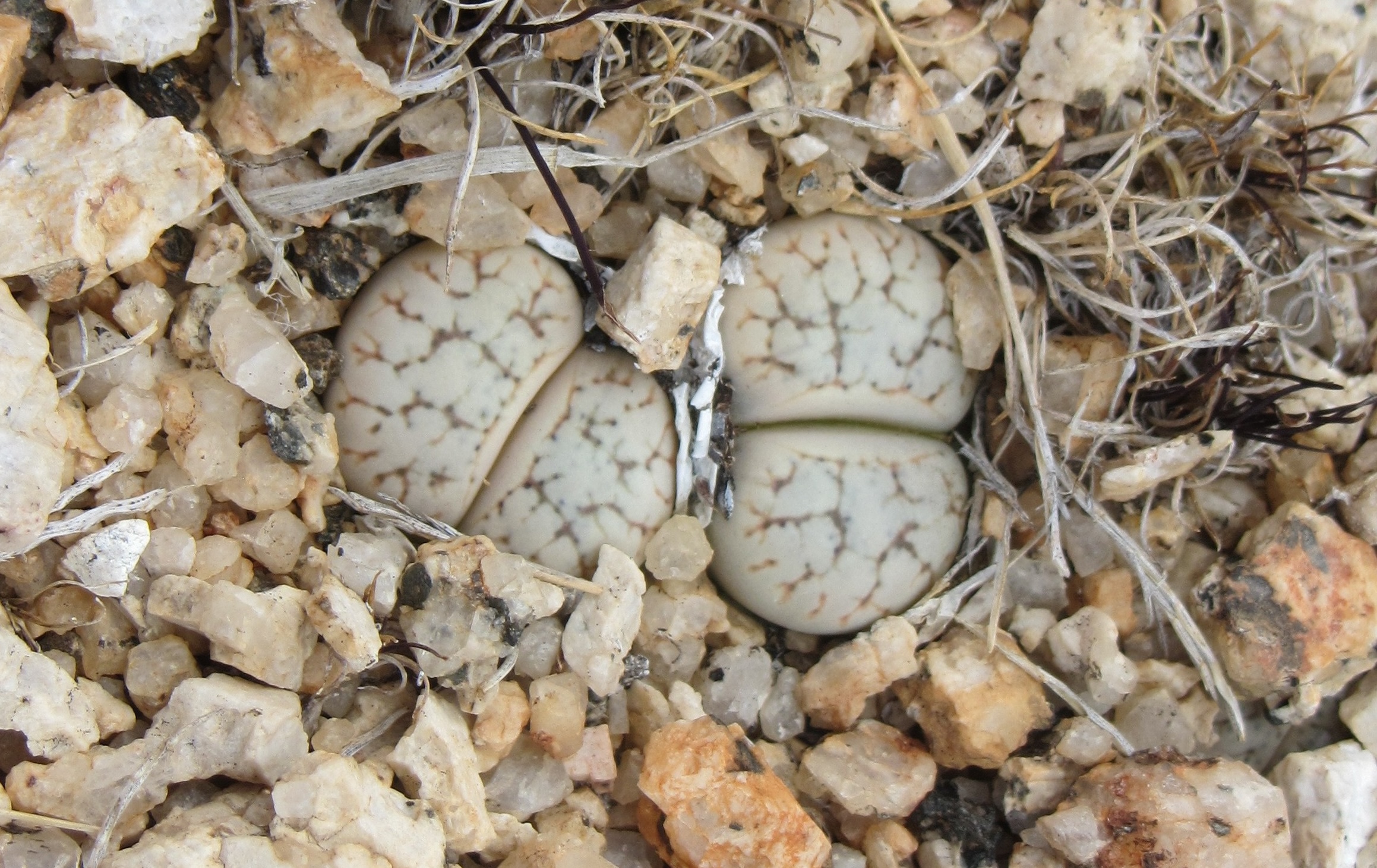
In a small area of Namibia’s Erongo Mountains, a tiny, pebble-like plant grows on a very thin layer of gravel.
This succulent, Lithops werneri, is found in just one tiny 4 square-kilometer (1.5 square-mile) area, according to the IUCN, the global wildlife conservation authority.
With more than an 80% decline in its population since 1981 and fewer than 200 plants remaining in the wild, the species was listed as critically endangered on the IUCN Red List in February 2026.
Sonja Loots, manager of the Threatened Plants Programme at Namibia’s National Botanical Research Institute, told Mongabay by email that the plant “has always had a restricted range”.
After it was first scientifically described in the 1950s, the succulent was “heavily harvested for the horticulture market in Europe”, she said. “Since then it was searched for numerous times by several succulent enthusiasts, but additional populations were never discovered.”
The plant was even once thought to be extinct, but was found again in the original location in 2012, Soots said.
A census in 2012 recorded 659 plants, according to the IUCN, but subsequent surveys found only 118 plants in 2019 and 163 in 2020.
Lithops are a group of dwarf succulents, commonly called living stones or pebble plants, found across South Africa, Namibia and Botswana.
These plants only grow on certain rocky outcrops and typically have just a single pair of water-storing succulent leaves attached to some roots, Loots said.
L. werneri grows in a very thin layer of gravel, approximately 2 centimeters (0.8 inches) thick, on top of a granite sheet, she added.
Illegal collection, which historically wiped out populations of Lithops plants, may still be a factor in L. werneri’s decline, Loots said.
Now, climate change is a major threat as well.
“The plants have a very shallow root system,” Loots said. “Mature plants can only survive a few years without water. The seeds can survive for a long time inside their capsules (which is why they should not be collected) but seedlings need follow up rain showers for several years to survive.”
Harsh droughts might also compel animals to look for edible plants they don’t normally feed on, such as L. werneri.
“There was evidence of such disturbance by some observers since 2012, when the population experienced a severe drought,” Loots said. “A significant number of plants were found dislodged and therefore died because the roots were exposed, they were eaten or the habitat was disturbed.”
Flooding is also a threat to the unstable habitat.
With L. werneri found in just one location, any random or extreme disturbance could wipe out the entire species, Loots said, “Any species where a 100% of the population occurs in a single location is important to conserve.”
“Plant poaching, although it has exponentially increased in the last 5 years is also being addressed by various collaborators in Namibia,” she said.
Banner image of Lithops werneri © Sonja Loots/National Botanical Research Institute of Namibia.
This story first appeared on Mongabay
This article is licensed under a Creative Commons Attribution-NoDerivatives 4.0 International License.
You may republish this article, so long as you credit the authors and Mongabay, and do not change the text. Please include a link back to the original article.

