



- Record gold prices and rising global demand are increasing the incentives for illegal mining across the Amazon, including in protected areas and Indigenous territories.
- Illicit gold can be laundered into legal markets through false documentation, shell companies, traders, and refiners, while mining damages rivers, forests, and communities through deforestation, sediment, mercury contamination, and diesel emissions.
- Central banks and other major buyers should impose stronger sourcing, traceability, audit, and due-diligence requirements to make illegal gold harder to sell, argues Robert Muggah, co-founder and research director of the Igarapé Institute.
- This article is a commentary. The views expressed are those of the authors, not necessarily of Mongabay.
In November 2025, Brazilian authorities, supported by Interpol, disabled 277 dredges used for illegal gold mining along the Madeira River. The machinery was valued at about $6.8 million. The operation
dealt a substantial blow to one of the Amazon’s busiest mining frontiers, yet its effect was likely temporary. After all, dredges can be replaced, miners can relocate, and financiers can redirect their money.
Satellite monitoring reveals how quickly the industry is spreading. A basin-wide monitoring initiative led by Amazon Mining Watch detected more than 37,000 hectares of new mining expansion across the Amazon in 2025. Of that total, more than 14,000 hectares lay within 222 protected areas and Indigenous territories. Since mining is generally restricted in such places, much of this activity was presumed to be illegal.
The immediate drivers of illegal gold mining are familiar. Enforcement is thin across vast stretches of forest, and illicit gold passes too easily into lawful commerce. The broader economic incentive comes from a global market in which gold prices have risen sharply and legitimate demand has become unusually strong.
Central banks are an important part of that story, though hardly the only one. Over the past four years, they have bought an average of roughly 1,000 metric tons of gold annually, twice the average of the preceding decade. A 2026 World Gold Council survey found that 89 percent of participating reserve managers expected official gold holdings worldwide to rise over the following year.
Investors, jewelry buyers and manufacturers also contribute to demand. Central bank purchases have been an important component of the unusually strong demand accompanying the rise in prices. The benchmark London price averaged $3,431 an ounce in 2025, an increase of 44 percent from the previous year. Total supply increased by just 1 percent.
Gold briefly traded above $5,600 an ounce in February 2026. Two decades earlier, its average price had been about $604. Over that period, it outpaced inflation, equities, and almost every other conventional asset. That rise has greatly increased the rewards available to anyone who can extract gold from a riverbed and give it a plausible path into the formal market.
No scientific study has calculated how much destruction in the Amazon can be attributed specifically to central bank purchases. A bullion order placed by a reserve manager does not directly finance a mining crew. Demand instead operates through prices: as gold becomes more valuable, deposits that were once too remote or costly to exploit become more attractive.
Researchers have linked earlier gold price surges to faster mining-related forest loss in tropical South America. Today’s market is producing the same incentive at exceptionally high prices. Central banks do not direct the illegal mines spreading across the Amazon, but they are influential buyers in a market whose signals now reach deep into the forest.
Why central banks are buying
Reserve managers tend to regard gold as protection against instability. In the World Gold Council survey, 90 percent cited its performance during crises. Eighty-four percent pointed to its ability to preserve value over time, while 82 percent cited its role in diversifying reserves.
Gold’s geopolitical appeal has grown since Russia invaded Ukraine. European Union sanctions immobilized about €210 billion in Russian central bank assets held in member states. The action demonstrated that foreign-exchange reserves held abroad can become inaccessible during a political confrontation.
Gold stored under a government’s direct control is harder for another country to freeze. It has no foreign issuer, and its owner is less dependent on an overseas custodian. An International Monetary Fund study found that sanctions imposed by the main reserve-currency economies were associated with a higher share of gold in central bank reserves.
The shift does not signal an imminent flight from the dollar. The U.S. currency still accounted for well over half of disclosed global foreign-exchange reserves at the end of 2025. The IMF has also cautioned that gold’s growing weight in official reserves reflects its rising price as well as fresh purchases.
Reserve managers are buying insurance against a financial system that feels more fragmented and politically contingent. The environmental cost of that insurance, however, is largely missing from their calculations.
A commodity made for laundering
Gold appeals to criminal organizations because its past can be erased. Illicit metal can be attributed to a licensed mine, passed through a shell company or accompanied by false invoices. Once gold from several sources has been melted together, its origin becomes exceptionally difficult to reconstruct without reliable records extending back to the mine.
A United Nations Office on Drugs and Crime assessment found that illegal gold markets can connect individual miners with criminal groups and apparently legitimate businesses. The same supply chain may contain lawful concessions, fraudulent declarations and companies created to disguise the metal’s origin.
This overlap between lawful and unlawful commerce distinguishes gold from illicit products such as cocaine. Once fraudulent paperwork gives the metal a credible origin, it can enter an ordinary refinery and emerge ready for export through established markets.
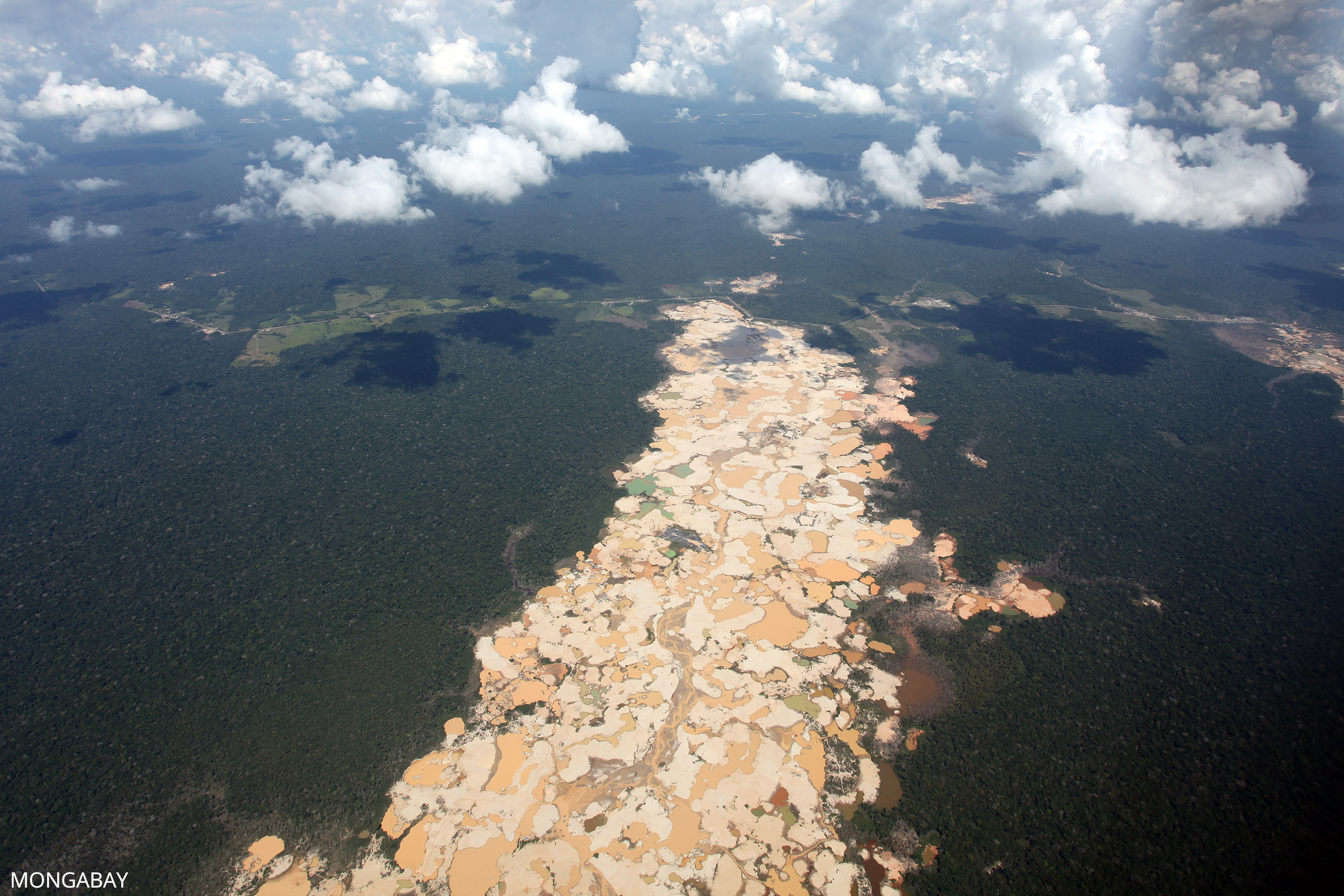
The scale of the trade is easy to underestimate because Amazonian countries are rarely grouped together as a single gold-producing region. Brazil, Colombia and Peru together produced about 230 metric tons in 2024. Taken together, the eight countries containing parts of the Amazon produced roughly 329 metric tons nationally, although a substantial share came from mines outside the biome. Official totals also inevitably miss some artisanal and illegal production.
Organized crime has moved quickly into the sector. Brazilian federal prosecutor André Luiz Porreca has said the country’s largest factions can finance dredges costing as much as 15 million reais, or about $2.9 million. The Primeiro Comando da Capital and Comando Vermelho have adapted expertise developed in the drug trade to mining.
The Brazilian Forum on Public Safety reported that criminal factions were active in 344 of the region’s 772 municipalities, up from 260 a year earlier. Their interests now encompass illegal mining and logging, while extortion and drug trafficking provide other sources of revenue.
These networks also cross national borders. Investigators have also documented links between the PCC and Venezuela’s Tren de Aragua around mining sites in Roraima. Colombia’s National Liberation Army, or ELN, draws revenue from mining areas along the Colombia-Venezuela border.
Criminal groups did not need to invent a new enterprise. They can use existing transport routes, corrupt relationships and money-laundering systems developed for the cocaine trade. Gold offered an additional advantage: Gold offers an additional advantage: once its origin is obscured, the metal can enter legal markets as an ordinary commodity.
Damage along the rivers
Mining causes far less Amazon deforestation than cattle ranching or agriculture, yet its destruction is concentrated in some of the forest’s most sensitive places. Dredging strips vegetation and churns sediment through river systems. Mining camps bring fuel and heavy machinery into isolated regions, while the tracks opened to reach them can expose surrounding forests to further exploitation.
Amazon Mining Watch estimates that the accumulated mining footprint across the Amazon reached about 496,000 hectares between 2018 and 2025. Roughly 223,000 hectares were in Brazil, much of it in areas where the activity carried a high risk of illegality.
Mercury poses the most immediate danger. Miners use it to bind small particles of gold into an amalgam. Mercury lost during processing enters the air and water, accumulates in fish and eventually reaches communities far from the mine itself.

A study of artisanal mining in Brazil’s Tapajós Basin estimated that the industry released at least 2.5 metric tons of mercury a year in the region, even where miners used equipment intended to recover some of it. The researchers also estimated emissions of roughly 16 metric tons of carbon dioxide equivalent for each kilogram of gold produced. Most came from the diesel burned by pumps, excavators and other machinery.
Gold mining alone will not determine the Amazon’s climatic future. It is one more pressure on a forest already weakened by land clearing, drought, heat and increasingly destructive fires.
A mine may occupy a small area, but a contaminated river can carry its effects hundreds of miles.
Following the money
Police operations remain indispensable. They destroy equipment, disrupt production and can uncover evidence about those financing the mines. Interpol said the Madeira operation yielded information that could help authorities identify the financial and logistical networks behind the dredges.
Raids on the riverbank, however, rarely dismantle the larger enterprise. A more durable strategy would place greater pressure on the companies that buy, refine and export the gold.
Major buyers should be required to determine where their gold originated and who ultimately owns the companies selling it. Declared output should be compared with what a mine could realistically produce. When a small concession reports implausibly large volumes, the discrepancy should prompt an investigation rather than the routine acceptance of another certificate.
Anti-money-laundering laws also need to reflect the financial character of environmental crime. A comparative review of Bolivia, Brazil, Colombia, Ecuador, Peru and Venezuela found that the countries take different legal approaches. Brazil, Ecuador, Peru and Venezuela generally allow the proceeds of any crime to support a money-laundering charge.
Bolivia and Colombia instead rely on defined lists of predicate offenses, and neither list expressly includes environmental or natural-resource crimes. Prosecutors in those two countries may still pursue such cases by connecting them to corruption, criminal association or other listed offenses, but that requires additional interpretation and can complicate enforcement.
Across the region, reporting requirements should be extended to businesses particularly exposed to illegal gold, including traders in mining equipment and fuel. Financial-intelligence units should also develop indicators tailored to environmental crime. These changes would make it easier to investigate the people financing extraction rather than stopping with miners working at the riverbank.

Payments for gold should pass through traceable financial channels. Authorities should also examine the purchase of dredges, excavators and aircraft, along with unusually large expenditures on fuel. These records may reveal an operation’s true scale more clearly than the paperwork attached to the metal.
The aim should be to make laundering more difficult and expensive. Today, illegally mined gold can acquire a respectable-looking history as it moves through traders, exporters and refiners. The market rewards the metal while asking too little about the place it came from.
Central banks can help change those incentives through the rules governing their own purchases. They should adopt procurement standards requiring counterparties to disclose the refiner, country of origin and chain of custody for newly mined gold. They could restrict purchases to approved refiners that follow internationally recognized due-diligence guidance, submit to independent audits and disclose material risks in their supply chains. Counterparties should also be required to identify their beneficial owners and retain records sufficient to trace gold through refiners and traders.
Reserve managers should suspend or remove refiners from approved lists when audits reveal persistent failures, unexplained production volumes or sourcing from high-risk areas without credible safeguards. Contracts could require counterparties to report suspected illegality and allow transactions to be terminated when chain-of-custody information is false or incomplete. Central banks that operate domestic gold-purchase programs could apply the same conditions directly to local aggregators and miners while helping legitimate small-scale producers meet them.
These measures would not make reserve managers responsible for crimes committed at a particular mine. They would instead recognize that large institutional buyers can influence which refiners gain access to official demand and what evidence counterparties must provide before a transaction is approved.
The connection between the world’s vaults and the Amazon’s rivers is indirect but real. When markets place a record value on gold, they also increase the value of hiding where it came from. Until buyers demand a transparent account of origin, the forest will continue to bear part of the cost.
Robert Muggah is co-founder and research director of the Igarapé Institute.
Cite this article
Robert Muggah (2026). The global gold rush consuming the Amazon (commentary). Mongabay Conservation news. DOI: https://doi.org/10.66709/news-324710
Credits

This story first appeared on Mongabay
This article is licensed under a Creative Commons Attribution-NoDerivatives 4.0 International License.
You may republish this article, so long as you credit the authors and Mongabay, and do not change the text. Please include a link back to the original article.

