



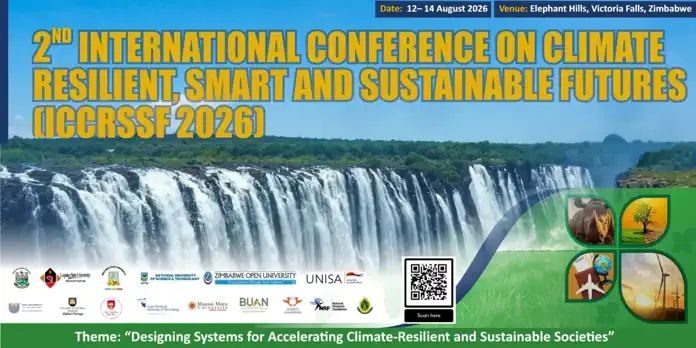
The Vaal University of Technology (VUT), founding institution of the International Conference on Climate Resilient, Smart and Sustainable Futures (ICCRSSF), will join leading universities, researchers, policymakers, industry experts and development partners for the second edition of the conference, taking place from 12 to 14 August 2026 at Elephant Hills, Victoria Falls, Zimbabwe. ICCRSSF 2026 is hosted by Great Zimbabwe University (GZU).
Established by VUT in 2025, when the University conceived and hosted the inaugural conference in South Africa, ICCRSSF was created as a platform for multidisciplinary and international collaboration around climate resilience, sustainability, innovation and the development challenges facing Africa and the wider world. Its progression from South Africa to Zimbabwe for its second edition marks an important step in the growth of an initiative that began at VUT and is increasingly developing into a regional and international platform.
The second edition therefore represents more than the continuation of an academic gathering. It reflects the strengthening of a growing African and international network committed to finding practical responses to climate change, sustainable development and the rapidly changing technological landscape.
Under the theme “Designing Systems for Accelerating Climate Resilient and Sustainable Societies”, the conference seeks to move climate conversations beyond isolated disciplines towards integrated, practical and collaborative solutions. Its emphasis is on transdisciplinary knowledge exchange, innovation, cross-sector partnerships and just transitions that respond to the realities facing communities, economies and institutions across Africa and beyond.
Importantly, the conference is closely aligned with the United Nations Sustainable Development Goals (SDGs), particularly Sustainable Development Goal 13 (SDG 13): Climate Action, which calls for urgent action to combat climate change and its impacts. Through its focus on climate resilience, adaptation, mitigation, research, innovation and international collaboration, ICCRSSF provides a platform for universities and their partners to contribute knowledge and practical solutions towards advancing this global goal.
The conference also intersects with other SDGs relating to affordable and clean energy, industry, innovation and infrastructure, sustainable cities and communities, responsible consumption and production, and partnerships for sustainable development.
Among the institutions and organisations participating in the broader ICCRSSF collaboration are VUT, Great Zimbabwe University, the National Research Foundation (NRF) of South Africa, the Presidential Climate Commission of South Africa, the University of South Africa (UNISA), the University of Fort Hare (UFH), Cape Peninsula University of Technology (CPUT), Botswana University of Agriculture and Natural Resources and Maasai Mara University in Kenya, among others.
The conference brings together researchers, practitioners, policymakers, innovators, development agencies, students, civil society, indigenous communities and international organisations. Its programme addresses five broad areas: climate impact, financing, resilience and mitigation; sustainable development and the United Nations 2030 Agenda; smart change and digital transformation; legal and policy frameworks for resilient futures; and the relationship between heritage, education, tourism, aviation and hospitality, sustainable development and climate change.
Professor Khehla Ndlovu, VUT Vice-Chancellor and Principal, said the growth of the conference beyond South Africa demonstrates the value of universities creating platforms that can develop beyond the institutions in which they originate.
“Climate change does not recognise national borders, institutional boundaries or academic disciplines. Our response must therefore be equally interconnected. ICCRSSF provides an important African platform through which universities, governments, industry and communities can bring knowledge together and translate it into solutions that strengthen resilience and improve lives.
“As the founding institution of ICCRSSF, VUT takes particular pride in seeing an initiative established at our University in 2025 grow beyond our institution and South Africa’s borders. This is precisely what meaningful academic partnership should achieve: creating platforms that are shared, sustained and strengthened by others. This work also speaks directly to the ambitions of SDG 13 and the broader global commitment to building a more sustainable future.”
The conference is also expected to explore how emerging technologies such as artificial intelligence, the Internet of Things, robotics, big data and digital climate information systems can strengthen environmental monitoring, disaster risk reduction, decision-making and sustainable development.
The inaugural ICCRSSF was founded and hosted by VUT in 2025 through its Faculty of Human Sciences, in partnership with institutions including the National Research Foundation, Great Zimbabwe University, the University of South Africa, the University of Fort Hare, Cape Peninsula University of Technology, Botswana University of Agriculture and Natural Resources and Maasai Mara University. The inaugural conference brought together academia, government, civil society, industry, international organisations, students and communities around climate resilience and sustainability.
As ICCRSSF enters its second year, its progression from VUT in South Africa to Great Zimbabwe University in Zimbabwe underlines both the regional character of the initiative and the importance of sustained collaboration among African higher education institutions. It also demonstrates how an initiative founded by one university can evolve into a shared platform for African and international knowledge exchange.
For VUT, the continued growth of the conference it founded reflects the University’s broader commitment to advancing research, innovation, internationalisation and partnerships that contribute towards SDG 13, the United Nations 2030 Agenda for Sustainable Development, resilient communities and sustainable economic and social development across Africa.

