



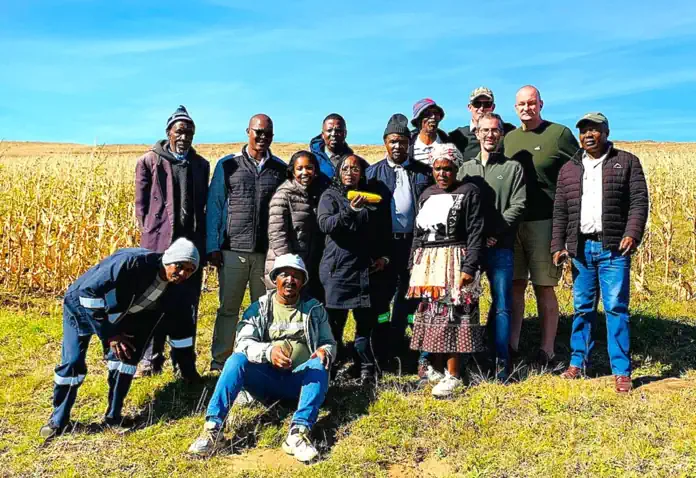
As the world marks World Rural Development Day on 6 July 2026, attention is being drawn to the role of agriculture in strengthening rural economies, improving food security, and creating sustainable livelihoods through collaborative development models.
In the Eastern Cape, a multi-partner agricultural initiative involving Impala Platinum Limited, Ntshwanti Consulting, the Original Grain Fund, and the Original Grain Company is providing a practical example of how structured partnerships can unlock rural agricultural potential.
The Mcambalala Maize Project currently supports white maize production across 50 hectares of communal land in the Eastern Cape, involving 70 participating farmers organised into a cooperative structure. The initiative is structured over a 10-month production cycle, covering planting, cultivation, and harvest.
A potential expansion to 350 hectares is currently under consideration, which would significantly increase production capacity and deepen community participation. If implemented at full scale, the expanded project is expected to yield approximately 2450 metric tons of maize, with an estimated harvest value of around R10 million.
Building a structured agricultural ecosystem
The project brings together complementary roles across funding, technical support, and market access.
Impala Platinum Limited has provided funding support as part of its broader social investment and community development commitments. Ntshwanti Consulting oversees project coordination, social facilitation, cooperative development, and governance support. The Original Grain Fund, through its Advanced Agricultural Product Purchasing (AAPP) programme, provides agricultural expertise, operational guidance, and production support across the farming cycle.
The Original Grain Company provides a guaranteed offtake arrangement, purchasing the harvested maize at market-related pricing and ensuring a secure route to market for the cooperative.
Strengthening rural resilience through agriculture
According to Ryan New, Managing Director of the Original Grain Company, the initiative demonstrates how coordinated agricultural support can unlock long-term rural development outcomes.
“Many rural communities have access to land but face barriers such as capital constraints, limited technical support, and uncertain market access,” says New. “This project brings together funding, expertise, and guaranteed offtake to help bridge those gaps. It is not only about this harvest, but about building a repeatable model for sustainable rural agriculture and long-term economic participation.”
New adds that the project has significant potential for expansion. “The planned scale-up to 350 hectares represents a major opportunity to increase production, strengthen local food systems, and extend the economic impact across the community. Agriculture, when properly supported, becomes a driver of both food security and economic empowerment.”
Skills development and food security
Ntshwanti Consulting Managing Director, Thandile Ntshwanti, says the initiative is already delivering meaningful social and developmental outcomes beyond production.
“Agricultural projects such as this go beyond food production. They improve food security and provide access to fresh food in communities where poverty and unemployment remain high,” says Ntshwanti. “These initiatives also contribute to long-term resilience by equipping people with agricultural skills, enabling them to move from subsistence farming into structured commercial production. In doing so, we are also addressing unemployment and strengthening local economic activity through agriculture.”
Ntshwanti emphasises the importance of collaboration. “We need stronger partnerships between government, corporate stakeholders, and local communities. When local knowledge, technical expertise, and structured market access are combined, rural agricultural development becomes far more sustainable and impactful.”
Cooperative development and risk mitigation
According to Impala Platinum Limited Chief Executive at its Rustenburg operations, Moses Motlhageng, the Mcambalala Maize Project demonstrates how structured cooperation can transform informal farming into a viable commercial operation.
“Agricultural initiatives such as the Mcambalala Maize Project are powerful drivers of rural resilience because they transform informal subsistence farming into structured, sustainable enterprises,” says Motlhageng. “In Mcambalala, 70 farmers have been brought together into a formal cooperative, supported through training in governance, compliance, and collective organisation. This structure improves efficiency, strengthens bargaining power, and lays the foundation for long-term development.”
He notes that securing a guaranteed buyer has been critical. “One of the biggest challenges in rural agriculture is the cashflow gap between planting cycles. Through the offtake agreement with the Original Grain Company, we have secured income certainty, reduced market risk, and strengthened the financial stability of the cooperative.”
Motlhageng adds that partnerships are central to resilience. “Rural agricultural projects are exposed to weather and market risks, which is why partnerships are essential. Each stakeholder brings a different strength, from funding and technical expertise to mechanisation support and market access. Together, these elements ensure the project is not only viable today, but positioned for long-term sustainability.”
A model aligned with rural development goals
The initiative aligns closely with the objectives of World Rural Development Day, which promotes investment in rural infrastructure, agriculture, and inclusive economic development as pathways to reducing poverty and strengthening resilience.
With a 50/50 gender participation split among stakeholders, the project also reflects growing inclusion within rural agricultural development.
“Rural development is most effective when communities are active participants in creating their own economic opportunities. Agriculture provides a practical and scalable way to achieve this, turning available land into productive assets that support livelihoods and long-term growth,” concludes New.
Website: www.theoriginalgraincompany.co.za
AAPP video: https://www.youtube.com/watch?v=1PwEuJQW5M8
For further information about Impala Platinum Limited and Ntshwanti Consulting please visit:

