



Afrika Tikkun says closing the gap is a compliance and economic question, not a charity one
South African employers have five years to close a compliance gap most have barely started addressing. The Commission for Employment Equity’s 26th annual report, covering April 2025 to March 2026, puts the share of the workforce made up of persons with disabilities at 1.3% among designated employers. The Employment Equity Regulations that took effect on 1 January 2025 set a sector target of 3% within five years.
That gap understates the real problem, says Lana Roy, Afrika Tikkun’s Disability and Inclusion Head. Most of the 1.3% is physical and sensory disability. Persons with intellectual and learning disabilities are barely represented in the figure at all, she says, speaking from years running placement and employer-partnership work for this group specifically. “This isn’t a talent problem. It’s a structural one.”
The economic case is not new, either. A 2009 International Labour Organization study, The Price of Exclusion, examined ten developing economies, South Africa among them, and put the cost of excluding persons with disabilities from work at 3% to 7% of GDP. Roy points to similar continental figures: youth with disabilities across Africa are far more likely to be out of school and out of work than their peers, and young women worse off again.
What keeps the gap open, says Latchean Mhlanga, Afrika Tikkun’s Disability Project Manager, is less about employer intent than about recruitment mechanics. Many young people with intellectual and learning disabilities spend years in special schools training in gardening, beauty therapy, carpentry and similar trades.
When they apply for jobs, Mhlanga says, they are routinely asked for a matric certificate and told to complete a standard online assessment, requirements that often have nothing to do with the role. “It’s not because there are no jobs. Our recruitment systems are not accommodating.” Candidates get turned away, she says, “not because they don’t have the skills, but because they are not given the opportunity to show the skills that they have.”
Roy’s ask of employers is specific enough for a compliance officer to act on: audit which roles genuinely require a matric certificate or a written test, and which requirements simply went unquestioned. Replace them, where possible, with a supervised trial shift or a practical demonstration. “Open your recruitment process and ask honestly whether it was ever designed to include this group.” Afrika Tikkun benchmarks its own employer-facing programme against the Valuable 500 coalition of chief executives and the UN’s Zero Project, and runs corporate sensitisation training alongside its placement work, on the view that hiring one candidate is not the same as fixing the pipeline.
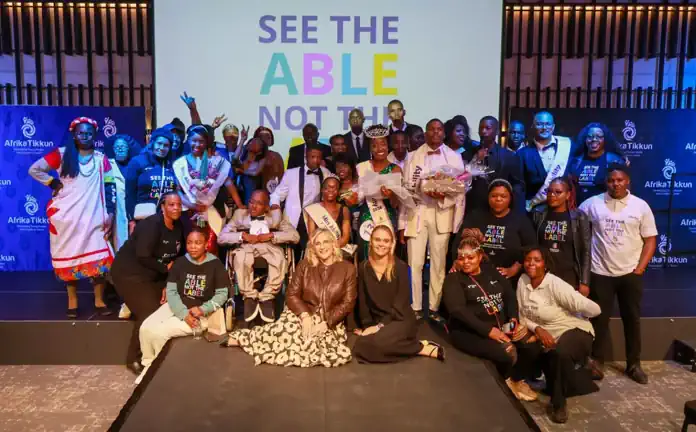
That work played out publicly on 31 July, when Afrika Tikkun crowned the winners of Mr and Miss Ability 2026 at The Venue at Nine Yards in Rosebank. Yanga Gongwana, 25, from Orange Farm, and Nonhlanhla Nxasana, 21, from Braamfontein, took the top titles; Njabulo Vincent Mthembu, 27, from Alexandra, and Ayanda Mncube, 28, from Braamfontein, were named Prince and Princess. All four will serve as Disability Inclusion Ambassadors for the organisation over the coming year.
It was the second edition of the pageant, which sits inside Afrika Tikkun’s cradle-to-career model alongside work-readiness training, life and work skills coaching and employer partnership work, and was supported by FNB, Afribrands, Legends Barber and Clothes to Good.
Roy’s broader ask is aimed at three audiences. She wants media to cover disability inclusion “not as inspiration porn, not as charity stories,” corporates to open up their recruitment processes, and government to enforce regulations that already exist. Formal employment pathways for young people with intellectual disabilities in South Africa remain extremely limited, she says, and that is the gap the programme exists to close.
Her goal for the pageant’s twenty finalists is economic rather than sentimental: “I want you to partake in the economy. I want you to be the next presidents, the next corporate owners, the next execs of this country. And you know what? You can.”

