



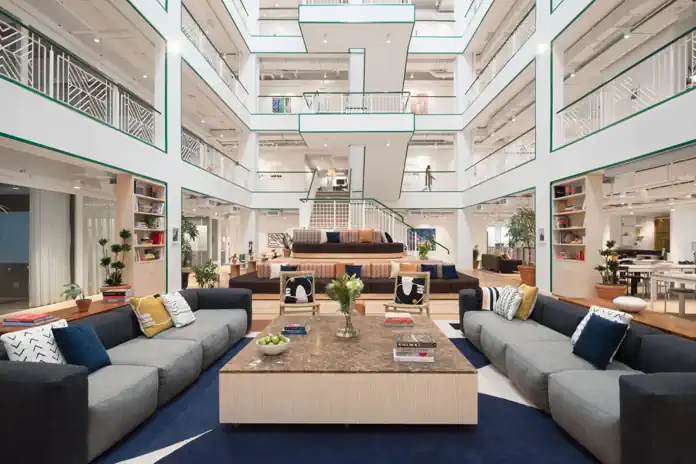
Back in 2020, real estate futurist Antony Slumbers made a prediction: Commercial real estate would have to shift from selling a product to delivering a service. More provocatively, he argued that people no longer needed an office to work. For Slumbers, landlords and corporate companies, ultimately, would have to rent offices that working South Africa actually wanted to use. Six years later, the prediction feels less future-gazing and more like a present disruption of a comfortable office heritage; one that not everybody knows how to write.
Johannesburg, 2 September 2026: For generations, the office has been shaped by a set of familiar conventions – the slick high rise, with clad grey corridors; the aspirant corner office; siloed departments; a microwave and a fridge, alongside the proverbial ‘lunch at your desk’. These components that once felt safe and shaped our collective identity by connecting employees to South Africa’s traditional corporate office culture, are shifting rapidly. Perhaps the most deeply inherited idea of all, is that the office is somewhere ‘we need to go to.’
According to WeWork South Africa CEO, Stefano Migliore, some of that inheritance is ready for retirement. Flexible workspaces are changing the industry – stretching far beyond the companies that are occupying it.
“South African businesses have outgrown the idea that work is a place we must go to. The building hasn’t disappeared, but what we’re asking it to do has fundamentally changed,” says Migliore.
Antony Slumbers predicted that the office company of the future would need to combine real estate, technology, workplace, HR and hospitality. Migliore concurs, and believes separating these disciplines misses the point, and that real estate and hospitality aren’t competing answers.
“Can you have a bacon-and-egg sandwich without the bacon? Or without the egg? Take either one out, and there’s no business,” says Migliore. “By comparison, if one compared the workplace to a hotel: at the back of house, sits a solid real estate play whilst out front, the guest is experiencing hospitality. The same applies to flexible real estate.”
“Hospitality is part of the new ‘office heritage’. Even Wi-Fi becomes hospitality. If the Wi-Fi in a flexible workspace doesn’t work, the office member doesn’t experience an IT problem, they experience it as a failure of what they have come to expect as part of the product they have bought into,” says Migliore.
Flexibility and Hospitality as a Real Estate Strategy
The shift is no longer anecdotal. Cushman & Wakefield | BROLL {2025} identifies the transformation of the office as one of the defining forces in South African CRE (commercial real estate), with flexible workspaces, health-oriented design and greater tenant control now shaping what businesses expect from their buildings.
“These days, your ‘tenants’ don’t experience all the operations behind the scenes, they’re meeting them as whether or not the day worked,” says Migliore.
While there is a demand growing for customisable layouts, modular and multi-use spaces as well as on-demand amenities including cafés, gyms and conference facilities, the rewrite may ultimately stretch beyond what happens inside the office walls.
South Africa’s future workplace footprint could become more distributed too with smaller offices closer to where talent lives, and flexible hubs and on-demand space all working as part of the same property ecosystem.
For Migliore, one of the clearest signs of this shift isn’t simply the growth of flexible workspace, it’s what traditional corporates are doing in response.
Migliore says: “Corporates for whom the shared workspace model may never be suitable have spent significant capital redesigning their offices to mirror the experience that shared workspaces have put at the centre of their business model.”
With office occupancy improving but still below levels seen five years ago, Cushman & Wakefield | BROLL {2025} suggest employers now face a very different property caveat: competing with the flexibility of home by creating offices people have a reason to choose.
Then the Tenant, now the Customer
Migliore’s thinking challenges another piece of property heritage: tenant versus customer, and who really is the landlord signing.
“Our customers are our members; the sooner commercial landlords start seeing tenants as members of a bigger ecosystem, the better their business models will stand up to the challenges of the future,” says Migliore.
Comparatively, Slumbers and Migliore sit on the same line – both seemingly determined that while the modern workplace is different, there is a massive move from designing for the leaseholder, to designing for the human being who walks through the door.
Slumbers went on to add that the workspace should be thought of more like software: never truly finished, but continually learning from their users and upgrading to improved versions.
For Migliore, that is already happening. “WeWork is a living product. As a future-forward workspace, we’re obliged to listen to our members, so that we can continue to evolve and keep up with modern workplace demands. South African companies should be following suit.”
The Next Chapter of Work
While more companies are waking up to the new ‘office’, South Africa’s office of the future is unlikely to be defined by one model winning and another disappearing. The new office heritage sees flexible workspace sitting alongside traditional commercial property as an enabler of customer and supplier – and a healthy competitor too.
“Looking ahead, a building that offers a component of flex space, whether operated by the landlord or not, will compete better than a building that has none,” says Migliore.
Perhaps the next generation of South African commercial property may not be judged solely by its flex space, square metres or the length of the lease attached to it. Its value will also sit in how quickly it can adapt to the businesses inside it; how well it responds to the people using it; and whether it provides enough reason for people to choose it.
“Heritage, after all, isn’t only what gets handed down to us, it’s what we decide is worth handing forward, and then doing the best we can to preserve the best parts of it,” says Migliore.
Sources:
Talent and the Real Estate Company of the Future — Antony Slumbers
About WeWork:
WeWork is the leading global flexible space provider, offering businesses of all sizes the solutions they need to thrive in a new world of work. In addition to its flagship South African locations in Sandton, Rosebank and Cape Town, WeWork provides members with a global footprint of 2000 locations across 37 countries, offering beautiful, functional spaces designed to foster productivity and community wherever work happens.
Since entering the South African market, WeWork South Africa has played a defining role in reshaping the country’s flexible workspace landscape. The business has helped shift coworking from a niche offering typically found in smaller spaces and lower-grade buildings, to a premium workplace solution located in some of the country’s most prestigious commercial developments.
Press Contact:
Mantis Communications
Kerry Simpson
Tel: 079 438 3252
Email: [email protected]

