



Artificial Intelligence (AI) is often spoken about in sweeping extremes; transformation, disruption, replacement or rescue. Step into a school, however, and that rhetoric loses its shine.
Inside schools, the work is pragmatic. Leaders are already managing immense pressure, from overcrowded classrooms and infrastructure challenges to inconsistent digital access and rising administrative demands.
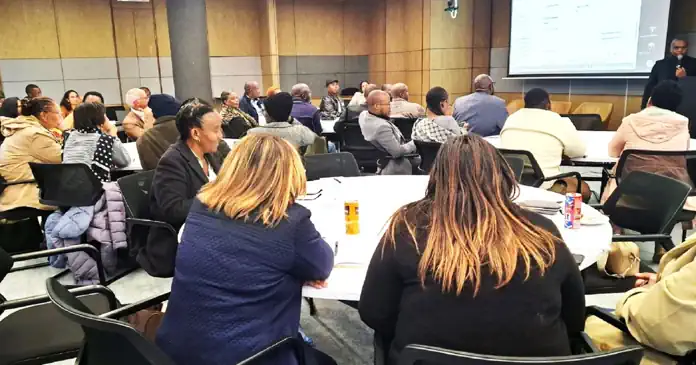
Citizen Leader Lab and Deloitte Africa recently convened a working session in Midrand as part of Deloitte Africa’s annual Volunteer Day, to explore what AI already looks like inside the daily reality of school leadership.
Rather than treating AI as a threat or panacea, participants approached it through the challenges schools already face – how AI might reduce administrative burden, support decision-making and strengthen existing systems without replacing human judgement?
CEO of Citizen Leader Lab, Komala Pillay, connected the purpose of the session to the organisation’s broader leadership mission. “We are all about leadership,” she explained. “We know leaders can change the world for the better or for the worse. But as an organisation, we have the opportunity to work with ethical, conscious leaders who want to make a positive difference. This is what gives us hope for our country.”
She added these spaces matter because they allow leaders to learn from one another and engage honestly with the pressures affecting them.
The technical session was facilitated by Thabo Tladi, AI and Data Manager at Deloitte Africa, whose work spans the mining, telecommunications, banking, oil and gas sectors. Tladi’s presentation focused on demystifying generative GenAI, explaining both its evolution and its limitations.
“Humans have always looked for ways to automate work and reduce burden,” Tladi noted. “AI has existed for a very long time in different forms. Predictive text is one example. Through pattern recognition, your phone predicts what you are likely to type next. But it is important to remember that through all of this, AI has no consciousness.”
Participants explored the different GenAI modalities currently available and the range of outputs these systems can produce, from text and images to video, audio and code. Discussions also examined where AI can add value when used responsibly: Improving efficiency, automating repetitive tasks and supporting creativity.
At the same time, the session did not avoid the risks. Tladi spoke about the limitations of Large Language Models (LLMs), including hallucinations, misinformation and the absence of built-in fact-checking mechanisms. The emphasis throughout remained on responsible use, critical thinking and human oversight.
The conversation became particularly dynamic during the discussion sessions, where educators and school leaders reflected on how AI is already entering classrooms and administrative systems.
Richard Mapike, an English teacher at the John Orr School of Specialisation, spoke about how many of his learners travel long distances to school and return home with limited time for homework. He explained that AI has helped him compile additional learning resources, generate educational games and create more engaging homework activities.
“As the creator using AI, I’m able to monitor progress,” Mapike said, adding that lessons often “stick better” when learners engage with AI interactively. At the same time, he cautioned against overreliance. “AI should not suspend thought,” he said. “The human aspect is still very relevant.”
Principal of Laerskool Jim Fouche, Robertson Mabaso, shared that he has begun using GenAI tools to assist with administrative communication. He noted that it has been especially useful when navigating sensitive communication with parents. “It helps you find the right words and the right tact,” he explained.
Meanwhile, UJ Academy mathematics teacher, Deepa Gopal, reflected on a challenge increasingly familiar to teachers globally – learners are often enthusiastic about using AI tools, but do not always understand the reasoning behind the answers generated. “They may arrive at the correct answer,” Gopal explained, “but they do not necessarily comprehend how they got there.”
Participants discussed other practical applications, including the use of AI to support timetable construction, reduce scheduling conflicts and setting examination papers. The consensus was that while AI can be extremely useful, outputs are often generalised and still require substantial human refinement to become contextually relevant for schools.
The session concluded with a practical case study on how to effectively prompt AI tools to extract the best possible response to a given request. This case study was delivered by Petros Hatzipanis, a Business Intelligence and Information Engineering professional associated with Deloitte Africa.
As AI continues to enter workplaces across sectors, education will inevitably continue to evolve alongside it. If the session demonstrated anything, it is that responsible implementation will depend less on the technology itself and more on the quality of leadership and human thinking guiding its use.

