



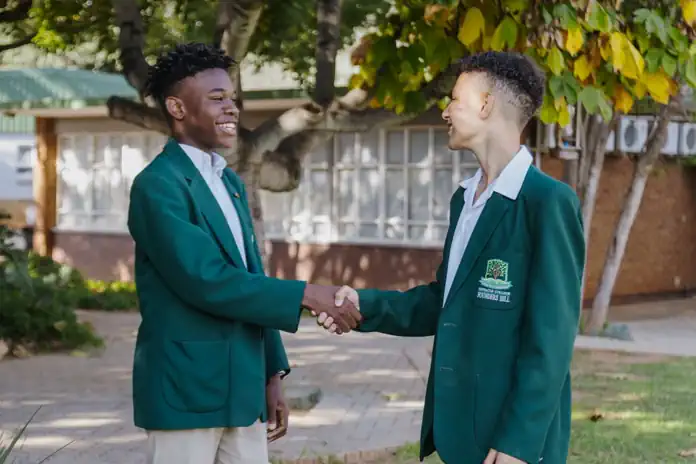
Schools have an important role to play in developing confident, responsible young people who can communicate, collaborate, make decisions and positively influence the world around them.
Leadership is often associated with a badge, title or position of authority. Yet some of the most powerful examples of leadership in schools come from students who may never become head girl, head boy or a member of a student council.
A student who supports a struggling teammate, includes someone who feels left out, takes responsibility for a mistake or helps a group succeed is already demonstrating leadership.
Louise Jansen, Executive Head of School at Pinnacle College Raslouw, believes every student should have opportunities to discover and develop their leadership potential.
“Leadership does not have an age attached to it,” says Jansen. “A child as young as four can begin learning to lead through simple, age-appropriate responsibilities. True leadership is about supporting others, setting an example and remaining grounded in values such as honesty, kindness and integrity.”
Schools provide a relatively safe environment in which students can make decisions, solve problems and learn what happens when things do not go according to plan.
Younger students might lead a small group, hand out books, help classmates understand a task or make simple decisions independently. Older students can take responsibility through sport, cultural activities, mentoring, outreach initiatives, academic projects and community programmes.
These experiences allow leadership to become something students practise rather than an honour reserved for a select few.
“A badge or title means very little if a student is never trusted to do anything with it,” Jansen explains. “Responsibility turns a leadership position into a genuine learning experience. Students develop judgement when they are allowed to make appropriate decisions, solve real problems and experience the consequences.”
Genuine responsibility also brings the possibility of failure. Schools should allow students to make mistakes, provided that reflection and accountability form part of the process.
“We cannot ask young people to become capable decision-makers while never allowing them to make a wrong decision,” says Jansen. “Students need to reflect, accept responsibility and learn from the experience. A second chance allows them to demonstrate that learning has taken place.”
Traditional ideas about leadership can unintentionally favour confident public speakers, popular personalities or highly visible students. Leadership potential, however, is not always loud.
Some students lead through empathy, organisation, creativity, reliability or quiet consistency. Teachers are ideally placed to notice the student whom others naturally trust, the child who includes someone standing alone or the reserved individual who consistently gets things done.
“Exceptional leaders are often quiet observers who listen carefully before they speak,” says Jansen. “Schools should develop the strengths that already exist in each child instead of trying to turn every student into the same type of leader.”
Women’s Month presents schools with a valuable opportunity to introduce students to women leading in business, science, education, sport, public service and their communities.
Girls also benefit from seeing female principals, teachers and other women in leadership roles every day. Such role models make leadership tangible and demonstrate that strength does not require women to surrender kindness or compassion.
“Girls should grow up knowing that their ambitions do not need to be limited,” says Jansen, who is also the mother of two daughters. “Meaningful responsibility teaches young women to trust their judgement, use their voices and become independent.”
Boys must be included in these conversations too. Young men and women will study, work and build communities alongside one another, making mutual respect and collaboration essential.
“Respect for women in leadership should be normalised from childhood,” Jansen adds. “Boys should learn to value someone’s contribution because of that person’s ability, character and values, rather than gender.”
Future workplaces will demand adaptability, sound judgement, emotional intelligence, integrity and the ability to communicate across differences. Technological advances may transform how people work, but human qualities will remain central to how effectively they lead.
“Skills can be taught and qualifications can be earned, but character determines what you do with them,” says Jansen. “Education should prepare a child for far more than an examination. Good leadership skills are ultimately good life skills.”
South Africa’s future leaders may already be sitting in today’s classrooms. Their potential will not always be announced by a title, badge or the loudest voice in the room. Sometimes, it will be seen in a quiet act of courage, a difficult decision handled honestly or a student choosing to help someone else succeed.
“South Africa needs thoughtful, capable and courageous young leaders,” Jansen concludes. “The way they treat people will always matter more than the titles they hold.”

