



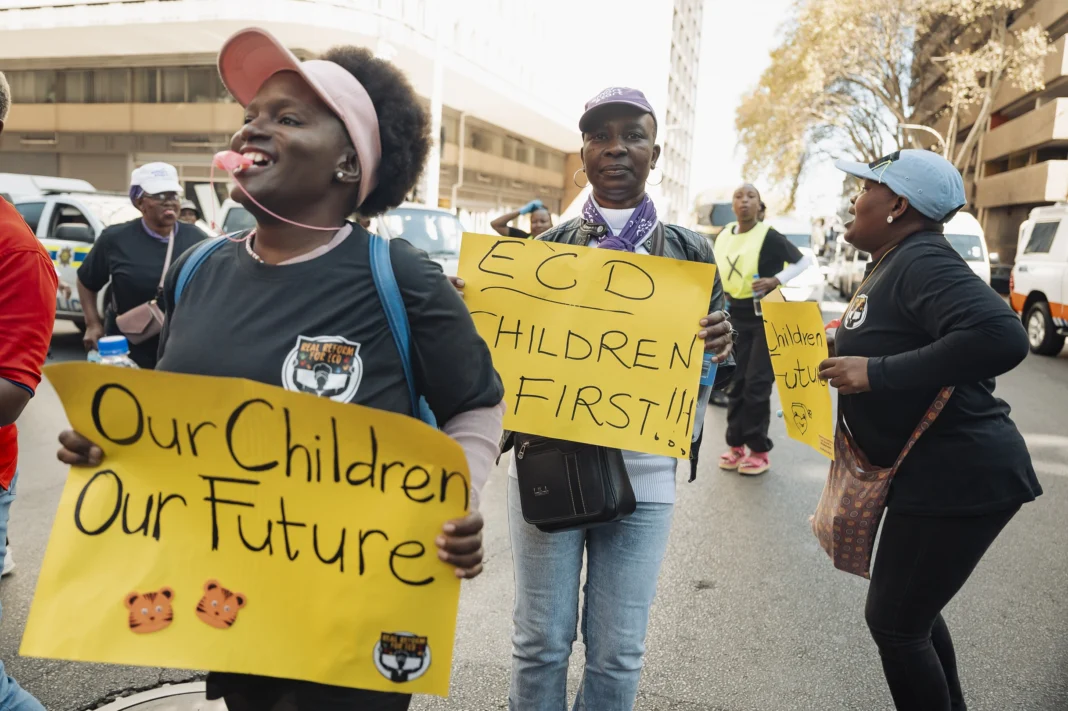
Thursday, 22 October 2026 – Real Reform for ECD calls on the government to use the 2027 Budget to turn fiscal stabilisation into meaningful investment in South Africa’s youngest children, and those who care for them. Increase the ECD subsidy, bring the Child Support Grant into line with the cost of basic nutrition, and ensure that funding for ECD meals reaches children.
Finance Minister Enoch Godongwana told Parliament yesterday that debt has stabilised and that the fiscal space created allows the government to protect frontline services and vulnerable households. Yet, we still do not see signs of a Budget that puts children first.
The 2026 Medium-Term Budget Policy Statement (MTBPS) includes welcome commitments to maternal and child nutrition and additional social workers. However it announces no increase in the per-child-per-day ECD subsidy or the Child Support Grant. Moreover, funds for a much-needed ECD nutrition programme are at risk for the third year in a row.
If no additional investments are made in the 2027/28 budget, instead of building on the promise of the 2025/26 budget, we will be taking steps backwards.
Under-investment in early childhood is a choice, one with disastrous consequences for our children, our economy and our democracy. We should no longer be making such a choice.
What we welcome
We welcome the R1.6 billion allocated over the medium term for pre-birth care and the first 1,000 days of life, and the government’s goal of ending stunting. We also welcome R3.8 billion to employ more than 3,500 social workers. Social workers are critical for child protection and family support, including the registration and support of early learning programmes, and play an important role in reducing and responding to gender based violence and violence against children.
Social workers in the ECD sector are extremely stretched, and additional capacity to support registration and improvement would help improve access to the per child per day subsidy.
Where the MTBPS falls short
At the recent Bana Pele leadership summit, President Cyril Ramaphosa told the sector that the value of the subsidy “will keep on increasing”. However, the subsidy was last increased on 01 April 2025 and no indication has been provided that the value will increase in the 2027 budget, despite the rising cost of food, energy and other operational costs of early learning programmes. The current value of R24 per child per day is far below the R45 target value in the Department of Basic Education’s 2030 Strategy for universal access to quality ECD programmes.
Families in poorer communities, where unemployment is rife, cannot make up the difference in fees. As a result, children in these communities attend lower-resourced programmes or none at all, while the women who care for and teach them earn far below the minimum wage or go unpaid. About one million children aged three to five still attend no early learning programme and over 90% of ECD practitioners earn below minimum wage.
The Child Support Grant cannot feed a child. At R580 a month, the grant sits 33% below the food poverty line of R868. In a country whose Constitution makes children’s best interests “of paramount importance”, this is a damning indictment of our priorities.
It is also concerning that the R1.6 billion allocation to tackle stunting is funded from social-grant savings. Government must provide evidence to show that declining access to the Child Support Grant is a result of falling birth rates, as claimed, and not due to administrative barriers and inefficiencies, such as difficulties and delays in registering births and processing CSG applications.
ECD nutrition money is still not reaching children. R743 million is set aside over the medium term for the DBE’s ECD nutrition pilot, first funded in 2024. Not a single meal has yet been served through it. The tender to feed 26,620 children at 1,035 Eastern Cape programmes has been postponed eight times. Meanwhile, the DBE surrendered R743 million in unspent funds in 2025/26, almost 40% of it from the pilot.
The allocated funds must be protected and the programme implemented urgently.
Children’s rights cannot wait
In South Africa, ECD is increasingly recognised as an implicit constitutional right—one which is also protected by the United Nations Convention on the Rights of the Child and the African Charter on the Rights and Welfare of the Child.
Allowing the value of support to erode undermines this right, especially for children from low-income households, who are often excluded from accessing quality ECD programmes. These cuts also raise serious concerns about the legal principle of non-retrogression: the government should not offer a lower level of rights protection than it used to.
Investing in children’s growth is investing in South Africa’s growth
The Minister said that “every rand invested must deliver greater economic returns.” Few public investments do this as reliably as early childhood. Quality early childhood programmes for disadvantaged children have returned 13.7% a year over participants’ lifetimes. A World Bank review of 22 studies in low- and middle-income countries found that childcare improved mothers’ labour-market outcomes in all but one. Investing in ECD has high multiplier effects; for example, research shows that R1 spent on ECD generates R9 in benefits on average.
Fully implementing the DBE’s 2030 ECD Strategy could support 300,000 new jobs and 70,000 enterprises in township and rural economies, and ease childcare burdens for up to two million women.
The ECD sector already employs nearly 200,000 people, overwhelmingly women and mostly paid below the national minimum wage. Increasing the ECD subsidy would help recognise and remunerate their critical work while improving the quality of care and early learning available to children.
With economic growth forecast at just 1.2% this year, a budget statement built around infrastructure cannot overlook the social infrastructure that makes work possible. Investing in ECD supports children’s development, women’s economic participation and employment in the communities that need it most.
Real Reform for ECD demands:
- Government must progressively increase value of the ECD subsidy to R50 per child per day by 2030,
- Government must ensure that the value of the Child Support Grant keeps pace with, at a minimum, the food poverty line.
- DBE must urgently launch the ECD nutrition pilot programme and protect its allocated funds.
Real Reform for ECD (RR4ECD) is a movement advocating for holistic, well-funded, inclusive and quality early childhood development (ECD) services for all children in South Africa. We campaign for a legal, policy, regulatory and budget environment that makes it possible to provide and expand ECD services, especially for children in low-income communities. RR4ECD is a broad alliance led by elected representatives who form its Steering Committee. Through local ECD forums it supports a network of more than 1,000 practitioners, and it is backed by more than 300 organisations. For more information, visit www.ecdreform.org.za.
This statement is also supported by the CARE Alliance, which brings together Real Reform for ECD and trade unions, community movements, rural women’s organisations and ECD organisations to campaign for greater public investment in care. Its members include the National Union of Public Service and Allied Workers Union, Stellenbosch University’s Institute for Life Course Health Research (ILCHR), Mining Affected Communities United in Action (MACUA)/ Women Affected by Mining United in Action (WAMUA), the Rural Women’s Assembly and the Labour Research Service (LRS).

