



A study from KLA shows that list-led shoppers are more likely than average to make unplanned supermarket purchases
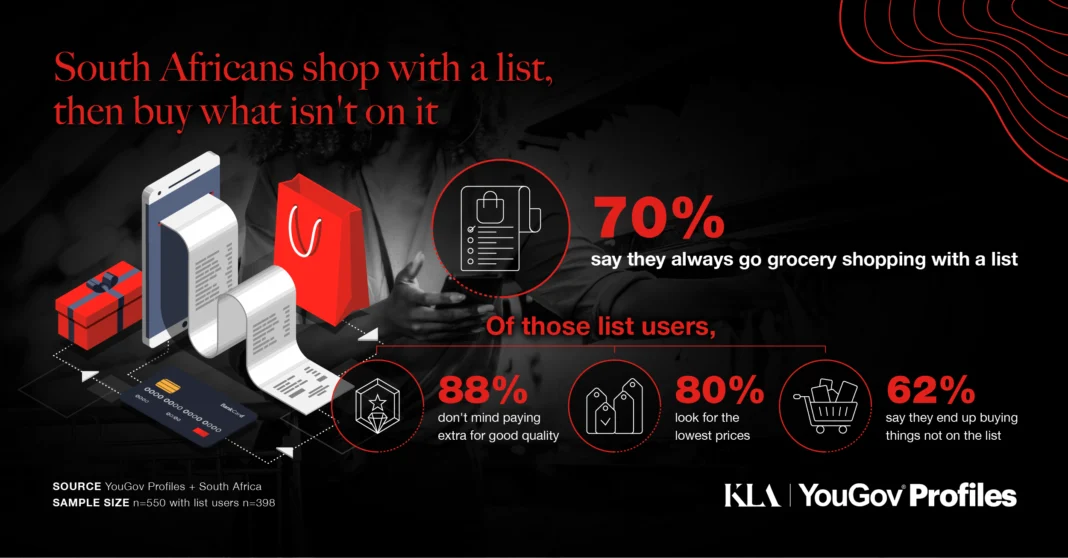
Seven in ten South African adults (70%) say they always go grocery shopping with a list, yet most of those same shoppers come home with things they never wrote down. That is the central finding of YouGov Profiles+ data accessed through consumer insights agency KLA, the exclusive partner for YouGov in Sub-Saharan Africa, and it overturns a common assumption about how planned shopping works.
Among list users, 62% say that every time they go to a supermarket they end up buying things they hadn’t intended to. Across all adults the figure is 56%, which means the country’s most organised grocery shoppers are more likely than average to buy on impulse. The list gives the trip its shape. What actually ends up in the trolley is still decided, at least in part, in the aisle.
Who the planned shopper is
List users are concentrated in the 25 to 44 age group and are split evenly between men and women. They are more likely than average to hold a bachelor’s degree (42% compared with 37% of online adults nationally). Income makes no real difference, though. Shoppers in every income group are equally likely to rely on a list, so this is a habit of mind rather than a matter of budget, and it makes list users a broad, commercially significant audience.
They are also the people deciding what the household buys. Around 59% are the sole grocery decision-maker at home and another 38% share that role. Most spread their spend across several chains, including Checkers, Pick n Pay, Shoprite, Spar, Woolworths and Food Lover’s Market. List use peaks among shoppers at bulk and hypermarket retailers such as Game (94%) and Makro (85%), where trips tend to be bigger and more considered. It drops among people doing a daily shop at convenience-oriented stores, where proximity and immediacy drive the visit far more than planning does.
Impulse buyers know exactly what things cost
People who regularly make unplanned supermarket purchases don’t fit the stereotype either. If anything, their attitudes say a lot about what drives the extra item into the basket. Close to half (45%) strongly agree that they are usually looking for the lowest prices when they shop, compared with a national average of 38%. At the same time, 58% strongly agree that they don’t mind paying extra for good quality products, compared with 51% nationally. These are price-literate shoppers who will trade up when the quality is obvious, and their unplanned purchases are a response to what is in front of them on the shelf rather than a lapse in attention.
“A shopping list tells you what someone is meant to buy. It doesn’t tell you what they’ll walk out with,” says Rakhee Naik, Managing Consultant, Insights at KLA. “The people who plan most carefully turn out to be some of the most open to persuasion once they’re standing at the shelf. Getting onto the list is only half the job for a brand. The aisle is a second moment of decision, and the shopper in it is weighing up price, quality and whether the deal in front of them actually makes sense.”
Deals, quality and loyalty all at once
List users show the same blend of instincts. Eight in ten (80%) say they usually look for the lowest prices and 87% always make sure they use sales, coupons and deals, yet 88% don’t mind paying extra for good quality and 91% prefer brands that are sustainable. Taken together, the figures describe someone who wants quality at a price that feels justified, and whose real frustration is paying over the odds for something ordinary.
Loyalty programmes fit neatly into that thinking. Among list users, 91% believe loyalty programmes are a great way for brands to reward customers, 85% sign up whenever they are given the chance, and 81% say they spend more with brands whose programmes they belong to.
“For this shopper, a well-run loyalty programme does more than bring them back. It gets them to spend more,” says Naik. “The brands that do well will reward people for planning and still give them a good reason to trade up in the moment. If the better choice feels like the sensible one, where price and quality meet, shoppers will take it.”
Methodology
Data sourced from YouGov Profiles+ South Africa, a segmentation and media planning tool that draws on data collected daily to build a comprehensive view of consumers’ lives. KLA is the exclusive authorised YouGov partner in Sub-Saharan Africa.
Population: South African adults with access to the internet, aged 18+.
Dataset: Profiles+ South Africa, shopping behaviour and retail attitudes variables, 2026-07-19.
Sample sizes: shopping list question n = 550; list users n = 398; supermarket impulse buyers n = 321.
Agreement figures combine “tend to agree” and “definitely agree” responses unless stated otherwise.

