



SOUTH AFRICA — The 2026 Local Government Elections in South Africa have commenced with a smooth operational rollout, as the Electoral Commission of South Africa (IEC) confirmed that 98 percent of the nation’s 23,696 voting stations were open by 7 am on Wednesday.
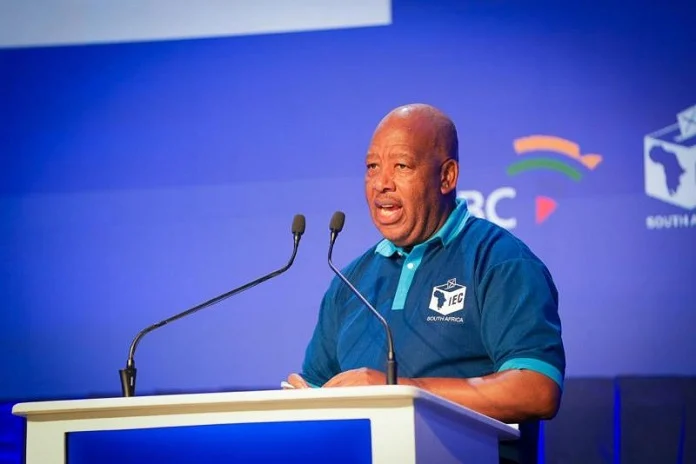
Providing an update at the Results Operations Centre (ROC) at the Gallagher Convention Centre in Midrand, IEC Deputy Chief Electoral Officer Masego Sheburi reported that voting proceedings are progressing well nationwide, with millions of registered voters already participating in the democratic process.
Voter Turnout and Technological Upgrades
By 10 am, preliminary figures indicated that 3,523,691 voters had cast their ballots across the country’s nine provinces. Gauteng recorded the highest turnout with 895,384 votes, followed by KwaZulu-Natal (623,380), the Western Cape (461,264), and the Eastern Cape (431,123).
The remaining provinces reported the following preliminary figures: Limpopo (366,378), Mpumalanga (252,859), North West (204,736), Free State (195,537), and Northern Cape (93,030).
Sheburi expressed encouragement at the enthusiasm demonstrated by the electorate, particularly those who arrived at voting stations in the early hours. The Deputy Chief Electoral Officer urged all remaining registered voters to utilize the remaining voting hours to exercise their democratic rights.
To improve efficiency, the IEC introduced several new measures for the 2026 Local Government Elections. These include handheld barcode scanners attached to Voter Management Devices (VMDs) and the implementation of sequence numbers on the voters’ roll. According to Sheburi, these additions are designed to speed up voter verification and reduce waiting times, with the VMDs currently functioning optimally to support smooth processing.
Minor Delays and Ballot Instructions
While the overall rollout was seamless, the Commission noted that a small number of voting stations opened at 9 am due to localized protests and access challenges caused by heavy rainfall in the Eastern Cape and KwaZulu-Natal. Despite these localized issues, all ballot papers have been successfully delivered to stations across the country, with only a few deliveries completed shortly after voting commenced.
The IEC also used the briefing to clarify voter instructions regarding ballot papers, noting that the number of ballots issued depends on the municipality type.
Voters in local municipalities will receive three ballot papers: a grey ballot to elect a ward councillor, a green ballot to vote for a political party in the local council, and a yellow ballot to elect political party representatives to the district council. Voters in metropolitan municipalities will receive two ballot papers: a grey ballot for their ward councillor and a green ballot for their preferred political party in the metropolitan council.
Sheburi reminded voters to make only one clear cross in the designated box next to their preferred candidate or party on each paper. Marking more than one choice or making additional marks will result in the ballot being declared spoilt.
Security Incident in KwaZulu-Natal
The Commission addressed an isolated security incident in KwaZulu-Natal, where unused ballot papers and a stamp were stolen from a single voting station in Ward 2 of eThekwini.
Sheburi noted that there are 20 voting stations in the ward and emphasized that stringent measures are in place to identify the stolen materials if they surface. Because it is a strict requirement that every ballot must be validated by a stamp on the back, any unauthorized ballots will be easily identifiable.
A case has been opened with the South African Police Service (SAPS), and the staff members at the affected voting station have been relieved of their duties pending an investigation into their dereliction of duty.
Inter-Agency Cooperation
In concluding the briefing, the IEC acknowledged the Department of Home Affairs for making its offices available to the public for identity document collection and applications during the election period. The Commission also thanked the various agencies and security structures operating under the National Joint Operational and Intelligence Structure (NATJOINTS) for their ongoing efforts to maintain a safe and secure electoral environment.

