



For most South Africans, foreign policy, diplomatic negotiations and international summits have tangible consequences. Changes in international energy markets, shipping costs, trade relationships and geopolitical tensions can eventually affect the price of fuel, transport, food and other household expenses.
South Africa is part of a global economy, and international developments can move through commodity markets, supply chains, exchange rates and trade before reaching consumers.
That means foreign policy can eventually become an economic issue.
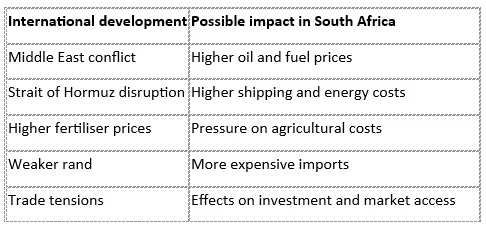
That connection has become particularly visible in 2026. The South African Reserve Bank says the prolonged Middle East conflict intensified global inflationary pressures, with higher fuel and fertiliser prices feeding into South African producer and consumer prices.
Ramaphosa’s foreign policy in addition to domestic conditions like the rand, electricity costs and South Africa’s own economic policies also influence what consumers ultimately pay.
At a glance
Why Does the Middle East Matter to South African Consumers?
One major reason is energy.
International oil markets respond to geopolitical developments, particularly when conflicts threaten energy production or important shipping routes.
The Strait of Hormuz is especially important because it is a major global energy shipping route. Uncertainty around the route can increase oil prices, shipping costs and insurance costs.
If international crude becomes more expensive, South African fuel prices can rise.
October 2026 fuel-price shock
This became particularly clear in October 2026.
From 7 October, petrol 95 was scheduled to increase by R3.33 a litre to above R30, while diesel was set to rise by as much as R3.24 a litre to above R35. The increase was linked to higher global oil prices, US-Iran tensions, uncertainty around the Strait of Hormuz, higher shipping costs and declining inventories.
The South African government said the increase reflected higher crude-oil prices and the impact of geopolitical tensions on global energy markets.
This example shows how international geopolitical developments can eventually reach South African households.
Why Does the Strait of Hormuz Matter to South Africa?
The Strait of Hormuz is one of the world’s most important energy shipping routes.
When tensions threaten the movement of oil through the Gulf, markets can react even before a prolonged physical shortage occurs.
Companies may face higher shipping, insurance and risk costs. Tankers may take longer routes. Traders may build inventories because of uncertainty.
Those additional costs can eventually filter into the prices paid by countries that import energy.
The October South African fuel-price increase demonstrates why the Strait of Hormuz is relevant to South Africans even though the country is geographically far from the Gulf.
The same principle applies to other international shipping routes.
South African businesses may rely on imported machinery, chemicals, components, fuel, agricultural inputs or finished products. A disruption in international logistics can therefore affect domestic production even when the final product is made in South Africa.
What Is BRICS’ Economic Relevance to South Africa?
BRICS is not only a diplomatic grouping but also an economic partnership involving trade, investment, finance and supply chains. However, membership does not automatically translate into economic benefits for South Africa. The key question is whether these relationships generate tangible returns for the domestic economy or reinforce existing trade imbalances and dependence on raw-material exports.
For ordinary South Africans, the relevant measure is not the diplomatic influence or international standing associated with BRICS membership, but its impact on employment, wages, investment, living costs and economic growth. If trade relationships fail to support local production, create sustainable jobs or deliver broader economic gains, the benefits of membership remain uncertain.
How Does Iran Affect South Africa?
South Africa’s diplomatic engagement with Iran, alongside its positions on developments involving Gaza and Hamas, places its foreign policy within a wider and increasingly complex geopolitical landscape. Iran is particularly relevant because it is a full member of BRICS alongside South Africa, creating an institutional link between the two countries.
Iran has provided financial, military and other support to Hamas, which is designated as a terrorist organisation by the United States, the United Kingdom and several other governments. South Africa’s diplomatic relationship with Iran therefore raises broader questions about the geopolitical implications of its international partnerships and how these relationships align with the country’s economic and strategic interests.
For South Africans, the potential consequences extend beyond diplomacy. Regional tensions involving Iran and the wider Middle East can disrupt energy markets, shipping routes and international trade, potentially contributing to higher fuel and transport costs, supply-chain pressures and investment uncertainty. These risks are particularly relevant to an economy that depends on reliable trade routes, affordable energy and sustained investment.
What About South Africa’s Relationship with the United States?
South Africa’s relationship with the United States has also become an important economic and diplomatic issue.
In September 2026, South Africa had summoned the US ambassador for the third time in nine months amid disagreements between the two governments. The tensions followed other disputes, including US visa restrictions affecting some South Africans.
The importance goes beyond diplomacy.
The US is an important trade and investment partner for South Africa. Prolonged tensions can create uncertainty for businesses, exporters and investors.
What Can South Africans Actually Feel?
The effects of foreign-policy tensions are easiest to see when they pass through prices, investment and economic activity.
Fuel
The October 2026 fuel-price increase is the clearest immediate example.
Petrol 95 was scheduled to move above R30 a litre, while diesel was heading above R35 a litre. The increase was linked to global oil prices, US-Iran tensions, Strait of Hormuz uncertainty and higher shipping costs.
Transport
Higher fuel prices can increase the cost of moving goods around South Africa.
That can affect logistics companies, delivery services, farmers, public transport operators and businesses that rely on vehicles.
Food
Higher fuel and fertiliser costs can increase agricultural and distribution costs.
But domestic conditions can offset or amplify these pressures.
Imported goods
A weaker rand can increase the rand cost of dollar-priced imports.
This can affect everything from machinery and industrial inputs to certain consumer products.
Jobs and investment
Foreign-policy relationships can influence where international companies invest, which markets South African exporters can access and how businesses view the country’s long-term economic prospects.
The Bottom Line: Foreign Policy Can Reach the Shopping Basket Indirectly
So, how does Ramaphosa’s foreign policy affect everyday life in South Africa?
The most defensible answer is that it can affect the external economic conditions in which South African households and businesses operate.
South Africa’s relationships with major powers and emerging-market partners, its participation in BRICS, and its responses to international conflicts all form part of a broader foreign-policy environment.
In August 2026, headline inflation was 4.4%, food inflation was 1.1%, while the Reserve Bank continued to identify fuel prices as a major inflationary risk.
For South Africans, therefore, foreign policy is not necessarily something that appears on a supermarket receipt. Its effects can arrive indirectly, through the price of oil, the cost of transporting goods, the availability of fertiliser, the value of the rand and the conditions facing South African businesses.
The Bottom Line: Does Ramaphosa’s Foreign Policy Affect South Africans?
Yes.
International geopolitical developments can create economic pressures that are transmitted to South Africa through energy, trade, shipping and exchange rates, while domestic conditions determine how strongly those pressures affect households.
The October 2026 fuel-price shock is a clear example. Global oil-market pressures linked to US-Iran tensions and uncertainty around the Strait of Hormuz contributed to a major increase in South African fuel prices.
At the same time, the food-price data shows why foreign policy together with domestic agriculture, the rand, transport, wages, electricity and social support can affect South African households.
The relationship can therefore be summarised simply:
Foreign policy → global events → markets → South African economy → household costs.
For South Africans, foreign policy may never appear as a line on a supermarket receipt. Its effects can nevertheless arrive through the price of fuel, the cost of transporting food, the price of imports, investment, jobs and trade.
That is the less visible connection between Ramaphosa’s foreign policy and everyday life in South Africa.

