



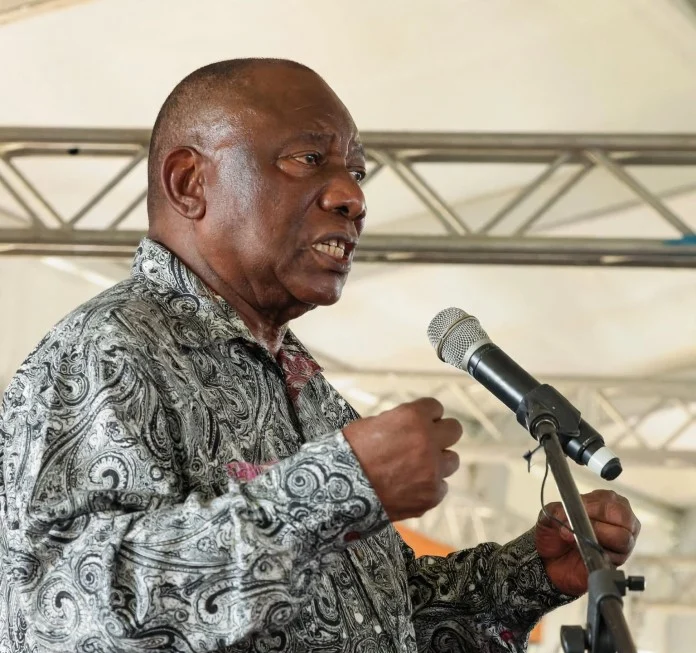
SOUTH AFRICA — President Cyril Ramaphosa has announced an upcoming national address focused on urgent gender-based violence (GBV) measures and the ongoing investigation into the tragic killings of women in Ekurhuleni. Speaking during the National Heritage Day celebrations, the President condemned the crisis as a profound national shame and promised to update the public on the government’s response.
The announcement follows the grim discovery of nine women’s bodies in Gauteng’s Ekurhuleni and surrounding areas over the past two months.
Addressing a crowd at the Bongolethu Sports Stadium in Oudtshoorn on Thursday, President Ramaphosa used the Heritage Day platform to draw a stark line between the country’s cultural pride and the realities of violence against women. He declared that the abuse, rape, and killing of women cannot be classified as part of South Africa’s heritage, emphasizing that women have a fundamental right to walk the streets at any hour without fear.
“The abuse, rape and killing of women is not our heritage. There is no culture worthy of the name that diminishes the dignity of women,” President Ramaphosa stated.
He noted that the pain and suffering endured by South African women stands out as a national shame, arguing that the country’s celebration of its heritage must directly confront the realities affecting daily life. This includes addressing the deeply unequal experience of freedom and safety among citizens.
“It is profoundly unequally lived by a man who can walk the streets without fear, and a woman who must constantly consider whether she will be safe,” he explained.
During his address, the President made a formal declaration on the country’s response to violence against women, maintaining that GBV will not be part of the inheritance left to the next generation. He stressed that strengthening the social fabric of South Africa requires bridging the gaps between the vastly different lived experiences of its people.
Freedom, he noted, is not experienced equally by those living in secure communities versus those living in fear of crime, nor is it equally shared by young people with access to education and those denied such opportunities.
Challenging the nation to build a safer, more dignified country where government effectively serves its people, President Ramaphosa outlined a vision for national prosperity. He called for “A country where there is work. Where business can invest, where workers prosper, [and] where children learn.”
Looking toward the future, the President urged South Africans to guard against forces that seek to undermine national unity. He reflected on the country’s history, noting that while the common enemy in the past was apartheid, the modern adversaries are unemployment, GBV, corruption, and alcohol and drug abuse.
“We must tackle these problems together, like our forebears did when they fought side by side until they defeated apartheid,” President Ramaphosa said. “Our common cause today is bringing about the conditions in which every South African can truly live the freedom that was promised them in 1994.”

