



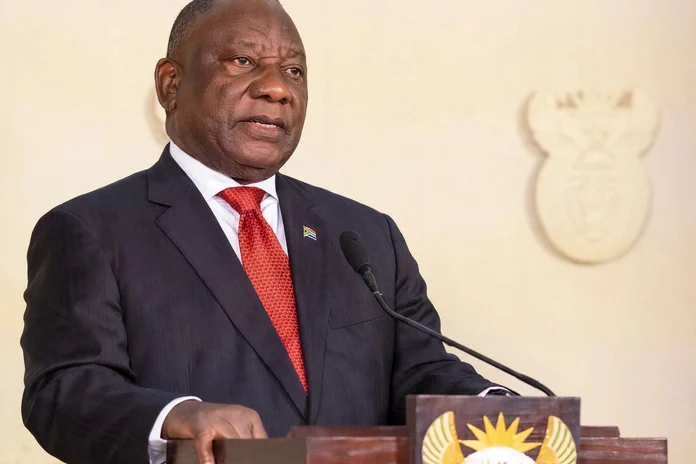
Pretoria, Gauteng — President Cyril Ramaphosa has taken delivery of the panel report on the Iranian navy’s participation in Exercise Will for Peace 2026, but the Presidency says the findings and the proceedings that produced them will remain confidential because of national security concerns.
The inquiry was launched in February after the Iranian navy joined the Chinese-led naval exercise in South African waters contrary to the president’s instructions. Ramaphosa thanked the panel members, chaired by Justice Ngoepe, and said he would give the recommendations careful consideration before deciding on any action.
For defence analyst Dean Wingrin, the handover raises as many questions as it answers. Without access to the report — or even a redacted copy — he says it is impossible to establish where the chain of command broke down, who bears responsibility, or what needs to be fixed.
A Presidential Directive and Two Parallel Tracks
Ramaphosa is commander-in-chief of the South African National Defence Force, and Wingrin stressed that a failure to obey a command is a serious matter within any military organisation.
Insubordination can result in a military trial and, at the most severe end of the disciplinary spectrum, a service member being cashiered from the force — the gravest professional mark against a career, he said.
But this case, he cautioned, cannot be read purely as a military discipline problem. Two tracks run alongside each other: the military chain of command and the diplomatic channel.
China led Exercise Will for Peace 2026 and extended invitations to the participating countries, including Iran. South Africa supplied the host waters rather than commanding the operation. The panel’s task was therefore complicated: it examined whether senior military officers or Defence Ministry officials had failed to implement the president’s instruction in a setting where Pretoria was not the exercise leader.
Wingrin said the president would most likely have passed his instruction to the chief of the defence force, who would in turn have taken it to the minister of defence. In parallel, he said, instructions would probably also have gone through the Department of International Relations and Cooperation, or DIRCO, to raise the matter with the Chinese.
That distinction matters, he argued. Iran was in South African waters on a legitimate invitation from Beijing, with whom it maintains friendly relations. Asking Tehran to stand down would have been a difficult conversation for China, and South Africa itself may not have had the standing to order an invited guest to withdraw, despite the drills taking place on sovereign South African territory.
Participation Was Known; Continued Participation Was the Issue
Wingrin pushed back on the idea that the controversy was simply about Iran turning up.
South Africa took part in the planning stages and meetings for the exercise, and Iran was involved in those discussions, meaning its attendance was known in advance. The problem, he said, was that the Iranian navy continued participating after the presidential instruction was issued.
That is why he wants to see the report’s account of the chain of command, even if operational details are blacked out. Without it, he said, the sequence of who instructed whom — and who was responsible for communicating with the Chinese and the Iranians — remains obscured.
November Plans, January Drills and the Optics of Non-Alignment
The exercise was originally scheduled for November 2025, the same period as the G20 meetings in South Africa. Wingrin described that as a poor moment for Russian, Iranian and other naval activity off the coast while international leaders were visiting the country, and said postponing the drills to January 2026 was the right decision.
The participation of China, Russia and Iran, alongside other BRICS partners, came against a backdrop of heightened tensions between Iran and the United States. Wingrin said the wider geopolitical context, rather than the naval manoeuvres alone, is where the risk lies for Pretoria.
South Africa describes itself as non-aligned, but he said that position is becoming difficult for outside observers to discern when the country is visibly drawn towards the Russian, Iranian and Chinese side of international politics. That alignment is not inherently wrong, he noted, but it has to be weighed against trade and diplomatic relationships.
China is a major trading partner, and Wingrin said few countries would object to South Africa maintaining military relations or holding exercises with Beijing. The difficulty, he argued, is that Russia and Iran have identified other important South African trading partners — Western Europe, the United Kingdom and the United States — as enemies.
With Washington already taking a hard line towards Pretoria, he said, South Africa did not need to provide an additional excuse, pointing to an unresolved negotiation over whether a trade arrangement would be renewed.
Secrecy, Scapegoats and Accountability
The Presidency’s national security justification drew direct criticism from Wingrin. He said analysts have struggled to identify what security interest is protected by withholding a report that is unlikely to address the defence force’s operational capability or the condition of its equipment.
Instead, the inquiry concerns officials in government and the defence force who did or did not follow the president’s instruction. On that basis, he said, secrecy is hard to defend unless it is intended to conceal something or to place blame on a convenient figure.
He drew a comparison with Guptagate, where, he said, a middle-ranking lieutenant colonel was blamed for conduct that many believe amounted to following orders. Keeping the panel’s work out of public view, he warned, will only deepen questions about what the president is withholding and why transparency is being resisted.
Questions put to Wingrin indicated that the panel found officials deliberately disregarded the presidential instruction. He said it would be premature to prescribe consequences or remedies without knowing the commission’s findings on cause and responsibility.
The broader lesson, in his view, is that South Africa must not allow a foreign country to determine who is invited onto its territory, how those visitors behave, and whether they may continue taking part in an exercise once they are here. Even as a host rather than a leader, Pretoria should retain the final say, he said.
Identifying exactly where the chain of command failed is the starting point for correcting it. Until some version of the report is made public, Wingrin’s position is that accountability cannot properly be assessed — and transparency is essential if the failure is not to be repeated.

