



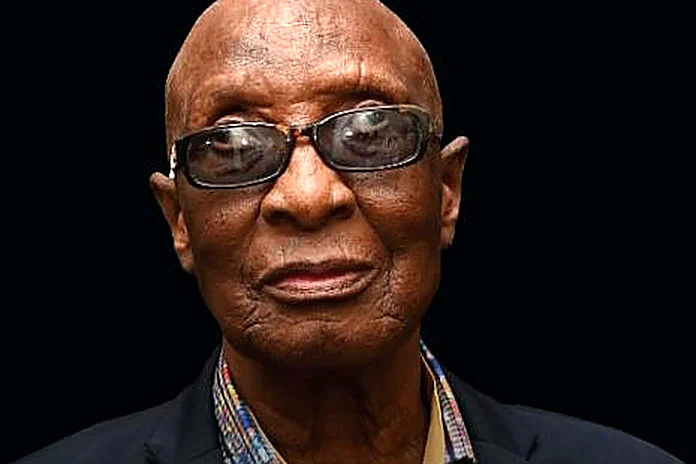
SOUTH AFRICA — South African music legend Babsy Mlangeni has passed away at the age of 83 following a short illness, marking the end of an era for the nation’s creative sector. The iconic singer and guitarist is being remembered by government officials and fans alike as a cultural pioneer whose timeless melodies became the soundtrack of the country’s history.
Sport, Arts and Culture Minister Gayton McKenzie and Deputy Minister Peace Mabe officially conveyed their sorrow over the loss of the Orlando East native. Minister McKenzie described the late artist as a “musical giant” and a foundational voice in the creative sector, noting that his passing represents a profound loss for the nation.
Born Bernard Mlangeni in Soweto in 1943, the artist overcame significant societal and physical hurdles to build a prolific career spanning nearly six decades. He honed his guitar skills at the Athlone School for the Blind in Cape Town, eventually emerging as a formidable singer and composer during an era when blind musicians faced severe systemic barriers.
His distinct vocal tone and relatable lyrics about everyday life resonated across diverse linguistic and generational divides. Beyond his own performances, Mlangeni was a dedicated mentor who paved the way for future stars, notably guiding the late Steve Kekana. Minister McKenzie highlighted that his legacy was defined by resilience, noting that his music carried “warmth, romance, and the experiences of ordinary people” without needing a shared language to evoke deep emotion.
The Minister emphasized that his journey was a testament to determination, proving that his vision loss never defined the limits of his talent and instead helped open doors for others in the industry.
Mlangeni’s extraordinary talent earned him numerous accolades throughout his life. He won the Black Music Award for Best Male Vocalist in both 1975 and 1976, and was later honored with a Lifetime Achievement Award at the South African Music Awards (SAMAs) in 2017.
His contributions were further recognized recently when Minister McKenzie presented him with the Artist Living With Disability Award at the 2025 National Arts and Culture Awards. McKenzie expressed deep gratitude for being able to honor the musician while he was still alive, emphasizing the importance of “giving our legends their flowers while they can still smell them.” Just months prior, in July 2025, Mlangeni had shared the stage with other icons at a departmental tribute concert for Mama Abigail Kubeka, an event where Deputy Minister Mabe also delivered remarks.
Reflecting on his broader impact, Deputy Minister Mabe emphasized that Mlangeni’s influence extended far beyond his discography. She noted that he was an integral part of the country’s “living history,” using his art to preserve heritage, tell authentic stories, and unite citizens across all generations.

