



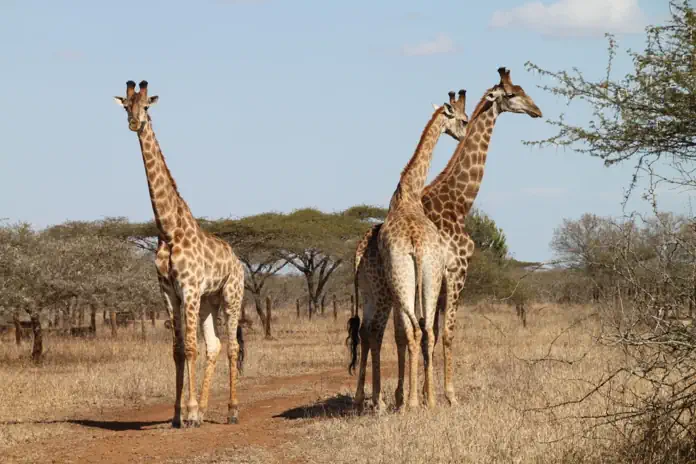
They’re instantly recognisable thanks to their long necks and towering height, but there’s far more to giraffes than meets the eye. In celebration of World Giraffe Day on 21 June, the Bothongo Rhino & Lion Nature Reserve is shining a spotlight on one of Africa’s most iconic species by sharing eight fascinating facts about these gentle giants.
Home to several giraffes that can be viewed on self-drive and guided game drives, the reserve also offers visitors the unique opportunity to get up close and personal at the popular Neck & Deck Restaurant, where guests can feed and even touch the resident giraffe while enjoying breakfast or lunch.
According to Didi Mahlo, Field Guide at the Bothongo Rhino & Lion Nature Reserve, giraffes remain some of the most misunderstood animals in the wild. “People are often amazed when they learn just how extraordinary giraffes really are,” says Mahlo. “From their powerful hearts to their complex social behaviour, there’s so much more to these animals than their height. World Giraffe Day gives us the opportunity to celebrate them while also creating awareness around the importance of protecting them.”
As World Giraffe Day draws nearer, the reserve shares eight interesting facts you may not know about these incredible animals.
Giraffes Are the Tallest Animals on Earth
It may seem obvious, but giraffes are true giants. Adult males can grow to more than 5.5 metres tall, making them taller than a double-decker bus. Their incredible height allows them to browse leaves and shoots that many other herbivores cannot reach, reducing competition for food. “Height gives giraffes a major advantage in the wild,” explains Mahlo. “They can access food sources unavailable to other species and have a better vantage point to spot predators from a distance.”
Their Tongues Are Longer Than Most House Cats
A giraffe’s tongue can measure up to 50 centimetres in length and is dark blue or purple in colour. Scientists believe the pigmentation helps protect it from sunburn while feeding for hours each day. Their remarkably flexible tongues are perfectly adapted for stripping leaves from thorny acacia trees without injury.
Every Giraffe Has a Unique Pattern
Just like human fingerprints, no two giraffes have identical coat patterns. The distinctive patches help researchers identify individuals and play a role in regulating body temperature through an intricate network of blood vessels beneath the skin. “Their markings are completely unique,” says Mahlo. “It’s one of nature’s most beautiful examples of individuality.”
They Need Surprisingly Little Sleep
While many animals spend a significant portion of the day resting, giraffes are among the shortest sleepers in the animal kingdom. They often sleep for just four to five hours in a 24-hour period and sometimes much less. Rather than sleeping for long stretches, giraffes take short naps throughout the day and night, remaining alert for potential predators.
Their Hearts Weigh Around 11 Kilograms
Moving blood all the way to a brain located more than two metres above the heart requires some impressive engineering. A giraffe’s heart can weigh up to 11 kilograms and generates blood pressure roughly twice that of a human. “This powerful cardiovascular system is one of the reasons giraffes are considered such extraordinary animals,” says Mahlo. “Their bodies are specially adapted to manage the challenge of being so tall.”
They Can Run Faster Than You Might Think
Despite their calm and graceful appearance, giraffes can reach speeds of up to 60 kilometres per hour over short distances. Their long legs allow them to cover enormous ground with each stride, helping them escape predators when necessary.
They Are More Social Than People Realise
For years, scientists believed giraffes lacked complex social structures. Recent research has revealed the opposite. Giraffes form loose communities, recognise familiar individuals and often maintain long-term relationships with others in their group. Mothers also create nursery groups where calves are looked after collectively. “Giraffes have rich social lives and strong bonds,” says Mahlo. “The more we learn about them, the more we appreciate how intelligent and emotionally aware they are.”
They Are Facing Silent Conservation Challenges
Although they remain one of Africa’s most iconic animals, giraffe populations have declined significantly in parts of the continent over the last few decades due to habitat loss, poaching and human expansion. “Many people assume giraffes are abundant because they are so well known,” says Mahlo. “But conservation awareness is crucial if future generations are going to enjoy seeing these magnificent animals in the wild.”
For visitors looking to celebrate World Giraffe Day in a memorable way, the Bothongo Rhino & Lion Nature Reserve offers a truly unique experience at its much-loved Neck & Deck Restaurant. Overlooking the reserve, guests can interact with the resident giraffe while feeding them by hand, creating unforgettable moments for animal lovers of all ages.
“Seeing a giraffe on a game drive is special,” says Mahlo. “But having the opportunity to stand eye-to-eye with one and appreciate just how gentle and majestic these animals are something people never forget.”
With self-drive routes, guided safaris and close encounters at Neck & Deck, the Bothongo Rhino & Lion Nature Reserve continues to offer visitors the chance to connect with one of Africa’s most remarkable species while celebrating the wonder of the natural world.
For more information, visit the Bothongo Rhino & Lion Nature Reserve’s Facebook or Instagram pages.

