



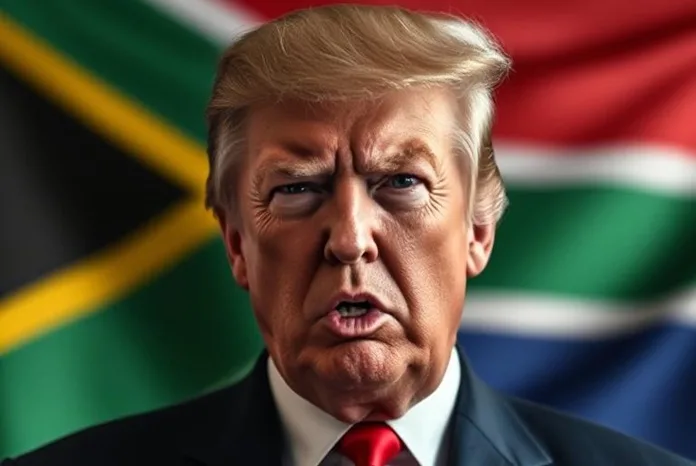
U.S. President Donald Trump confronted South African President Cyril Ramaphosa during a tense meeting at the White House, playing a graphic montage of violent rhetoric against white South African farmers and doubling down on his controversial claims of a “genocide” against the country’s white minority.
The meeting, initially cordial, took a sharp turn when Trump presented a compilation of clips featuring South Africa’s Economic Freedom Fighters (EFF), a far-left political party, using incendiary language such as “kill the farmer, kill the boer.” Jacob Zuma singing “they will run” and “shoot them with machineguns” while soldiers danced was also shown. The footage, which Trump described as evidence of ongoing violence, included images of slain farmers, with the president repeatedly emphasizing the word “death.”
“Look at this story—these are all people that recently got killed,” Trump said. “And I don’t know how it can get any worse.”
A Diplomatic Ambush
Before the confrontation, Ramaphosa had sought to ease tensions, discussing trade opportunities, mineral resources, and even golf—a topic known to appeal to Trump. However, when journalists began questioning the leaders, Trump shifted focus to his allegations of systemic violence against white farmers, putting Ramaphosa on the defensive.
Visibly uncomfortable, Ramaphosa attempted to downplay the claims, stating that South Africa faces a broader law-and-order crisis affecting all racial groups. He denied an “exodus” of white farmers and pointed to members of the farming community present in the room as evidence of cooperation.
Broader Political Context
The dispute stems from long-standing claims by Trump and figures like billionaire Elon Musk, who have amplified allegations of white genocide in South Africa. Musk, who attended the meeting but remained silent, has previously claimed his company Starlink was denied business opportunities in South Africa due to racial bias as well as racist BEE laws.
The U.S. has granted fast-tracked asylum to some white South African farmers, a move criticized as selective given the struggles of refugees from war-torn regions.
Ramaphosa’s Balancing Act
Ramaphosa, walking a diplomatic tightrope, avoided outright condemnation of Trump’s claims but insisted the situation was being misrepresented. His measured response highlighted the fractured state of U.S.-South Africa relations, which have been strained since Trump first raised the issue in 2018.
As the meeting concluded, the divide remained stark—with Trump standing by the evidence shown and Ramaphosa struggling to have a comeback.
South Africa Today has been covering farm attacks and farm murders since early 2014, read about more farm attacks here.
Source: Sky News Australia

