



World Turtle Day is celebrated every May 23 to raise awareness about the threats faced by turtles and tortoises.
Turtles, tortoises and terrapins, which together make up the order Testudines, have evolved over millions of years, dating back to the Triassic period. However, recent reports show that more than half of the world’s 359 turtle and tortoise species now face extinction. They have outlived dinosaurs and survived multiple ice ages, but they can’t evolve quickly enough to keep up with human pressures, including climate change, researchers have concluded.
The IUCN has logged a total of 68 turtle, terrapin and tortoise species that are critically endangered. One of the most endangered, the Burmese roofed turtle (Batagur trivittata), is estimated to have just 10 mature individuals left in the wild.
However, this past year was not all bad news. Floreana giant tortoises (Chelonoidis niger niger), were once believed extinct after disappearing from Ecuador’s Galápagos Islands roughly 180 years ago. In February, they returned to Floreana Island thanks to a long-running breeding program using tortoises from another island that still carried Floreana tortoise DNA.
In addition, green turtles (Chelonia mydas), whose range is global, were moved from the endangered list to least concern after its population increased by around 28% since the 1970s.
In Mexico, a massive turtle trafficking bust in November 2025 put more than 2,300 live, wild-caught freshwater turtles back on the path to living freely. The month-long police operation was launched after 55 critically endangered Vallarta mud turtles (Kinosternon vogti), the world’s smallest turtles, were stolen from a university lab.
In more good turtle news from Mexico, an experimental trial of fishing nets equipped with solar lighting showed positive initial results; they reduced turtle bycatch by nearly two-thirds. According to the researchers, green flashing lights might help sea turtles see the nets in dark water and avoid getting caught. If used more widely, it could help more green turtles and loggerhead turtles (Caretta caretta) avoid fishing nets.
In the Brazilian Amazon, researchers have warned that a planned shipping waterway on the Tapajós River could disrupt the communication between endemic Amazon river turtles (Podocnemis expansa). They are South America’s largest freshwater turtle species.
Scientists behind the study found the turtles use vocalizations to coordinate their nesting, hatching and migration. Researchers fear that added underwater noise from dredging and barge traffic could interfere with those calls in one of the species’ most important breeding areas.
Brazil classifies the species as near threatened and approaching the vulnerable category, noting the health of the species depends on conservation measures.
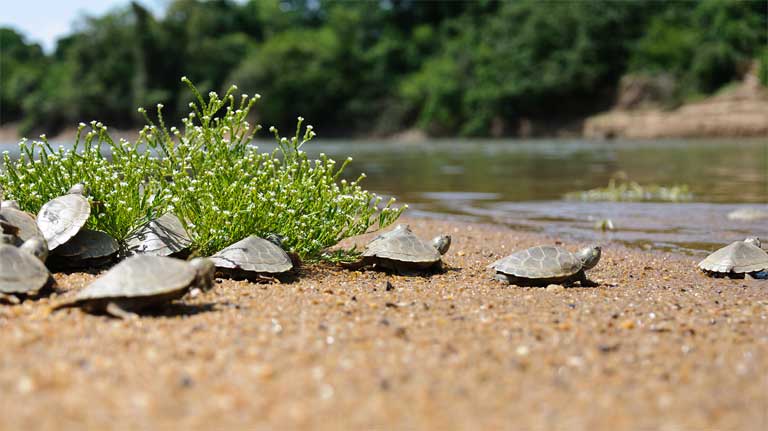
Banner image: Amazon river turtles (Podocnemis expansa) in Brazil. Image courtesy of Luiz Alfredo Batista/IBAMA.
This story first appeared on Mongabay
This article is licensed under a Creative Commons Attribution-NoDerivatives 4.0 International License.
You may republish this article, so long as you credit the authors and Mongabay, and do not change the text. Please include a link back to the original article.

