



- Canada’s independent watchdog for overseas human rights complaints against Canadian companies has been leaderless since May 2025, leaving at least 24 active cases effectively stalled.
- Communities in the Dominican Republic, Namibia, Pakistan and elsewhere say delays have left them without a meaningful avenue to seek accountability for alleged environmental and human rights harms linked to Canadian mining and energy projects.
- Critics argue the office of the Canadian Ombudsperson for Responsible Enterprise (CORE) was already limited by weak investigative powers, and the year-long vacancy has further undermined confidence in the mechanism.
- The leadership gap comes as Canada promotes mining investment tied to growing demand for critical minerals. The vacancy is prompting renewed calls from advocates, former officials and the United Nations for the office to be strengthened and a new ombudsperson appointed urgently.
Leoncia Ramos has lived her 65 years in the lush Dominican Republic town of La Piñita, but now says she is fearful for her health and wants to leave. She’s among 450 families asking the government and the company behind the Pueblo Viejo gold mine to be relocated because of concerns of pollution from the nearby mine.
They allege the site, controlled by Canadian giant Barrick Mining Corp., is harming their health and the environment, and fear that if a tailings dam about a kilometer away were to collapse, it would be disastrous.
Ramos’s community has spent 15 years fighting to have its concerns addressed and now says Canada, where Barrick Mining is headquartered, could play a role. In 2019, the Canadian government created an office of an ombudsperson to handle complaints from communities like Ramos’s. But the government has left the role vacant for the past year, and its work has seemingly come to a standstill.
Canada is home to about half of the world’s publicly traded mining and mineral exploration companies, with operations both in Canada and overseas, including some of the world’s largest miners, like Barrick Mining.
The government created the office of the Canadian Ombudsperson for Responsible Enterprise (CORE) in 2019 to address human rights complaints about Canadian companies’ operations overseas.
But the office has now been without an ombudsperson since May 2025, and advocates say its work has stalled at a critical moment, as demand for transition minerals and a changing geopolitical climate are driving new Canadian investments in mining.
While the Canadian government said it’s seeking new leadership for the office, the vacancy has left at least two dozen active complaints at various stages in limbo. Communities concerned about the impacts of Canadian companies — like Ramos’s village — are left with few other options.
Ramos said she worries that time is running out. “Our health has been deteriorating, unfortunately, quite noticeably,” she said. “Our livelihood has also been disappearing.”
Ramos said that if the ombudsman’s office were operating as intended, it could be a place for their community to turn and they would submit a complaint.
The CORE office told Mongabay that, despite the vacancy, it’s still taking complaints, but decisions on complaints are being deferred until the position is filled. The office would not provide details on how many complaints have come in since the vacancy, only that it has 24 active complaints.
Catherine Coumans, the Asia-Pacific program coordinator with Mining Watch Canada, an independent industry watchdog, said work on these complaints appears to be stalled. She was part of a decade-long fight to launch the ombudsperson’s office, but today she said she can’t in good faith advise communities around the world to use the mechanism.
“Please do not use this office because your complaint will just be languishing. It’ll just be sitting there in a black box, and it won’t move,” Coumans said.
The office declined to provide numbers on how many complaints it has received since 2019. Older quarterly reports show the office received at least 35 complaints since it started operations. But the office has not reported on complaints that have come in since March 31, 2024.
It also failed to complete any investigations for its first four years of operations. The office reported on the outcome of five complaints in 2024, two involving mining and three in the garment sector. Other complaints may have been closed through mediation. The office declined requests by Mongabay to provide additional data. The released reports made recommendations directly to the companies involved and the Canadian minister of international trade, and gave some skeptics hope that the office could address concerns.
Last year, Mongabay examined underreported issues involving Canadian mining companies and Indigenous peoples or local communities. Communities in Asia, Latin America and Africa impacted by Canadian mining operations said if the office were functioning, they too would submit a complaint, according to interviews by Mongabay and additional information from Mining Watch Canada, an environmental nonprofit organization.
In the Dominican Republic, Ramos said contamination from the Pueblo Viejo mine, owned through a joint-venture between Barrick Mining (60%) and Newmont Corp. (40%), has impeded the community’s ability to grow crops, bathe and use local water sources for cooking and drinking. Ramos said young girls have been experiencing troubling vaginal infections, and the community believes contaminated water is to blame.
“I wouldn’t have wanted to live in another community because I love and cherish my own,” Ramos said, “but for us right now, and for me specifically, the best solution would be to leave.”
Barrick Mining has denied responsibility for water contamination in the area. In an emailed statement to Mongabay, it said the communities of Las Lagunas, La Cerca and La Piñita are located “upgradient” of the mine, so water from the the tailings dam does not flow to those communities. It said the tailing dam is “a zero-discharge facility” and there is “no threat of a tailings dam collapse.” The company also countered that it “improved access to services and improved livelihoods,” including more medical services and access to potable water.
Advocates supporting the communities living around the Pueblo Viejo mine say a lack of independent water testing has meant communities don’t have access to information they can trust on water quality. Barrick disputes this. It said water samples are analyzed independently and are reported every six months to the Dominican Republic Ministry of Environment. Separately, the company said it works with community members to test water they want sampled, and those results are shared with the public in person.
International research has shown environmental and health risks associated with proximity to gold mines. A global review of 77 studies across 24 countries conducted by researchers at China’s Jilin University found that soils near gold mines consistently contain elevated levels of toxic metals, with arsenic, cadmium and mercury reaching levels associated with serious ecological and health risks. The metastudy was conducted in 2023 and does not appear to mention whether it included scientific work from the Pueblo Viejo mine.

An ‘unparalleled’ opportunity
The mining and minerals sector is a significant driver of the Canadian economy. Yet, the conduct of Canadian mining companies around the world has also long been seen by critics as a stain on the country’s reputation. After decades of calls for greater oversight of the overseas operations of Canadian companies from civil society, the government of Canada announced the ombudsperson’s office in January 2018. It was the first office of its kind in the world.
When the office was established in 2019, Canada’s Liberal government saw it as a way to bolster the country’s reputation in the global economy. When François-Philippe Champagne, Canada’s international trade minister at the time, announced the creation of the office, he expressed hope that companies representing Canada overseas would feel a responsibility to live up to Canadian values.
“To fly the maple leaf means something. It means being associated with a set of values based on dignity, respect, diversity and tolerance,” Champagne said.
CORE was set up to take complaints about alleged human rights abuses by Canadian companies in the garment, mining, and oil and gas sectors operating outside Canada, offering parties the option of mediation or a formal review. Although the office cannot force compliance, it can report its findings publicly and recommend specific remedies like financial compensation, public apologies, or suggest that a company clean up pollution.
In April 2019, Sheri Meyerhoffer, a lawyer with experience in both the private and international development sectors, was appointed as the first and so far only permanent Canadian ombudsperson for responsible enterprise.

Meyerhoffer described the chance to help build a first-of-its-kind office as an exciting moment: “the opportunity was unparalleled,” she said.
Yet, many in civil society who had lobbied for the creation of the office took issue with the fact that the office was given insufficient investigative powers to hold companies accountable, like the ability to compel document disclosure and witness testimony, and avoided using it.
Meyerhoffer led the office for a five-year term, which ended April 2024. An interim ombudsperson, Masud Husain, then took over the post, until May 20, 2025. Since then, the role has sat vacant.

Complaints ‘languishing’
One of the complaints stuck in limbo was submitted in April 2024 by the International Human Rights Program at the University of Toronto. The complaint was made on behalf of communities in Namibia represented by Saving Okavango’s Unique Life (SOUL), about the conduct of Reconnaissance Energy Africa Ltd. (ReconAfrica), which has been conducting oil and gas exploration activities in northeastern Namibia since 2019.
It took the International Human Rights Program approximately six months to gather material for the 187-page complaint, including a trip to Namibia to speak to community members and gather testimony.
The complaint alleges ReconAfrica failed to respect the rights of indigenous San and Bantu communities. The complaint said they had not consented to projects in their territory. The complaint said these failures jeopardize the communities’ access to safe drinking water, endangers their health, and harms their livestock by contaminating groundwater.
The complaint also raises concerns about harm to the ecologically delicate Kavango-Zambezi Transfrontier Conservation Area, home to protected animals including cheetahs, African wild dogs and rhinos.
Mongabay contacted ReconAfrica for comment but did not receive a response.
CORE said on its website that it aimed to complete intake of the claim in 30 days. More than two years later, Sandra Wisner, director of the International Human Rights Program, who led the complaint, said it has not passed the initial assessment phase. The last update she had was in June 2025, when the office confirmed the complaint was still at the intake stage.

Thomas Muronga is the chair of the Kapinga Kamwalye Conservancy. He grew up in the Kavango-East region of Namibia, where ReconAfrica’s exploration drilling is taking place.
He said that since the complaint was filed two years ago, exploration has expanded, deepening the community’s struggles as their land and resources continue to be used without consent, resulting in environmental damage, loss of traditional livelihoods, and cultural erosion, which he said is not benefitting the impacted communities.
“If you tell me of oil, what will I do with oil? For me, our lifestyle is wildlife. We do hunting and gathering. We also do farming with our crops like mahangu and maize. So, what will I use oil for?”
Muronga said at the beginning of the CORE process that he had hope for accountability. Two years on, however, he said, “We are actually at a stage where we are trying to lose hope.”
He said from afar, Canada appears to be a country with good resource management and respect for human rights, but his experience with this complaint had made him question these perceptions. “Maybe this is the culture in Canada whereby they don’t care about people,” he said.
After two years, Muronga said, he would like to see the office get on with its work. “We are tired of waiting; we cannot be actually living in a situation where we call ourselves an independent country, but we are tormented by other countries,” he said.
*
“Appointing someone sooner rather than later is critical, ” former ombudsperson Meyerhoffer said, now working as an instructor at the University of Ottawa and a consultant for responsible business conduct. She said the year-long leadership gap affects the timely resolution of complaints, impacting both communities and Canadian companies. She said she’s also concerned that the capacity she helped build within the office is atrophying in the interim.
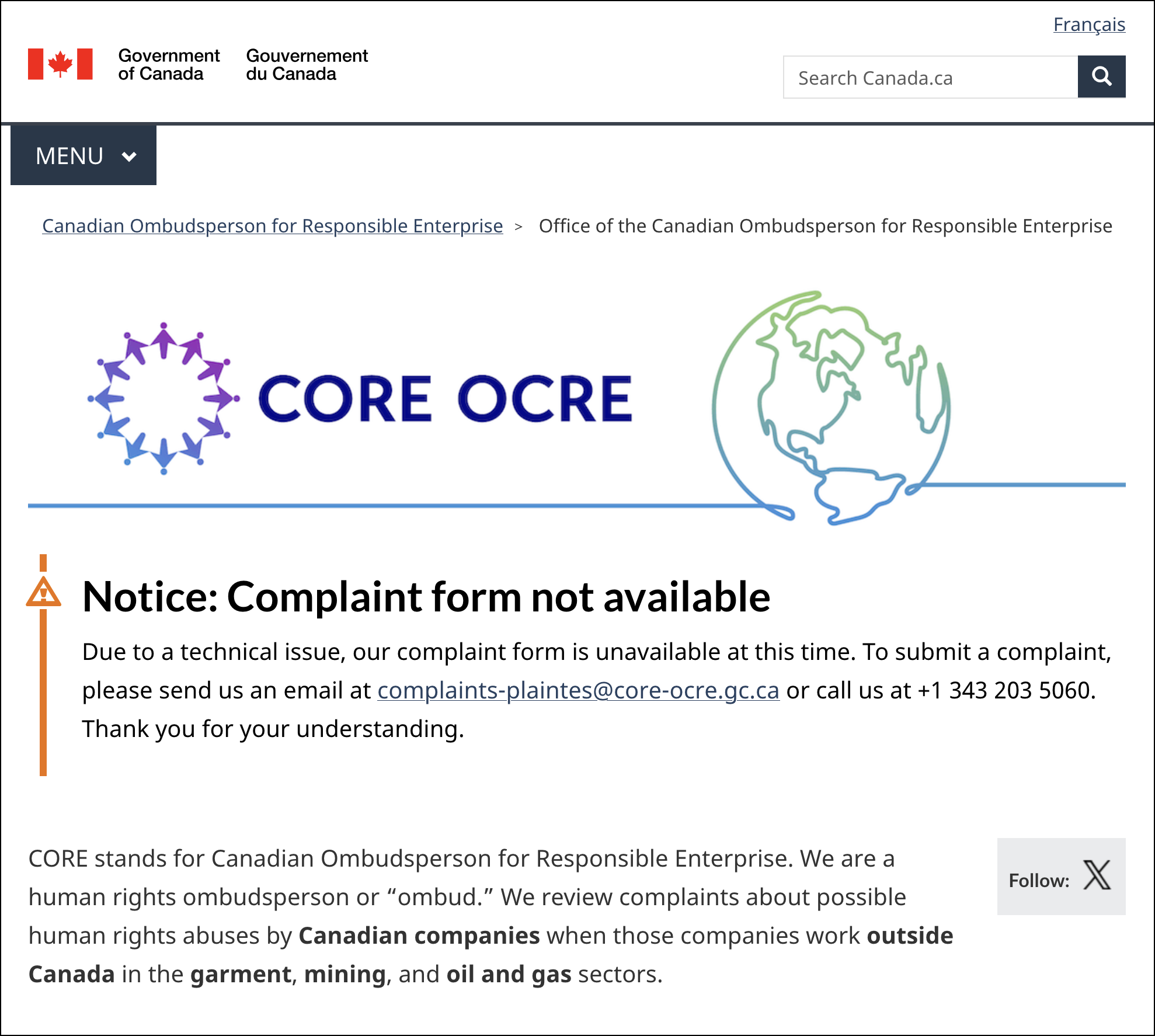
Web archives show the official complaint form has not been available due to a technical issue since at least July 2025. Yet, the office said it still has 12 funded positions and has a base budget of $4.3 million Canadian ($3.1 million U.S.) per year.
The latest quarterly report information from the office covers the period between Jan. 1 and March 31, 2024. At that time, the office had seven complaints at the intake stage, five at the initial assessment stage, eight at the investigation stage, and two complaints at the “follow-up on recommendations” stage. No complaints have been concluded since the end of 2024.
Lateef Johar has also been waiting. He is a member of the Human Rights Council of Balochistan, who came to Canada as a refugee from Pakistan’s resource-rich, largest province. He submitted a complaint in January 2023 against Barrick Mining, which is developing the Reko Diq copper and gold mine in Balochistan. The mine is a joint venture of Barrick Mining (50%), three federal state-owned enterprises (25%) and the government of Balochistan (25%).
The complaint alleges the company is abusing residents’ rights of self-determination and failing to obtain approval from the Indigenous population to operate in the region, while also causing harm to the environment and local ecosystems, including by polluting local water sources that local people rely on for drinking and agriculture.
When Johar first brought the complaint, he, like Muronga, believed in the process: “It’s a Canadian company, it’s a western company, and we have a mechanism in Canada, they are going to do something.”
In May 2023, CORE decided the complaint’s allegations related to the abuse of self-determination were admissible. In August 2023, Johar was told to expect an Initial Assessment Report, a document produced before a full review or investigation, by Oct. 18, 2023. Though the initial assessment process is supposed to take 90 days, three years later, the preliminary report he was promised has still not been completed. He said if the case had progressed, it could have made a difference to the situation in Pakistan.
“The delay is huge for us because if CORE had released the report at the end of 2023, Barrick might have been acting differently,” Johar said.
Barrick has said publicly “the process related to the reconstitution of the Reko Diq project was transparent and specifically took into account the interests of the people of Balochistan.” In a statement to Mongabay, a spokesperson for the company said it’s committed to operating responsibly with respect for human rights and the environment across all of its operations.
Johar said he’s disappointed with Canadian foreign policy when it comes to mining companies: “I think it’s very, very dangerous for our Canadian reputation.”

Fewer options at a time of increased mining activity
Since 2010, the shift to clean energy has significantly increased demand for minerals, according to the International Energy Agency. Recent geopolitical tensions and economic nationalism, including U.S. tariffs, have pushed Canada to place an even greater emphasis on mining.
But Coumans, from Mining Watch Canada, said the human rights and environmental issues she sees today are very similar to the ones her NGO has been dealing with for 27 years. “It really is quite discouraging to have these conversations with many people that we work with who are facing really serious human rights and environmental issues because of our Canadian mining companies. That has not improved,” Coumans said.
The options for communities seeking redress are limited. Canada’s other nonjudicial mechanism is called the National Contact Point (NCP) for Responsible Business Conduct. It’s a government-established body that promotes responsible business practices and acts as a nonjudicial forum for resolving complaints about companies under OECD guidelines.
Coumans said that in Canada, “it’s rooted in the very department of trade which has the mandate to promote and protect the interests of our corporations operating overseas. So there’s an inherent conflict of interest there.”
Limitations of the National Contact Point, including its lack of independence, were among the reasons she and other advocates pushed for the creation of the CORE office.
With CORE not functioning as intended, she said, communities lack an independent and effective nonjudicial mechanism to accept complaints, conduct robust investigations, make findings, and recommend remedies.
Without these nonjudicial options, communities can turn to the courts. But Canadian lawyer Cory Wanless said there are significant barriers to using the legal system, both abroad and in Canada.
In the host country, it can often be difficult to find lawyers due to costs, political climate, risks regarding corruption, or threats of violence. One of the biggest challenges in bringing lawsuits in Canada over alleged harms abroad is jurisdiction: Canadian courts can decide the cases should be heard elsewhere.
This was Wanless’s recent experience in a long-standing case against Barrick Mining, in which the plaintiffs allege the company is responsible for human rights violations that occurred over a decade at the North Mara gold mine in Tanzania, of which Barrick, through subsidiaries, owns 84%. The alleged abuses include killings and beatings committed on the company’s behalf by security forces and Tanzanian police at the mine. Tanzanian police were allegedly paid by Barrick’s subsidiary to act as a kind of private security force.
Barrick denied involvement, stating the allegations are all against the Tanzanian police, which acted independently. The company said it maintains a zero-tolerance policy for human rights violations by employees, contractors, or any third parties acting on its behalf.
In April, the Ontario Court of Appeal released a decision in the case preventing the plaintiffs from bringing a lawsuit in Ontario, and agreeing with Barrick that the claim would need to be brought in Tanzania. The legal team is planning to seek leave to appeal the decision at Canada’s Supreme Court.
Joe Fiorante, Wanless’s co-counsel on the case, said in a press release that “this decision undermines access to justice in Canadian courts.”

Mounting calls to fill vacancy and reform the office
The challenges with both the courts and the National Contact Point are why Coumans said she would like to see the CORE vacancy filled and simultaneously strengthened.
“If there’s any concern at all for human rights, there has to also be a mechanism in Canada that can hold our companies to account when they don’t live up to the standards Canada says they expect our companies to live up to,” she said.
It’s a sentiment that has received national and international attention. In its seventh periodic review of Canada published in April, the U.N. Human Rights Committee expressed concern about continued allegations of human rights abuses and environmental degradation by companies headquartered in Canada, specifically mining companies, and the lack of access to remedies for victims.
The committee also expressed concern about the year-long vacancy in the ombudsperson’s office. It recommended that Canada urgently appoint a new ombudsperson and ensure the office is given strengthened investigative powers, including the ability to compel witnesses and the production of documentary evidence — two powers that advocates have long said are necessary for the office to do effective work.
Calls for expanded powers were echoed in a petition, an online request from the public to the House of Commons, launched in April and sponsored by Simon-Pierre Savard-Tremblay, a member of parliament for the Bloc Québécois Caucus. It called for the immediate appointment of a new ombudsperson and emphasized the need for the office’s independence.
In an interview, former ombudsperson Sheri Meyerhoffer agreed with calls for reform. “In my view, the effectiveness of the office would be strengthened by greater structural independence and access to investigative power,” she said.
CORE directed questions about the review of the office, the appointment of a new ombudsperson, and the future of CORE to Global Affairs Canada, the Canadian government’s foreign ministry.
In a statement to Mongabay, Global Affairs Canada wrote, “In January 2024, following a report tabled by the House of Commons Standing Committee on International Trade, the government announced a review of the Canadian Ombudsperson for Responsible Enterprise’s (CORE) operations and effectiveness. CORE, though well-intentioned, has only completed one investigation since its inception in 2019. The Government of Canada is focused on results by modernizing measures currently in place to make them stronger and more effective.”

In March, Foreign Affairs Minister Anita Anand said during a conference call with journalists, “The office remains important. We are working with alacrity to fill numerous positions across the government, both externally and internally.”
Mongabay contacted the office of Canadian Prime Minister Mark Carney for comment for this story but did not receive a response.
As the Canadian government considers the future of the office, Leoncia Ramos in the Dominican Republic said she would like decision-makers to understand that communities like hers, impacted by Canadian development, need avenues for accountability.
“Here we feel unprotected,” she said. “They say it’s development, but it’s for the powerful, because we have nothing — what we’re living through is just more misery.”
Banner image: In May 2023, communities affected by Barrick Gold joined together to demand that then-CEO Mark Bristow stop doing harm with his toxic mines. Image by Ekō via Flickr (CC BY 2.0).
Still no trial over Argentina cyanide mine spill, 7 years after officials were charged
Citation:
Hou, Y., Zhao, Y., Lu, J., Wei, Q., Zang, L., & Zhao, X. (2023). Environmental contamination and health risk assessment of potentially toxic trace metal elements in soils near gold mines: A global meta-analysis. Environmental Pollution, 330, 121803. doi:10.1016/j.envpol.2023.121803
Credits

This story first appeared on Mongabay
This article is licensed under a Creative Commons Attribution-NoDerivatives 4.0 International License.
You may republish this article, so long as you credit the authors and Mongabay, and do not change the text. Please include a link back to the original article.

