



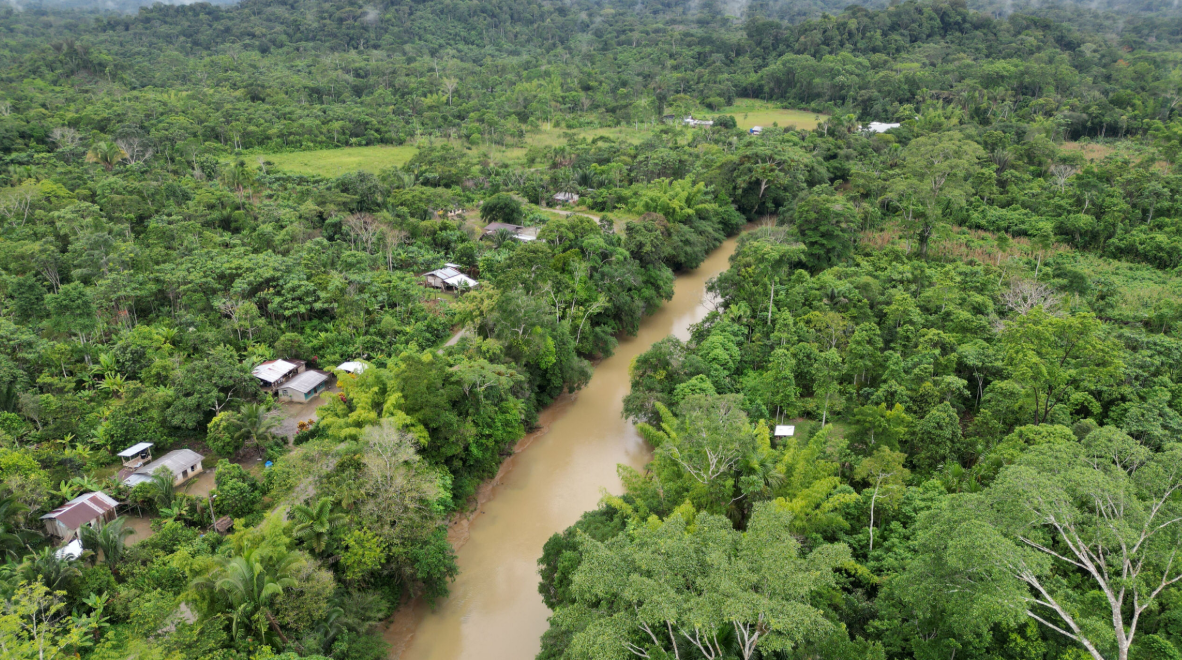
- On the banks of the Puní River’s middle basin, in the Ecuadorian Amazon, illegal mining has increased by 2,700% over seven years, contaminating the main water source for the ancestral Kichwa community of Capirona.
- Residents of Capirona say that, by 2021, the color of the Puní River started to change, turning brownish. Meanwhile, problems such as skin rashes, fungal infections, and itching became frequent.
- In samples of mining ore collected by Ecuadorian authorities from an illegal mining camp on the banks of Puní, signs of mercury were found at levels far exceeding the permitted limit for this metal in agricultural soils.
- Industrial farming activity has also polluted the waters of the Shalkana River, another watercourse located within the community. Despite being surrounded by two rivers, residents of Capirona rely on two water tankers sent weekly by municipal authorities, which is enough for barely half of the families for just a few days.
The man’s cheekbones are painted with achiote, a red pigment extracted from the seeds of the Bixa orellana plant. He wears a thin headband over his gray hair, and a traditional green shirt with yellow and blue trim on the collar and sleeves. In his right hand, he holds a wooden spear, 2.5 meters long, or just over 8 feet, made from the chonta palm (Bactris gasipaes). He stares at the journalist. His dark eyes widen as he laments the occurrence of several cases of community residents, including children, suffering from fungal infections. “Even two people have already died from stomach pain, and at the hospital, they said: ‘Maybe it’s the water.’”
The video was first broadcast on Sept. 28, 2024, on an Ecuadorian national news program. The man recorded is Galo Villamil, one of the leaders of the Capirona community, an Indigenous Kichwa resistance enclave in the Ecuadorian Amazon. One year before, in 2023, 22-year-old Joana Ashanga and her 2-year-old nephew, Ville Ashanga, were victims of what the community considers the fatal consequence of river pollution. “Despite the complaints, official reports from the [Ecuadorian] Ministry of Health made no mention of links between the pollution and the deaths, which generated distrust and outrage,” said Linda Tapuy, president of the Capirona community, before an audience at a university auditorium in Ecuador’s capital, Quito, two years after the deaths. The victims’ death certificates said the cause of death was “unknown.”
For the Indigenous group, appearing in that television news story was a victory, which they proudly shared on WhatsApp. Since then, however, the situation hasn’t changed.
“From the city, we only needed matches and salt,” Villamil told Mongabay in early 2026. He was speaking in the middle of Capirona’s empty sports field, his arms resting on an old wooden table. His gray cap gave him a less formal look than in the viral video. Behind Villamil, residents sat on the concrete bleachers where families usually gathered for local football championships, ecuavoley, a popular three-a-side variation of volleyball, believed to have originated in Ecuador, and general assemblies.
Capirona is a 300-resident village composed of 59 families at the confluence of two rivers: the Puní and the Shalkana, both within the rural parish of Puerto Napo in the canton of Tena, in Napo province, one of Ecuador’s six Amazonian provinces. Three-quarters of the village’s territory is primary forest, conserved by the Kichwa families who live throughout the area.
Nevertheless, Capirona is dying of thirst.
According to a report by the Monitoring of the Andes Amazon Program (MAAP), mining activities on the banks of the Puní River, only 4 kilometers (2.5 miles) upstream of Capirona, increased by 2,700% between 2017 and 2024. The area of disturbed land and discharged water containing heavy metals grew from 4 to 112 hectares (10 to 276 acres), or the equivalent of 157 football fields. Also, 99% of the mining occurred outside the official mining registry; in other words, it’s almost all illegal mining, according to MAAP.

Capirona hasn’t extracted a single gram of gold. Moreover, residents fought 40 years ago to prevent oil companies from operating here, creating one of the first community-led tourism programs in all of Latin America as an alternative economic model.
Fundamentally, Capirona is an “anti-extractive community.” And yet, in 2021, its residents noticed the first changes in the Puní River, whose waters went from crystal clear to what they described as a “chocolatey” color. They began experiencing redness on their arms and legs, rashes, and stomachaches. The river served as a place to bathe, wash clothes, and for children to play. People collected water in pots for cooking. They also boiled it to drink and to fight back the high temperatures of the rainforest, an ecosystem that covers the village’s 2,000 hectares (nearly 5,000 acres).
At first, they thought the brownish color that replaced the river’s typical light green shade was due to a rise in the water level. But the color didn’t disappear — on the contrary, it became murkier, flowing heavier. The Shalkana River, as a smaller watershed, had stopped being useful at that point, due to the waste coming from agricultural and livestock areas in the upper part of the basin.
After the two deaths in 2023, Capirona also stopped using water from the Puní River.
Not a single gram of gold
“Sometimes we forget that the territory is crossed by rivers, forming hyperconnected systems. Rivers are like the veins of a body,” said Jorge Celi, a professor and researcher in water and aquatic resources at the Ikiam Regional Amazonian University.
He spelled out how the watershed functions like an animal’s nervous system: The Puní is a tributary of the Arajuno, which then flows into the Napo River. “In Capirona, the problem is serious because it’s not just water pollution: it is also the destruction of the physical habitat,” Celi said. He shared a heat map of the Puní River Basin: Colonia San Jacinto, Luz de América, Cotona, Quinsacocha, and San José de Shalcana are the towns near Capirona shown in red, which indicates a high incidence of mining activity. According to Celi, more than 50% of the basin is currently affected by illegal mining.
A river is not just its channel; it’s a much more complex ecosystem that includes, in addition to the watercourse, the area beneath the riverbed, known as the hyporheic zone, where surface and groundwater mix; and the riparian zone, with banks that took hundreds of years to form.
“That’s where the heaviest sediments accumulate, stirred up when [miners] are looking for gold, destroying the forests and the riverside vegetation. Also, these destroyed areas are then exposed to rainfall. The rain erodes the soil, and these sediments end up in the river, which becomes completely silted up, full of fine sediments, sand, and gravel,” Celi told Mongabay.
On March 20, 2024, in the community of Puni-Kotona, 4 km upstream of Capirona, Ecuador’s National Police and the then-environment ministry (now subsumed into a unit of the mining ministry) conducted an inspection operation. They confirmed that open-pit mining was being carried out on the left bank of the Puní River using a backhoe with no license plates. The material extracted by the machine was processed by a sorting facility that, using high-pressure water jets and gravity, separated the coarse material from the fine.
The operation’s technical report described how sedimented water was being discharged straight into the river “without any treatment.” It also described containers, presumably containing diesel, “located everywhere, without any technical considerations.” There was also no signage or contingency equipment in place to handle potential fuel spills.
At the bottom of the sorting facilities at such illegal mining operations is usually a kind of storage area. During the 2024 operation, Ecuadorian officers broke the padlock and found, covered by tarpaulins, what was “visually verified and presumed to be mercury.” The use of this heavy metal is prohibited in Ecuador.


In the inspection, authorities took a small sample of the processed gold ore and sent it to Ikiam University for analysis.
The results came back two months later. The samples had 861 milligrams of mercury per kilogram of soil, exceeding the permitted limit for agricultural soils (0.1 mg/kg) by 8,600 times, according to Ecuador’s Environmental Quality Standard for Soil. High concentrations of chromium and zinc were also found.
“The important thing here is that this high concentration of mercury shows its direct use in amalgamation processes for gold extraction,” said Marcela Cabrera, head of Ikiam University’s National Water Reference Laboratory. “In aquatic ecosystems, it can transform into methylmercury, a highly toxic form that bioaccumulates in fish, and that can affect Indigenous communities that depend on the river for their food.”
“We are not involved in mining,” said Villamil, the Capirona Indigenous leader. “Our neighbors poisoned our river. We have nothing to do with that ‘party.’” He repeatedly invoked the date of Sept. 16, 2023: that was the day, he said, when the communal assembly decided to resist, to say “no” to mining.
In Capirona’s sports field, the echo of the people’s manifesto continues to resonate. “I currently work in agriculture: cacao, corn, yuca root, plantains, and peanuts,” said a villager in his 30s. “We notice the contamination when the yuca root comes out with spots; these spots are from the mercury chemical.”
In the background, the shouts of children can be heard as they head out for recess. The school is a few steps away from the sports field, and the youngsters have no idea their adults are weeping over their dead rivers.

Linda Tapuy, the Capirona community president, sat at the old wooden table with Villamil. She told Mongabay that women residents collect water from the river in buckets and let it settle before using it.
“We’ve made arrangements with the municipality, and after two years, they came to deliver water tanks. But it’s only enough for 40 families. Friends and foundations have supported us with other small tanks, but it’s not enough,” Tapuy said.
Each family has between eight and 10 members. The two tanks obtained by Capirona hold a combined 2,200 liters (580 gallons) of water. Tapuy said it’s enough for three or four days. “All the rest is drought.”
“The water truck just came by; it’s unbelievable,” she added. “When I was a child, I heard that there would eventually be wars over water, and I didn’t understand why, since we had enough here. Now, in the jungle, where we have abundance, we’re in these deplorable conditions.”
To reach the Capirona territory, one has to head out of the city of Tena, the capital of Napo province, and travel by pickup truck for about 45 minutes along a road in terrible condition. Moments before Mongabay arrived, a blue-and-white water tanker sent by the municipality pulled up ahead of another truck.
Before, Capirona also relied on subsistence farming. The residents sold their surplus produce in the city. But since the rivers became contaminated, getting money to buy food, equipment for rainwater collection, medicine to pay doctors, and a list of other things — which they didn’t need less than five years ago — has forced residents to work their land much less judiciously.
The worst part, they said, is the falling price of their produce. The $30 they used to earn for a few yuca roots has dropped to $15. They’ve gained a “bad reputation”: the word has spread that their soil is contaminated and their crops are no longer usable.
“Many times you don’t even sell it, and we have to go back with the product. It’s a major blow to the communal economy,” said another resident, seated in the stands of the sports field. Back in the day, those living in Capirona ate river fish; lately, a merchant comes once a week with fish from the sea.
They still haven’t gotten used to the saltiness, but they have no other option.
Anacondas in the Puní River are no more
For the Capirona people, where 90% of the community is Indigenous Kichwa, the river has always been a mother, according to Tapuy. Anacondas lived in the rivers and were part of their lives: they gathered fish on the riverbanks when they coiled up, and at night visited them in their dreams. “The Yacuwarmi or Yacuruna” — mother or father of the water, in the native language — “used to come at night,” Tapuy said. “Now they don’t come anymore because the river is polluted.”
For the Amazonian Kichwa, the anaconda appears in their dreams in the form of a woman, for men; and a man, for women.

Alba Aguinaga is an anthropologist working on her doctoral thesis at Ikiam University, investigating how mining affects a community’s social fabric. She spent two years working with Capirona residents, and spoke passionately about her dissertation and what she had learned from the community.
She said that, from an anthropological perspective, it’s known that Indigenous Amazonians believe in the sacred power of transforming into animals. This is animism: a symbolic representation, constructed from their Indigenous identity, in which an animal becomes a form of human expression — and vice versa.
“They practice animism with everything: they are the river, the river is them. This applies to their fields, plants, food, and their animals. The anaconda is a mythical element in the constitution of the Napo Kichwa people,” Aguinaga said.
That the anaconda no longer comes is a symbol of destruction for them. “We are being abandoned. Not by the state, which has never listened to us, but by the anaconda,” said Galo Villamil, the community leader.

Fernando Ríos, from the Tena municipal government’s communications department, told Mongabay the mayor’s office has no jurisdiction over river concessions; that falls under what used to be Ecuador’s environment ministry. “When we learned of the damage, we provided PVC tanks and supplied water,” Ríos said of the municipality’s response to the residents’ plight. According to the local administration, deliveries by a tanker truck carrying 1,100 liters are scheduled for Capirona every Tuesday, Thursday, and Saturday.
Mongabay reached out to the remnant of the environment ministry for comment on whether there’s a remediation plan for the Puní River or solutions to the other problems facing the Capirona community. As of the time this story was originally published, they were still waiting to share technical information. The Napo provincial government did not respond to Mongabay’s requests for comment.
Indigenous resistance seeking solutions
Despite the pain, anger, and grief of being spiritually separated from their land, the Capirona residents haven’t stopped searching for solutions.
They approached Ikiam University for assistance with studies; they reached out to the municipality to denounce the violation of nature’s rights, for which the bureaucratic Band-Aid has been two water tanker deliveries per week; and they also contacted various foundations, seeking to build rainwater harvesting systems. Amid this quest, for the past couple of months, residents have been working on their own water treatment plant with the Yachana Foundation, which supports research and environmental education in the Ecuadorian Amazon.
There are no clean water sources within 8 km (5 mi) of Capirona. If the experimental system works, it could filter up to 300 liters (79 gal) of water per day from the Puní River.

The system consists of a prefiltration stage with gravel, a biofiltration stage with sand, and another absorption process with biocarbon, before the treated water is transferred to a storage tank for communal distribution.
Both the technicians and the Kichwa leaders acknowledge that they’re not sure it will work. However, through their traditional collective community work, called mingas, they’ve built the barrels with the filtration layers.
“What gives us strength is that we are a united group,” is a repeated refrain from the Capirona residents.
“Capirona doesn’t need support with water tanks, and ‘that’s it,’ but rather for society to connect with their struggle, which isn’t about two water trucks a week,” said Aguinaga, the anthropologist. “They are fighting for a political identity that is demonstrating their ability to resist.”
Villamil confirmed this with another video, sent to Mongabay over WhatsApp a few days after our visit. It shows him speaking angrily to fellow residents, who are once again gathered at the community’s sports field during one of their quarterly assemblies. “Will they ever make a soup of gold, a soup of dollars?” he’s seen asking while waving his hands and raising his voice.
“What do we have to defend? Life! What is life? Water, water, water, water.” The video ends with a round of applause from the crowd.
The experts Mongabay interviewed for this story agreed that the case of Capirona could, sooner or later, befall any other town or city that, without having mined a single gram of gold, silver, copper, critical mineral, or rare earth element, and without any connection to or knowledge of extractive activities, suddenly finds itself without a single drop of water suitable for human consumption. After all, all cities, and not just those in the Amazon, rely on river water.
Any community could be next.
Banner image: Women and girls from Capirona gather to collect stones and make water filters, as part of the community experiment developed in partnership with the Yachana Foundation. Image courtesy of the Yachana Foundation.
The story was first published here in Spanish on March 26, 2026.
Indigenous guardians successfully keep extractives out of Ecuador’s Amazon forests
Credits


This story first appeared on Mongabay
This article is licensed under a Creative Commons Attribution-NoDerivatives 4.0 International License.
You may republish this article, so long as you credit the authors and Mongabay, and do not change the text. Please include a link back to the original article.

