



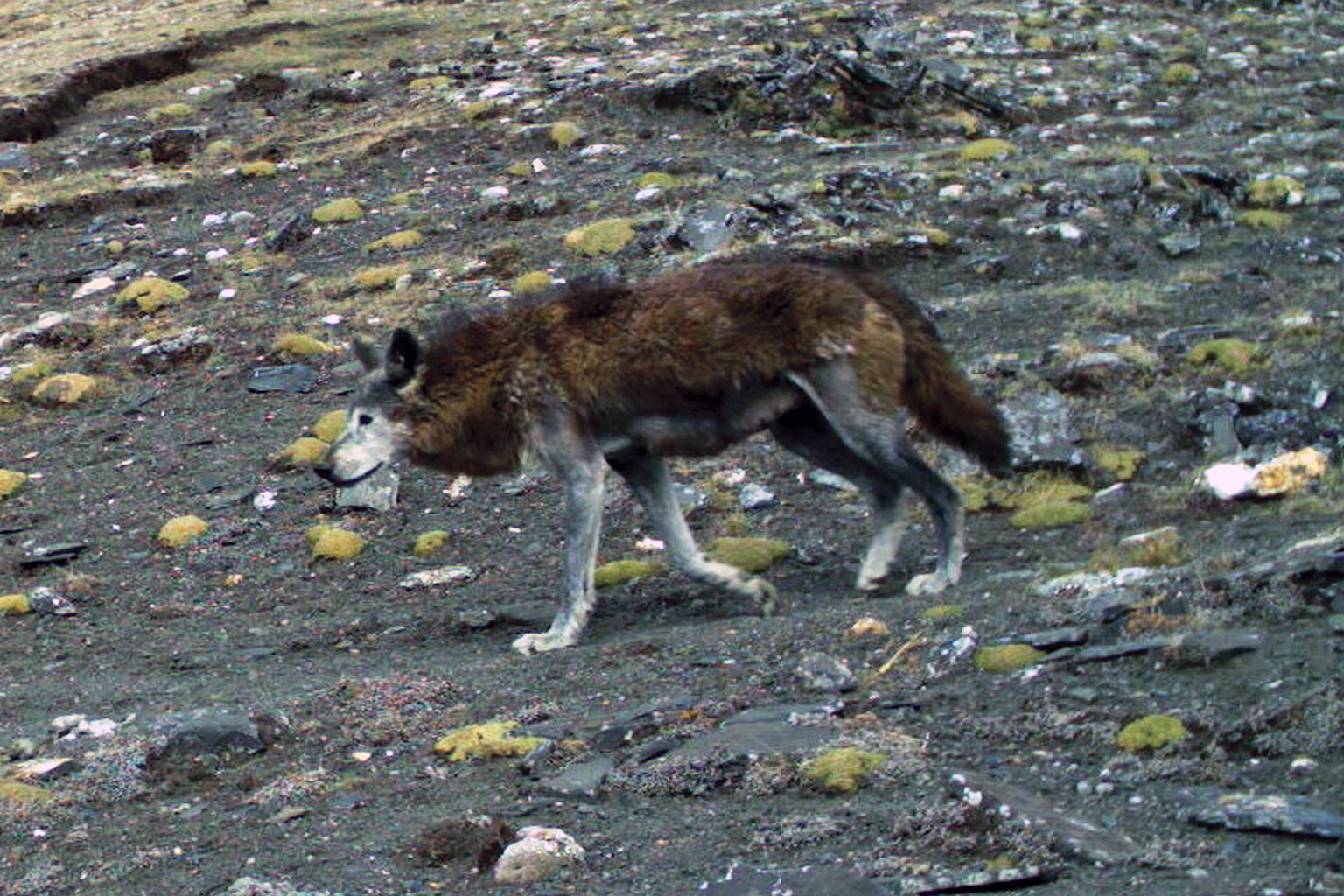
- Three apex predators (snow leopards, common leopards, and Himalayan wolves) coexist in a remote valley in Nepal’s central Himalayas by relying on different food sources.
- Researchers analyzed six years of camera-trap footage and fecal DNA from the Lapchi Valley to discover that snow leopards eat mainly wild ungulates, leopards feed on livestock and animals near human settlements, and wolves eat a mix of both.
- All three predators are mostly nocturnal and use overlapping terrain, but their specialized diets prevent direct conflict among these similarly sized apex predators.
- Protecting abundant wild prey is the most effective way to keep all three predators away from livestock and reduce retaliatory killings that threaten their survival.
Three of Asia’s most formidable predators share territory in a remote Nepal valley by eating different prey, according to a new study. Researchers found that diet, not time or space, is what keeps snow leopards (Panthera uncia), common leopards (Panthera pardus), and Himalayan wolves (Canis lupus chanco) from coming into direct conflict.
The study, published in PLOS One, drew on more than six years of camera-trapping and scat analysis in the Lapchi Valley of the Gaurishankar Conservation Area in Nepal’ s central Himalayas. Researchers set 26 cameras across the landscape over three survey periods between 2018 and 2025 and identified each predator’s diet by analyzing fecal DNA and examining prey hair under a microscope.
Snow leopards, they found, fed mainly on wild ungulates, including blue sheep (Pseudois nayaur), musk deer (Moschus leucogaster), Himalayan tahr (Hemitragus jemlahicus), and Himalayan serow (Capricornis sumatraensis). Blue sheep alone made up nearly half their diet.
Himalayan wolves ate a mix of wild prey like blue sheep and musk deer as well as livestock such as goats, horses, and yaks (Bos grunniens).
Leopards relied heavily on livestock and animals associated with human settlements, including dogs, though barking deer (Muntiacus muntjak) and goral (Naemorhedus goral) also appeared in their scats.
Snow leopards and wolves shared roughly three-quarters of their prey, far more than either shared with leopards. Of the three, snow leopards had the narrowest diet, concentrating on wild ungulates. Leopards ranged most widely, and wolves fell in between, switching between wild prey and livestock depending on what was available. All three predators were active mostly at night and used overlapping terrain.
In the Lapchi Valley, livestock currently graze with no pens or fencing at all. When livestock are killed, herders may blame snow leopards even when leopards are responsible, he said, because snow leopards are the more familiar target.
“When wild prey declines, all three predators shift toward livestock, which triggers retaliatory killings and destabilizes the whole system,” Koju said.
Koju said the best protection for all three predators is keeping their wild prey plentiful, so the animals have enough to hunt and are less likely to go after livestock. Building sturdier pens to guard herds, and paying herders fairly when their animals are killed, hey says, could also help.

A separate study in Nepal’s Shey Phoksundo National Park found even higher dietary overlap between snow leopards and wolves, with wolves there relying heavily on livestock. The Lapchi findings suggest how much these dynamics change from valley to valley.
Nepal is home to an estimated 397 snow leopards, according to a 2025 government survey cited in the study. Both snow leopards and common leopards are classified as vulnerable on the IUCN Red List. Himalayan wolves are listed as least concern, though the study notes that all three predators face mounting pressure from declining wild prey, habitat fragmentation and conflict with people.
The three predators have not always shared the valley. Earlier surveys recorded only snow leopards. Leopards and wolves moved in more recently. The result is a rare case of three similarly sized apex predators overlapping in a single high-elevation landscape, giving researchers an unusual window into how they avoid one another
Leopards have been expanding into high-altitude snow leopard habitat, likely driven by climate change, shifting treelines, and infrastructure development at lower elevations.
Madhu Chetri, a researcher at the National Trust for Nature Conservation who has studied predator overlap in the Gaurishankar Conservation Area, told Mongabay that up to half of the current snow leopard habitat in the Himalayas could be altered by shifting treelines, shrinking the alpine zones snow leopards depend on.
Culture also shapes how people and predators get along in Lapchi. The valley is revered as a “beyul,” or sacred hidden land, in Vajrayana Buddhism, and is a pilgrimage site linked to the saint-poet Milarepa. Local communities “uphold environmental taboos” and protect wildlife through ritual, the study notes, helping people and predators share the landscape despite occasional livestock losses.
Banner image of a Himalayan wolf by Madhu Chetri via Wikimedia Commons (CC BY-SA 4.0).
Liz Kimbrough is a staff writer for Mongabay and holds a Ph.D. in ecology and evolutionary biology from Tulane University, where she studied the microbiomes of trees. View more of her reporting here.
In Kyrgyzstan, a climate-ready corridor gives snow leopards and herders room to roam
Citation:
Koju, Narayan Prasad, et al. “Niche partitioning facilitates coexistence of three apex predators in the Lapchi Valley, Central Himalaya, Nepal.” PLOS One, April 1, 2026, https://doi.org/10.1371/journal.pone.0344947.
Lamichhane, S., Shrestha, B., Tharu, B.P.C., Koirala, R.K., Bhattarai, B.P., Poudel, P., et al. (2025). “Narrow dietary niche with high overlap between snow leopards and Himalayan wolves indicates potential for resource competition in Shey Phoksundo National Park, Nepal.” Ecology and Evolution, 15(1), e70873. https://doi.org/10.1002/ece3.70873
FEEDBACK: Use this form to send a message directly to the author of this post. If you want to post a public comment, you can do that at the bottom of the page.
Cite this article
Liz Kimbrough (2026). How snow leopards, wolves and leopards share the same Himalayan valley, study. Mongabay Conservation news. DOI: https://doi.org/10.66709/news-321933
Credits

This story first appeared on Mongabay
This article is licensed under a Creative Commons Attribution-NoDerivatives 4.0 International License.
You may republish this article, so long as you credit the authors and Mongabay, and do not change the text. Please include a link back to the original article.

