



- Living Seawalls is a global initiative that aims to make seawalls, marinas and other hard coastal structures more hospitable to marine wildlife by installing biodiversity-friendly panels, boulders and pilings.
- In 2025, Ireland’s first Living Seawalls installation was established at Kennedy Pier in the port town of Cobh, and marine life is already starting to colonize the panels.
- While researchers say the panels can help marine life colonize hardened coastlines, and stayed cooler than standard flat seawall surfaces, questions remain about their effect on seawalls’ main function of keeping waves at bay, leading scientists to suggest that design modifications may be needed.
COBH, Ireland — On a bright, warm day in April in Cobh, Ireland, I step down a centuries-old cobbled slipway that descends into a harbor packed with fishing boats. Halfway down, something interrupts the weathered wall: an installation of 60 hexagonal concrete panels bolted into the stone. Some panels are ridged or textured; others are pitted with holes and crevices that either trap water or let it filter through with the changing tide.
Bright green algae drapes across many of the panels. When I look closer, I notice a few marine snails, including periwinkles (Littorina littorea) and dog whelks (Nucella lapillus), stuck to the tiles.
These panels were installed at Kennedy Pier in Cobh, a seaport town in Ireland’s County Cork, in September 2025, as part of the Living Seawalls project. Spearheaded by the Sydney Institute of Marine Science and the company Reef Design Lab, both in Australia, the Living Seawalls project aims to create biodiversity-friendly panels, boulders and pilings that can be installed on seawalls, marinas, piers and other hard coastal infrastructure to make them more hospitable to marine wildlife.
Louise Firth, a senior lecturer in environmental sustainability at Ireland’s University College Cork and one of the principal investigators of the Living Seawalls project, is on site to show me the Cobh installation, Ireland’s first. (Since my visit, a second Living Seawalls installation went up in the neighboring County Cork village of Ringiskiddy.) As we stand on the slipway gazing at the algae-adorned panels, Firth tells me the point of the project is to give nature a “helping hand” as the world struggles through both a climate crisis and a biodiversity crisis.
Coastlines are becoming increasingly developed as human populations grow and industries expand. On top of that, rising sea levels — driven by human-induced climate change — are increasing the need for seawalls and other hard coastal infrastructure to protect shorelines from erosion and flooding. With coastal infrastructure construction increasingly displacing habitat for marine life, Living Seawalls is trying to help humans build with nature, rather than against it.
“Biodiversity is in dire straits at the moment, so this is very much one of the many solutions that we as humans are coming up with to try and help nature,” Firth says, “specifically in an urbanized, built environment.”
‘We’ve got a real construction boom’
Coastal ecologist Melanie Bishop, a co-founder of the Living Seawalls project, says the idea for the initiative grew out of conversations about the rapid expansion of coastal construction around the world. For instance, she points to research showing that in Sydney Harbour alone, 50% of the foreshore has already been hardened with seawalls, while global marine construction is projected to increase by 23% between 2018 and 2028.
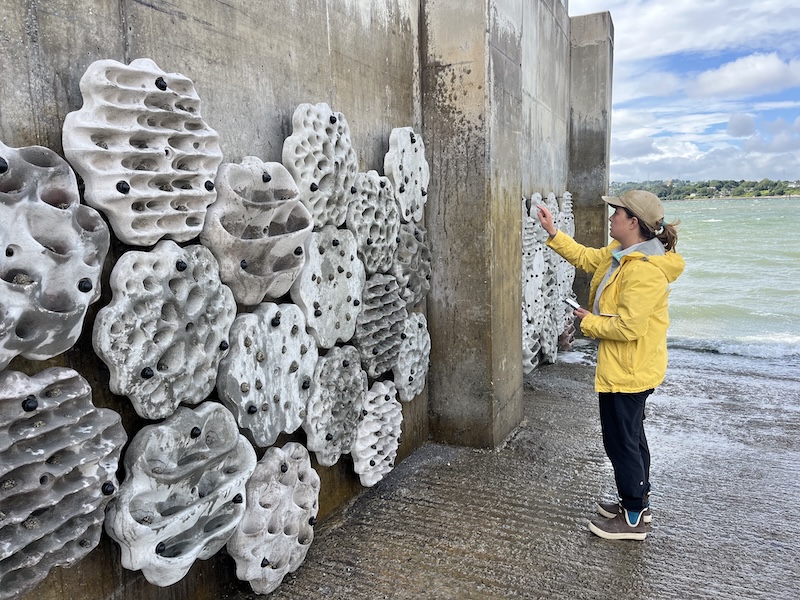
“We’ve got a real construction boom in our oceans at the moment,” Bishop, a professor at the School of Natural Sciences at Australia’s Macquarie University, tells me on a video call after my visit to Cobh. However, she points out that most marine construction tends to be “smooth, featureless surfaces” that lack “protected spaces for species to thrive in.” The Living Seawalls project aims to change this by adding ecologically inspired surfaces to both existing and new coastal structures, boosting biodiversity while reducing the environmental impacts of urban infrastructure.
Bishop and her colleagues worked with Reef Design Lab, a Melbourne-based company that designs and manufactures marine habitat infrastructure to support ecological diversity, to come up with the concept for the panels. Drawing inspiration from the rocky shore habitats of Sydney Harbour, industrial designer Alex Goad at Reef Design Lab created the panels to mimic the rock pools, crevices and honeycomb-like patterns of weathered sandstone, as well as the textures of mangroves and shellfish reefs.
Reef Design Lab ultimately produced nine ecologically inspired panel designs, as well as a featureless control panel for comparison, so researchers can tease out how the textured designs influence marine life.
In 2018, the team installed the first Living Seawalls panels on an existing sandstone seawall at Sawmillers Reserve in Sydney, Australia’s most densely populated city. Since then, panels have gone up at 28 other seawalls across Australia, at sites including ferry wharfs, marinas and ocean pools, and “living boulders” have been installed in three Australian locations.
So far, these Australian installations have delivered promising results. Bishop says biodiversity has increased by 36% at some of the initial sites, including Sawmillers Reserve. At Milsons Point, another Sydney location, Living Seawalls panels supported 69% more biodiversity than nearby control sites, according to a 2025 study in the Journal of Applied Ecology.
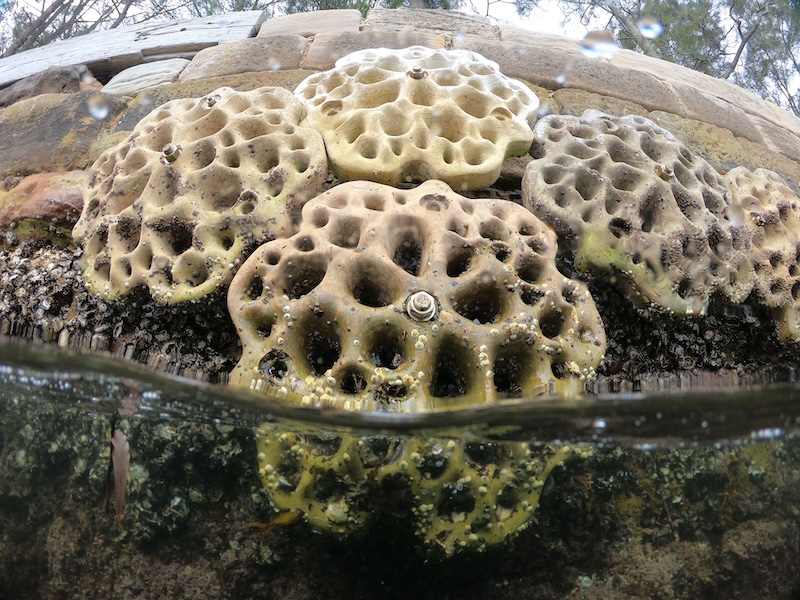

The project has expanded beyond Australia to sites in 10 other countries. Panels now line existing seawalls in locations including Plymouth in the U.K. and Boston in the U.S., and boulders have been installed on rip-rap revetments — sloping rock structures that protect shorelines from waves and erosion — in Aotearoa New Zealand. The project has also contributed to the custom design of pilings that marine life can colonize for the deep-water port terminal expansion in Posorja, Peru. And at Jebel Ali Port in Dubai, 1,000 panels line the seawalls, with plans to add another 5,000 by 2028.
Bishop says a key component of the Living Seawalls program has been regular scientific monitoring and evaluation that allow the team to compare the sites and to “adapt and optimize” the panels for different environments and biological conditions. For instance, she says active monitoring is taking place in Australian locations such as Sydney and Townsville, as well as abroad in Singapore, Plymouth and Boston.
More species, more resilience
At Cobh, the story is only just beginning. When I visit, the Living Seawalls panels have been in place for just seven months, not long enough for many species to colonize them, or for the researchers to determine the success of the panels.
Corryn Knapp, a marine ecologist and postdoctoral researcher at University College Cork, is one of the scientists in charge of monitoring biodiversity at the Cobh site. While she can’t meet me in person on the day I visit, she later tells me over the phone that since the panels were installed in September, they missed last year’s summer recruitment period, when many marine species release their larvae to drift through the water and settle onto surfaces. As a result, relatively little marine life has colonized the panels so far — with the exception of green seaweed.
But things are likely to shift now that summer is here. Knapp says she believes the seawalls are following a “standard colonization process,” also known as “ecological succession.” This started with the near-immediate colonization by microorganisms when the tiles were first submerged, followed by the settlement of green algae, she says. And as the communities mature, Knapp says she expects to see a wider range of species appear, including barnacles, red algae and various types of brown algae, such as egg wrack (Ascophyllum nodosum), bladderwrack (Fucus vesiculosus), spiral wrack (Fucus spiralis), and toothed wrack (Fucus serratus). More snails and other grazers should soon take up residence, according to Knapp.
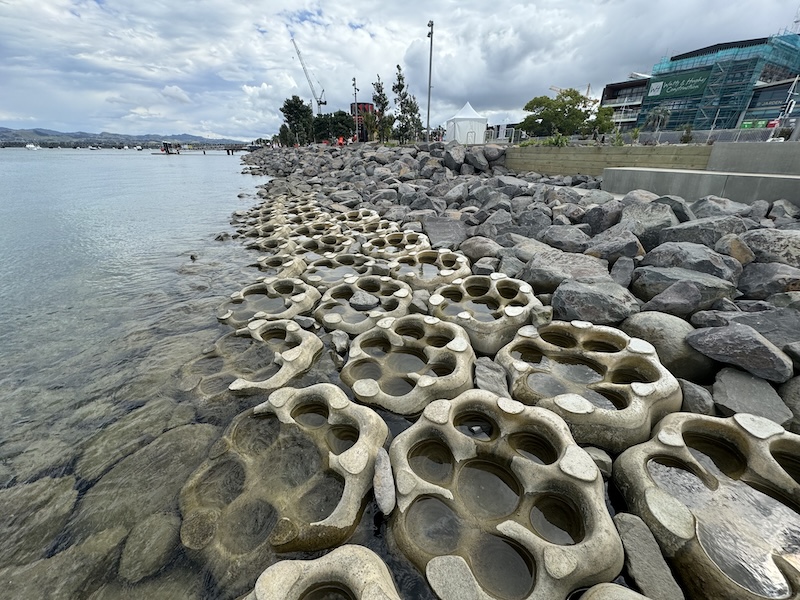

Each of these species plays a different role in the development of the mini-ecosystems these panels create, helping to increase biodiversity and restore ecological functions in an altered environment, according to the researchers. For instance, seaweeds and other algae can provide food and habitat for other marine organisms, produce oxygen, and help regulate conditions at the surface by providing shade and reducing heat stress. Filter-feeding species such as mussels and oysters can help improve water quality, while grazers, including limpets and periwinkles, feed on seaweeds, helping to prevent any one species from becoming overly dominant.
“The more species you have, the more resilient that system will be to any kind of perturbations,” Firth says.
Beyond encouraging organisms to colonize the panels, the Cobh project was also designed and placed to engage the public, encouraging people to think differently about their relationship with the natural world and how human-made structures can coexist with marine ecosystems. On the day I visit, Firth says she and her team have just finished a presentation to local schoolkids about the Living Seawalls panels.
“Accessibility and visibility are hugely important, so that’s largely why we chose this location,” she says, gesturing toward the iconic St. Colman’s Cathedral, which towers over Cobh and is clearly visible from the Living Seawalls site. “There’s loads of people that pass through here at all times of the year, so in terms of reaching a wide audience, it couldn’t be better, really.”
One potential challenge for the Cobh project may be balancing the ecological goals with the practical needs of maintaining the working slipway, which must be cleaned regularly for health and safety reasons. Without cleaning, green algae will grow over the slipway, making it hard to walk down without losing your footing.


“It is a conflict that we are trying to encourage marine life in a place right beside where we really do not want any marine life,” Firth says.
Dylan Morley, a spokesperson for the Port of Cork, tells me in an email that monthly power washing takes place on the pier, but that the Living Seawalls installation would be “deliberately excluded from any power washing or other cleaning operations.”
‘A work in progress’
While the Living Seawalls project offers a promising way to give biodiversity a foothold along hardened coastlines, the panels may not provide the best defense against wave overtopping — when waves spill over coastal infrastructure, a phenomenon expected to worsen as climate change accelerates and coastal storms become more volatile.
According to a study in the Journal of Environmental Management led by Franz Bauer, a former doctoral student at the Plymouth Marine Laboratory in the U.K., experiments conducted in a lab setting revealed that the Living Seawalls panel types found at the Plymouth site actually increased overtopping due to their texture. However, the study also found that once seaweed and other marine life colonized the panels, this mitigated the effect, but did not cancel it out.
“I do believe that if the panels were designed slightly differently, they might mitigate wave overtopping too,” Bauer tells me in an email. “There have been other studies with different seawall designs that have shown this.” However, he says he believes the Living Seawalls panels can still “contribute to reducing biodiversity loss in coastal areas by making seawalls as ecologically functional as they can be.”
Bishop tells me in an email following our initial interview that the effects on overtopping largely depend on where panels are installed on a seawall in relation to wave action, and that panels are rarely placed at the top of seawalls, as they were in Bauer’s experiments. However, she says a crucial next step would be optimizing the design not only for biodiversity, but for engineering function, and that “simple design modifications, such as angling panels, may enhance wave dissipation.”

While the overtopping study identified a potential drawback, a different study in Ecological Engineering, also led by Bauer, found that the textured panels reduced the surface temperature more than flat panels. When marine life colonized the panels, the temperature-cooling effect got even stronger — an effect that could potentially aid marine life during extreme heat events.
For Firth, each Living Seawalls installation is another step in a long-term effort to better understand how coastal infrastructure can support both people and nature.
“We can’t just keep building the way we have in the past,” Firth adds. “We have to think about biodiversity in nature.”
Banner image caption: In September 2025, 60 Living Seawalls panels were installed at Kennedy Pier in Cobh, Ireland. Image courtesy of Port of Cork.
Elizabeth Claire Alberts is a senior staff writer for Mongabay and was a 2024-2025 fellow with the Pulitzer Center’s Ocean Reporting Network. Find her on Bluesky and LinkedIn.
Citations:
Chapman, M. G., & Bulleri, F. (2003). Intertidal seawalls — New features of landscape in intertidal environments. Landscape and Urban Planning, 62(3), 159-172. doi:10.1016/s0169-2046(02)00148-2
Bugnot, A. B., Mayer-Pinto, M., Airoldi, L., Heery, E. C., Johnston, E. L., Critchley, L. P., … Dafforn, K. A. (2020). Current and projected global extent of marine built structures. Nature Sustainability, 4(1), 33-41. doi:10.1038/s41893-020-00595-1
Vozzo, M. L., Bishop, M. J., Dafforn, K. A., & Mayer‐Pinto, M. (2025). Ecological effects of habitat complexity vary with intertidal elevation: Implications for seawall eco‐engineering. Journal of Applied Ecology, 62(8), 2018-2035. doi:10.1111/1365-2664.70068
Bauer, F., Knights, A. M., Hanley, M. E., Griffin, J. N., Foggo, A., Brown, A., … Firth, L. B. (2025). Thermal patterns on eco-engineered coastal infrastructure depend on topographic complexity and spatial scale. Ecological Engineering, 215, 107596. doi:10.1016/j.ecoleng.2025.107596
Bauer, F., Knights, A. M., Firth, L. B., Griffin, J. N., Foggo, A., Brown, A., … Hanley, M. E. (2026). Wave overtopping on eco-engineered seawalls: Does biodiversity enhancement conflict with coastal protection? Journal of Environmental Management, 402, 129091. doi:10.1016/j.jenvman.2026.129091
Cite this article
Elizabeth Claire Alberts (2026). Can coastal infrastructure be engineered to harbor marine life instead of harming it?. Mongabay Conservation news. DOI: https://doi.org/10.66709/news-322179
Credits

This story first appeared on Mongabay
This article is licensed under a Creative Commons Attribution-NoDerivatives 4.0 International License.
You may republish this article, so long as you credit the authors and Mongabay, and do not change the text. Please include a link back to the original article.

