



- Environmental groups continue to allege widespread illegal use of driftnets in the Mediterranean Sea.
- The use of driftnets — fishing nets, sometimes kilometers long, that drift with the ocean currents — is prohibited to catch large pelagic species like swordfish.
- Highlighting that current measures lack adequate definitions and enforcement provisions, the European Union presented a proposal to strengthen international restrictions on driftnet fishing at the International Commission for the Conservation of Atlantic Tunas technical meeting in June.
- Morocco, one of the countries most criticized for the use of illegal large driftnets, has emerged as a strong supporter of the proposal.
Driftnets, vertically hanging nets that drift with ocean currents and can stretch for kilometers, are used to catch large pelagic species such as swordfish and tuna. However, they have long drawn criticism from conservationists as they also capture and kill sharks, turtles, dolphins and other marine wildlife.
For decades, debate has raged about use of the large nets. It’s a particularly contentious issue in the Mediterranean Sea, an important migration corridor that faces considerable pressure from overfishing, pollution and climate change.
Now, international efforts to tighten legislation on driftnets in the Mediterranean have gained new momentum as member states of the International Commission for the Conservation of Atlantic Tunas (ICCAT) consider a proposal aimed at closing loopholes in existing rules.
ICCAT is the world’s largest regional fisheries management organization, managing the stocks of highly migratory species, including tuna, swordfish (Xiphias gladius) and some shark species across the Atlantic Ocean and adjacent seas. At ICCAT’s technical meetings held in Brussels in June, the European Union presented a proposal (see IMM_09_ENG.docx in link) that seeks to strengthen current driftnet rules.
The EU proposal would establish clearer definitions for driftnets, prohibit their possession on vessels that target certain species, and extend restrictions beyond the Mediterranean to parts of the Atlantic Ocean.
“The EU has the clear ambition to push for the adoption of this measure at this year’s annual meeting of ICCAT (in November),” an EU official told Mongabay via email.
ICCAT has 52 member parties, including the EU, and four additional cooperating nations. The majority of its member parties have been in favor of firmer driftnet regulations. However, since decisions are taken through consensus, any opposition from a member party can prevent a proposal from being adopted.
New evidence of illegal driftnet use
Governments have debated driftnets for decades. The current proposal comes amid renewed allegations that, despite existing restrictions, driftnets continue to be used widely in the Mediterranean Sea.
In May, the United Kingdom-based nonprofit organization Environmental Justice Foundation (EJF) released footage showing the impact of these nets on wildlife in the Alboran Sea, between Morocco and Spain. The sea is considered an important ecological corridor connecting the Atlantic Ocean with the Mediterranean basin. Scientists and conservation organizations have long raised the concern that bycatch from driftnets poses a threat to migratory species already under pressure from overfishing, habitat degradation and climate change.
EJF documented sharks, dolphins and whales caught in large driftnets, as well as so-called “ghost nets” — nets that were lost or abandoned and continue to trap animals. An investigation conducted by EJF between August and September 2024 documented 843 Moroccan vessels carrying driftnets operating from the Moroccan port towns of Tangier, Al Hoceima, Sidi Hsaïn, Nador and M’Diq.
“We can see that it is having an impact on precious ecosystems in a unique area, which is the Alboran Sea,” Jesús Urios Culiañez, an ocean policy officer at EJF and the investigation’s lead researcher, told Mongabay in a phone interview.
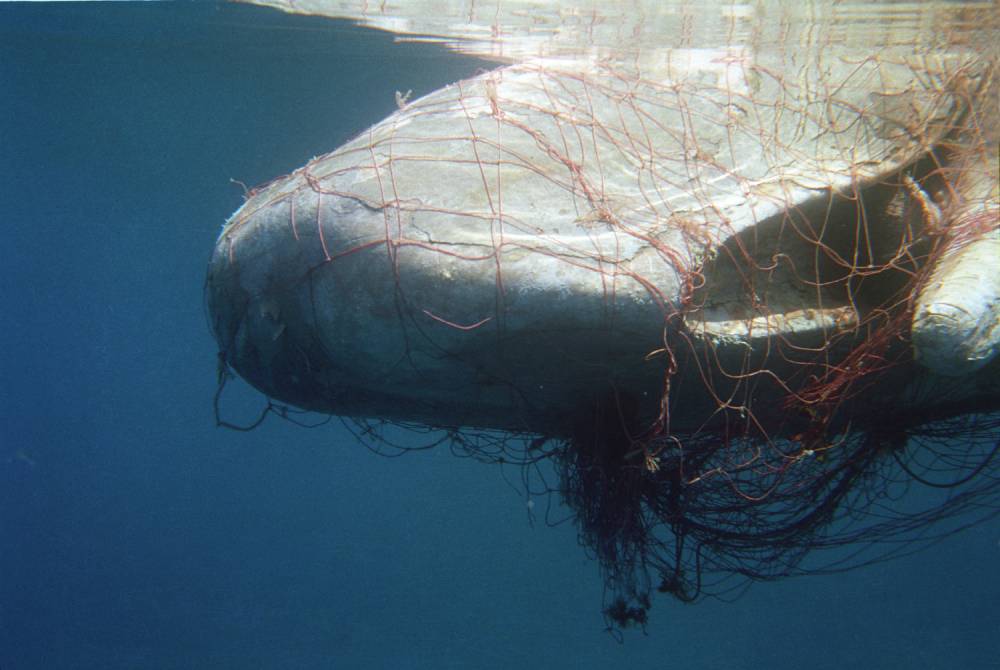
EJF called for action from multiple stakeholders, including the EU as well as the governments of Spain and Morocco. The EU is the largest importer of Moroccan swordfish, mostly through Spain, according to EJF. While Spanish vessels were not implicated in the investigation, the EJF found Moroccan vessels using large driftnets in both the Spanish and Moroccan exclusive economic zones.
The allegations come as Morocco has emerged as one of the strongest supporters of tighter driftnet regulation. At ICCAT’s annual meeting in 2025, the North African country — together with the European Union and South Korea — was a major driver of a previous proposal to restrict driftnets, which failed to achieve a consensus vote.
Mongabay contacted the Moroccan Department of Maritime Fisheries about the allegations raised by EJF, the country’s engagement with the EU proposal and measures it’s taken to enforce the existing rules, but did not receive a response by publication time.
In August 2025, Zakia Driouich, Morocco’s secretary of state at the Ministry for Agriculture, Maritime Fisheries, Rural Development and Water and Forests, sent an email to the European Commission responding to allegations of illegal driftnet use by Moroccan vessels. In the email, Driouich wrote that Morocco has adopted multiple measures “to ensure the effective implementation of the national programme for the elimination of driftnets.”
“We see this as a very positive step that Morocco is engaging constructively and positively, but we also hope that this translates into a real ban,” Urios Culiañez said.
Legislative loopholes
The renewed debate within ICCAT around driftnets in the Mediterranean is highly technical as it aims to identify the legislative loopholes that have made enforcement difficult. One of those gaps lies in the fact that driftnets are not banned entirely in the Mediterranean.
Currently, the ICCAT prohibition only applies to the use of driftnets in large pelagic fisheries targeting highly migratory species such as swordfish and tuna in the Mediterranean. The General Fisheries Commission for the Mediterranean (GFCM), which shares responsibility for fisheries management in the Mediterranean with ICCAT, separately bans the use or carrying of driftnets measuring more than 2.5 kilometers (1.55 miles) in length. However, according to the EU official, neither “large pelagic fishery” nor “driftnet” is clearly defined under the existing measures, and driftnets can be used in fisheries for small pelagic species, as long as the nets are less than 2.5 km long.
According to the European Commission, inspections conducted under ICCAT monitoring schemes have repeatedly identified vessels carrying driftnets, but enforcement action proved difficult because inspectors lacked a sufficiently clear legal basis.
“The lack of a definition of driftnets makes it difficult to determine the infringement when this gear is detected on board,” the EU spokesperson said.
Another challenge is that present ICCAT rules prohibit the use of large pelagic nets, but not the possession of such driftnets on board vessels. The EU proposal pushes for that to change as well.
In the draft proposal sitting with ICCAT, officials acknowledged that “weaknesses have been identified in the enforceability of the current ban.” The proposal seeks to strengthen the existing framework on driftnets by extending the geographic scope, and defining terms and the list of prohibited species. It would also impose a ban on the possession on board and use of driftnets for large pelagic species.

From paper to practice
For environmental groups like EJF, however, a real solution requires going beyond legal definitions.
“The European Union should cooperate with Morocco to help to make sure that this ban is fully implemented and supported,” said Urios Culiañez, adding that the EU should also reinforce its existing controls to make sure no swordfish or tuna caught with the lethal gear enters into the European market.
In its report, EJF stated that “EU Member States may be importing swordfish caught illegally by driftnet vessels, potentially violating EU regulations,” and called for more stringent enforcement and import rules.
Urios Culiañez also said swordfish fishing is an important source of income for many coastal communities in Morocco. He told Mongabay that some fishers EJF spoke to are open to transition, and that more stringent enforcement efforts would ideally be coupled with support for fishers transitioning to alternative gear and livelihoods.
Following the technical meetings in June, EU officials Mongabay spoke to said contracting parties remained broadly supportive of the current ICCAT proposal, which will come to a vote at the annual meeting in November.
The similar proposal presented at the ICCAT annual meeting in 2025 nearly reached the consensus necessary to adopt a regulation. According to Urios Culiañez, that proposal failed to gain consensus after objections raised by the United States.
Mongabay contacted the U.S. National Oceanic and Atmospheric Administration (NOAA) for comment, but had not received a response by publication time.
Banner image: A striped dolphin (Stenella coeruleoalba) caught in a French driftnet off the Azores, North Atlantic. Image © Peter Rowlands/Greenpeace.
Conservationists see progress for swordfish, problems for sharks at Atlantic fisheries summit
Feedback: Use this form to send a message to the editor of this post. If you want to post a public comment, you can do that at the bottom of the page.
Cite this article
Victoria Schneider (2026). Seeking swordfish, catching dolphins and whales: EU pushes to rein in driftnets. Mongabay Conservation news. DOI: https://doi.org/10.66709/news-322913
Credits

This story first appeared on Mongabay
This article is licensed under a Creative Commons Attribution-NoDerivatives 4.0 International License.
You may republish this article, so long as you credit the authors and Mongabay, and do not change the text. Please include a link back to the original article.

