



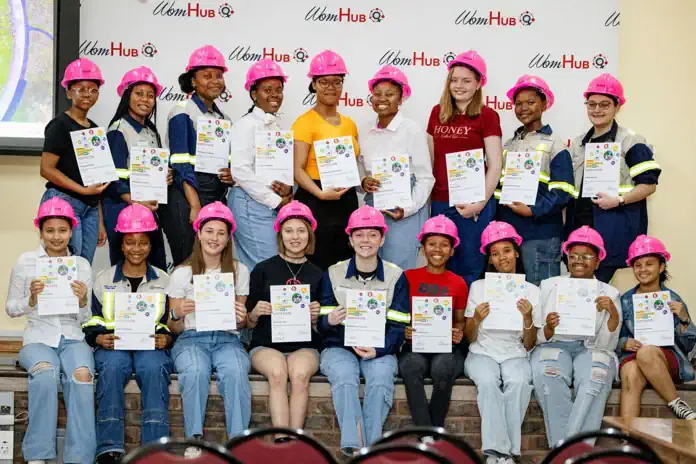
In an industry where women make up just 16% of registered engineers, a Northern Cape camp is trying to change who gets in the room early.
In a conference room in Kathu, four teenage girls stood before a panel to present their solution to a community challenge. Their idea was a recycling programme that rewards people for the materials they bring in. It was the kind of pitch you might expect from professional engineers, except these presenters were still in high school.
One of those learners was Mia du Preez. While the experience gave her a taste of what engineers do, it was the power of turning ideas into action that left the biggest impression. “The camp taught me to take your ideas and turn them into things, not just let them stay as ideas,” she said.
It’s a lesson South Africa’s engineering sector needs more of. Women make up only around 16% of the country’s registered engineering professionals, according to industry figures. While more women are entering STEM fields, barriers to participation and advancement remain, making programmes that support and empower young women more important than ever.
That is the gap that Anglo American’s Kumba Iron Ore business is trying to close in the Northern Cape through its Women in Mining (WiM) initiative and partnership with WomHub. Launched in 2025, their three-year partnership reached more than 200 girls and young women in Kathu during its first year alone through programmes designed to build STEM interest, confidence and practical skills before learners reach the age when many begin to opt out of these fields.
The partnership forms part of Anglo American and Kumba’s broader Women in Mining strategy and commitment to creating more inclusive pathways into science, technology, engineering and mathematics. Designed as a long-term talent pipeline, the programme supports young women from early career exposure and mentorship through to advanced digital and technical skills development, helping prepare the next generation of engineers, technologists and mining professionals. Through a combination of career guidance, practical STEM experiences and industry-recognised training opportunities, the initiative aims to expand participation and opportunity for young women in fields where they remain underrepresented. At the heart of the programme is the GirlEng Technovation Camp, a four-day experience for Grade 9 to 11 learners studying mathematics and science. Designed to move beyond traditional classroom learning, the camp immerses participants in the world of STEM through sessions on the future of work, #AskAnEngineer engagements with practising female engineers, LaunchPad self-awareness and career-mapping workshops, and hands-on exposure to coding and robotics.
As part of the global #1MillionGirlsinSTEM campaign, LaunchPad helps girls identify their strengths, interests and potential career pathways, encouraging them to think beyond job titles and focus instead on the challenges they want to solve and the impact they want to make. Participants then put their learning into practice through the Innovation Challenge, where teams develop and pitch solutions to real challenges facing their communities.
Kutlwano Takadi, Women in Mining Integration Lead at Kumba Iron Ore, says the objective is simple: to help more girls see themselves as future leaders, innovators and professionals in STEM. By connecting learners with relatable role models and hands-on experiences, the programme helps make careers in science, technology, engineering and mathematics feel both accessible and achievable. “We want girls in the Northern Cape to know that STEM careers are genuinely open to them, through mentors who look like them and opportunities that follow through,” she says. “This is about building a pipeline.”
That exposure proved particularly meaningful for Mia. Spending four days alongside female engineers challenged some of the assumptions she says still exist about girls who enjoy mathematics and science. “You don’t have to be the stereotype of the smart but nerdy girl,” she said. “You can be smart and beautiful and mix your creativity with your career.”
Her perspective reflects one of the programme’s broader goals: demonstrating that there is no single mould for success in STEM and that young women can pursue these careers while staying true to who they are.
Asked what she would say to a younger girl considering attending the camp, Mia’s response was immediate.
“They should go for it. At that age you still don’t know what you want to do, and some girls don’t think they can achieve anything. But the women at this camp proved that no matter what you’re going through, you can achieve anything if you put your mind to it and you’re given the opportunity.”
For the girls who attended the camp, the experience went beyond engineering and technology. It provided a space to build confidence, solve real-world problems and see new possibilities for their future. As South Africa celebrates Women’s Month, initiatives like this demonstrate the power of early exposure, mentorship and support in helping young women recognise their potential and envision themselves as the engineers, innovators and leaders the country needs.

