




IRASA Model Puts Community First in Local Governance since 2005
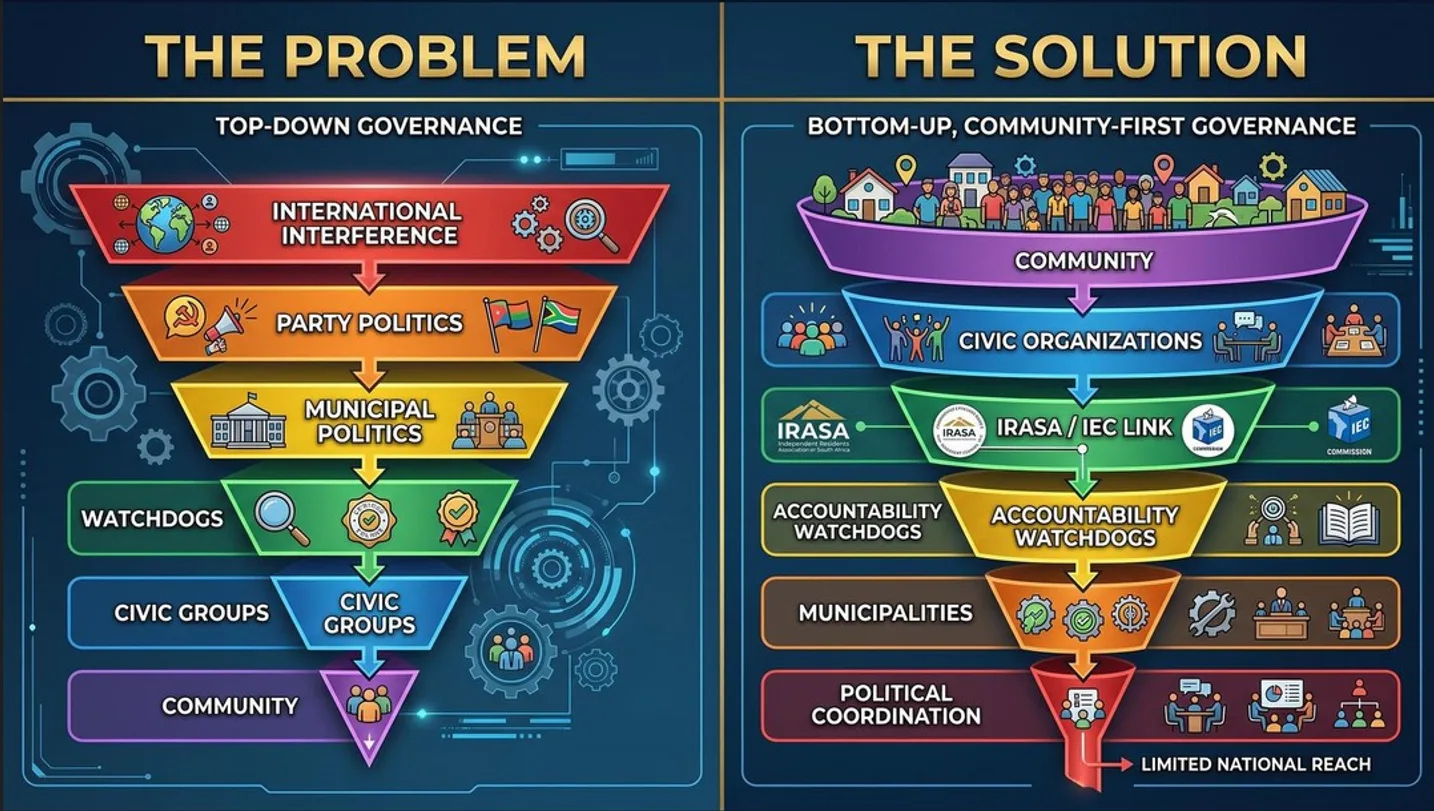
Local government can feel top-down. Residents report a leaking pipe, unsafe road, missed refuse collection or rising tariff, yet may feel decisions were shaped elsewhere. IRASA’s proposed model reverses that starting point. Its central message is simple: the community should not be the final recipient of political decisions; it should be the first source of local priorities.
The graphic places a familiar party-led sequence on the left, with political and municipal structures above civic groups and the community. On the right, IRASA proposes a bottom-up route: residents, families, businesses, schools, churches and local groups identify town needs; civic organisations gather evidence, identify patterns and form a clear, informed voice. IRASA says this is a network of roles and accountability, not a corporate reporting line.
IRASA is positioned as a civic support structure, not as a replacement municipality. Its stated function is to keep engagement focused on facts, fair process, transparency and service-delivery outcomes rather than party allegiance. Watchdogs and formal channels may add scrutiny where serious concerns arise about public money, conduct, corruption or repeated non-performance. Municipalities remain responsible for lawful administrative, budgeting and service-delivery responses; South African municipalities are charged with local infrastructure and services.
Political representatives retain a defined role: coordinating democratic oversight and concerns that cross municipal boundaries, without displacing the community voice. The model does not seek to bypass lawful government; it seeks to make political coordination answerable to community priorities.
The test is implementation. Participation must include tenants, young people, lower-income households and people beyond established property-owner groups. Civic bodies must disclose conflicts, publish progress and avoid becoming gatekeepers. Municipal commitments must be visible, measurable and followed by clear public reporting. IRASA’s proposal is therefore a discipline as much as a structure: start with the community, organise evidence, protect accountability and require every level to report back to the people it serves.

