



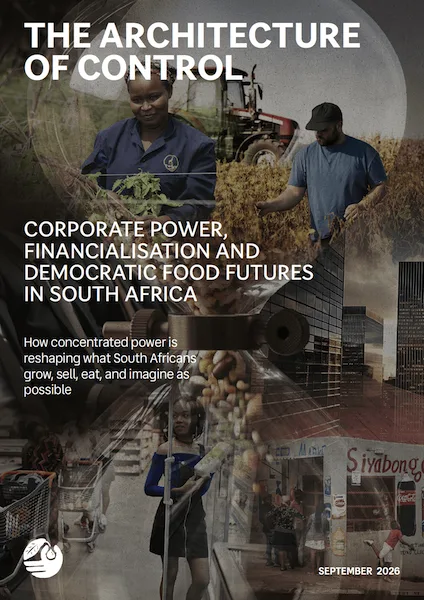
How concentrated power is reshaping what South Africans grow, sell, eat, and imagine as possible
Authored by Daniel Adeoluwa Adeniyi and Mariam Mayet, this significant and timely report is a powerful intervention into one of the most pressing structural crises facing South Africa today. The country’s food system is frequently held up across Africa as a model of agricultural modernisation, efficiency, and food production—an example many countries aspire to emulate. Yet beneath this image of success lies a profound contradiction. Despite producing enough food, maintaining sophisticated agricultural industries, and exporting food worldwide, hunger, malnutrition, diet-related disease, ecological degradation, farmer distress, worker precarity, and deepening inequality continue to define the lived reality of millions. Our report, The architecture of control: corporate power, financialisation, and democratic food futures in South Africa, argues that the problem is not scarcity—it is power.
Drawing on extensive research, the paper reveals how a small number of corporations have come to dominate every major node of the food system—from seeds, agrochemicals, fertilisers, and animal feed to grain storage, logistics, processing, supermarkets, finance, and digital platforms. One of the report’s central findings is the emergence of an hourglass-shaped food system, where millions of producers and consumers are squeezed through a narrow middle controlled by a handful of powerful corporations. It is in this narrow centre that value, wealth, and decision-making power are increasingly captured and concentrated, while risks, costs, and vulnerabilities are pushed onto farmers, workers, consumers, and the environment.
But the report goes further than documenting concentration. It introduces the concept of an “architecture of control” to show how corporate power works. Control is exercised not only through ownership, but through strategic bottlenecks that govern seeds, data, logistics, storage, processing, finance, procurement systems, retail platforms, and market access. Power increasingly operates through infrastructure, standards, algorithms, contracts, intellectual property, financial instruments, and digital systems that shape participation across the food system.
A second major insight is that South Africa’s food system is entering a new phase in which corporate concentration, financialisation, and digitalisation are converging. Food is increasingly governed as an investment portfolio, while data and digital technologies are becoming new sources of extraction and control. Farmers, workers, and consumers are generating value through systems over which they have little influence, creating what the report identifies as a profound democratic deficit in the governance of food.
A third major insight is that concentrated corporate power has expanded alongside the weakening of public institutions and public food system capacity. As public investment, regulation, market infrastructure, and food governance have been fragmented, privatised, or neglected, corporations have increasingly come to govern food systems through procurement systems, private standards, logistics networks, digital platforms, and financial instruments. The report argues that South Africa’s food crisis is therefore not only a crisis of markets, but also a crisis of democratic governance and public capacity.
It traces the roots of this concentration to colonial dispossession, apartheid, and post-apartheid-era restructuring, showing how historical injustices have been reproduced through privatisation, deregulation, financialisation, and digitalisation. It demonstrates how food has increasingly become an asset class for investors, while data, algorithms, and digital platforms are emerging as new instruments of corporate control. Corporate concentration is no longer confined to isolated sectors; it has evolved into an interconnected architecture of power that shapes who farms, who trades, who profits, what food reaches consumers, and whose interests determine the future of South Africa’s food system.
At the same time, the report connects these structural realities to everyday life. It shows how concentrated power drives rising food prices, the spread of ultra-processed foods, the erosion of biodiversity, dependence on hazardous pesticides, the marginalisation of small-scale farmers and informal traders, and a growing democratic deficit in decisions that affect food, health, and livelihoods.
Importantly, the report also examines the challenges facing agroecology and food sovereignty alternatives. These include unequal access to land and resources, policy bias in favour of industrial agriculture, concentrated control over seeds and agricultural inputs, inadequate public investment in agroecological transitions, financial exclusion, and the growing influence of digital and financial actors over food systems. The report argues that agroecology cannot be understood simply as a set of farming practices or niche production systems. Rather, it advances a food-systems-facing vision of agroecology and food sovereignty that seeks to transform markets, governance, seed systems, labour relations, distribution networks, and public institutions, while rebuilding public capacity and collective control over the systems that sustain life. Yet despite mounting evidence of agroecology’s social, ecological, and economic benefits, these alternatives continue to operate on an uneven playing field.
This is not merely a critique of corporate concentration. It is an invitation to rethink how food systems are governed and in whose interests they operate. We argue that South Africa’s food crisis cannot be solved simply by making concentrated markets marginally more competitive. While competition policy remains important, corporate power today operates through a far wider architecture of control embedded in seeds, logistics, storage, finance, procurement systems, retail platforms, data, and digital infrastructures. The challenge, therefore, is not simply to regulate concentrated power, but to democratise the infrastructures through which food is governed. The report proposes a democratic transition rooted in public accountability, ecological justice, and shared prosperity—one that reclaims food as a public good rather than a site of corporate accumulation.
We argue that the future of food should not be determined primarily by corporations, investors, algorithms, and private governance systems, but by the people, communities, and public institutions whose lives and futures depend upon them.
At its core, The architecture of control asks a fundamental question:
Will South Africa’s food system continue to serve concentrated corporate interests, or can it be reclaimed as a public good that nourishes people, communities, democracy, and the environment?
This report is more than a diagnosis of a broken food system. It is an urgent invitation to challenge concentrated power, reclaim democratic control, and build a just, equitable, and ecologically resilient food future for South Africa.

