



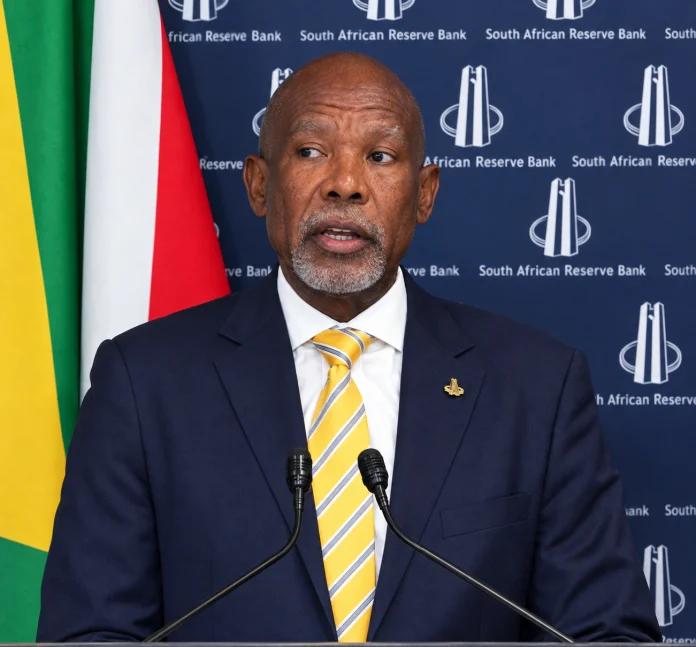
SOUTH AFRICA — South Africa’s repo rate has climbed to 7.25% after the Monetary Policy Committee delivered a unanimous 25-basis-point increase, a move that takes effect on 25 September and underscores the central bank’s determination to rein in inflation that currently sits at 4.4%.
South African Reserve Bank Governor Lesetja Kganyago, who announced the decision, pointed to a constellation of domestic and international pressures that left the MPC with little room to hold steady. The latest Bureau for Economic Research survey showed that while inflation expectations eased marginally from the previous quarter, longer-run projections remain anchored near 4% — a full percentage point above the SARB’s 3% midpoint target.
“A few months back, it seemed that the fuel-price shock might be unwinding, but now it has intensified,” Kganyago said, adding that global interest rates are also trending higher.
A Measured but Firm Stance
Despite the hike, the Governor stressed that the committee is proceeding cautiously amid what he described as heightened uncertainty. The SARB’s Quarterly Projection Model indicates the policy rate will remain broadly stable for the rest of the year, with reductions only materialising later in the forecast horizon as inflation gradually drifts back toward 3% and the model shifts to a more neutral posture.
Kganyago was careful to note that the QPM rate path serves as a broad guide rather than a commitment. “Our decisions will continue to be taken on a meeting-by-meeting basis, with careful attention to the outlook, data outcomes, and the balance of risks to the forecast,” he emphasised.
Global Headwinds Intensify
The international backdrop played a significant role in the MPC’s deliberations. Kganyago highlighted that supply chains worldwide are being disrupted by the escalating conflict in the Middle East and the ongoing Russia-Ukraine war, both of which are injecting additional inflationary pressure into the global system. In response, central banks across major economies are tightening their own policy settings.
To stress-test its baseline assumptions, the MPC modelled a scenario in which major central banks raise rates by a full percentage point between this year and next — double the roughly half-a-percentage-point increase embedded in the baseline forecast. Under that scenario, the rand depreciates, inflation accelerates, and the model prescribes a tighter domestic stance equivalent to roughly one additional hike above the baseline path, followed by slower subsequent cuts.
A second scenario explored the consequences of higher inflation expectations feeding into wage demands. That simulation also pointed to a more restrictive outcome, with the policy rate climbing by the equivalent of one to two extra hikes above the baseline peak and staying elevated for a longer period.
Growth Revised Lower, Inflation to Stay Elevated
The SARB now projects annual economic growth of 1.2% for the year, a downward revision from the previous 1.4% estimate. Although the economy contracted in the second quarter, officials anticipate a rebound during the second half.
Inflation, however, is expected to remain stubbornly high through 2027, fuelled primarily by energy costs and services. Kganyago said the bank’s current projection has inflation returning to the 3% target only toward the end of 2027.
Fuel prices, which had moderated between June and August, have resumed their upward trajectory, while services inflation continues to run at elevated levels. On a brighter note, food inflation has dropped to its lowest point since 2010, buoyed by strong crop harvests and more stable meat prices in the wake of the foot-and-mouth disease outbreak. The rand’s relative resilience has also helped contain imported price pressures.
Guarding Against Second-Round Effects
Kganyago framed the rate decision within the broader challenge of preventing temporary price shocks from becoming permanent fixtures of the economy. While the MPC’s standard approach is to look through the initial impact of supply-driven price spikes, he warned that the scale and persistence of current disruptions make second-round effects — where isolated price changes cascade into economy-wide increases — a growing risk.
“Unfortunately, large and sustained shocks, like those we are experiencing now, are more likely to trigger second-round effects,” he said. “To prevent this, we are adopting a more restrictive monetary policy, with rates above longer-term levels.”
The Governor closed by reaffirming the MPC’s core mandate: protecting the purchasing power of the rand by steering inflation back to 3% over the medium term, even as geopolitical turmoil and global monetary tightening continue to weigh on South Africa’s economic recovery.

